 Ban dino nga? Kiis
 Xeexu dino
 Rawante dino
 Fo yu ndaw yu dino
 Albomu sitikeer
 Limu TOP yu dino
 Bett ma!
Eurycleidus
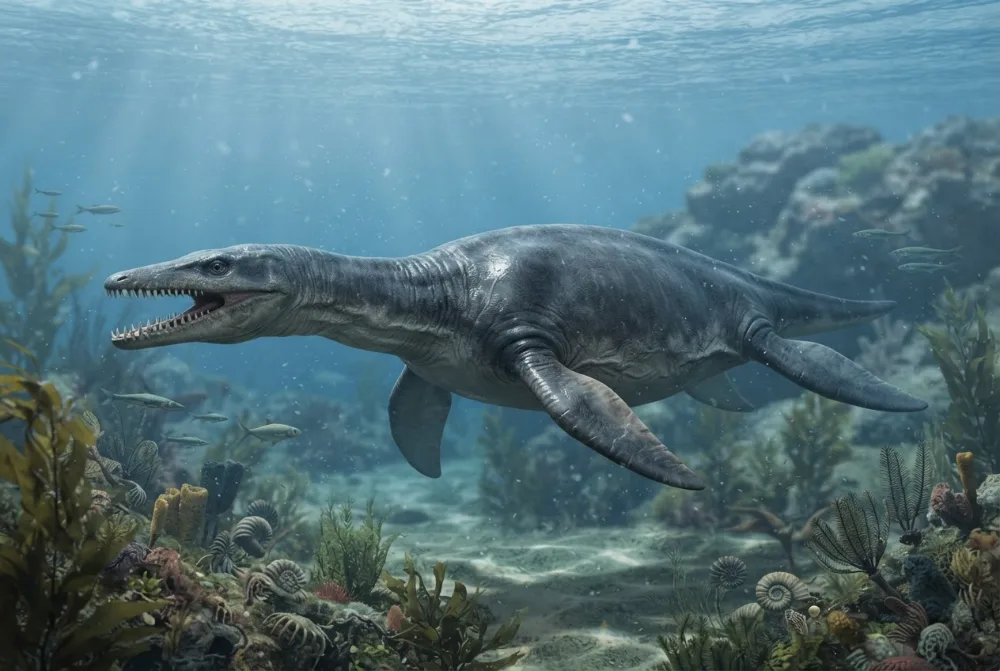
Eurycleidus was a big, swimming reptile that lived in the sea during the Early Jurassic, about 200 million years ago. It was not a dinosaur, but a plesiosaur with a long body and strong flippers. It used its sharp, needle-like teeth to catch fish.1
Kañ la dundoon?
Naka la gaawoon?


Xibaar yu neex
Eurycleidus had large shoulder bones, which gave it a powerful forward stroke for fast swimming.1
The first fossils were bought by Thomas Hawkins in the early 1830s from a quarry in Street, Somerset, England.1
In 1837, Richard Owen mistakenly thought the fossils came from Lyme Regis, but they actually came from Somerset.1
The species was first named Plesiosaurus arcuatus in 1840, and later renamed Eurycleidus in 1922.1
Some fossils that were once thought to be Eurycleidus were later moved to other genera, like Atychodracon and Lindwurmia.1
Eurycleidus lived in the sea and was an active swimmer, living near the surface.2
Ku tas léeb yu dul dëgg
Léeb: Eurycleidus was a dinosaur.
Dëgg: Eurycleidus was a plesiosaur, a marine reptile, not a dinosaur.1
Ngir ñi xam dino lool
- Turu xam-xam
- Eurycleidus
- Ku ko tudde
- Andrews 19222
- Kurél
- Plesiyosoor yi
- Njaboot / klad
- Rhomaleosauridae2
- Klasifikasiyoŋ
- Plesiosauria > Sauropterygia2
- Màggaayu doj yi
- 201 ba 184 milyoŋ at (Hettangian / Pliensbachian)2
- Formasiyoŋi doj
- Blue Lias2
- Réew yi
- Angalteer2
- Fosil yu ñu gis
- 4 ci The Paleobiology Database2
- Gisees
- The first fossils were collected by Thomas Hawkins in the early 1830s from a quarry in Street, Somerset, England. Richard Owen named the species Plesiosaurus arcuatus in 1840, and Charles William Andrews renamed it Eurycleidus in 1922.1
- Ñu ngi koy werante ba tey
- Scientists still debate exactly which fossils belong to Eurycleidus, because some specimens were later moved to other genera.1
Fa xibaar yi jóge
- Eurycleidus (en.wikipedia.org)
- Eurycleidus in The Paleobiology Database (CC BY 4.0): at, béréb yi, formasiyoŋi doj, klasifikasiyoŋ.
Bépp xibaar ci xët wii am na lim bu wone fa mu jóge. Su nu juumee, baal nu, nun ñu bëgg dino lanu, du ab sërnaalu xam-xam. Wax nu ko ci [email protected] nu defar ko.
 Rex xiif na! Dino Wiki, mbiru ab baay la ngir doomam ju góor ju bëgg dinosoor, ci neen te amul kaamuñaate, amul tracker. Mag ñi mën nañu jox Rex tuuti ñam ngir dimbali ko mu des ci internet.Dundal Rex
 Elasmosaurus
 Pliosaurus
 Plesiosaurus
 Cimoliasaurus
 Colymbosaurus
 Trinacromerum
 Dilophosaurus
 Stenopterygius
 Dorygnathus
 Lufengosaurus
 Scutellosaurus
 Yunnanosaurus