 Ban dino nga? Kiis
 Xeexu dino
 Rawante dino
 Fo yu ndaw yu dino
 Albomu sitikeer
 Limu TOP yu dino
 Bett ma!
Galleonosaurus
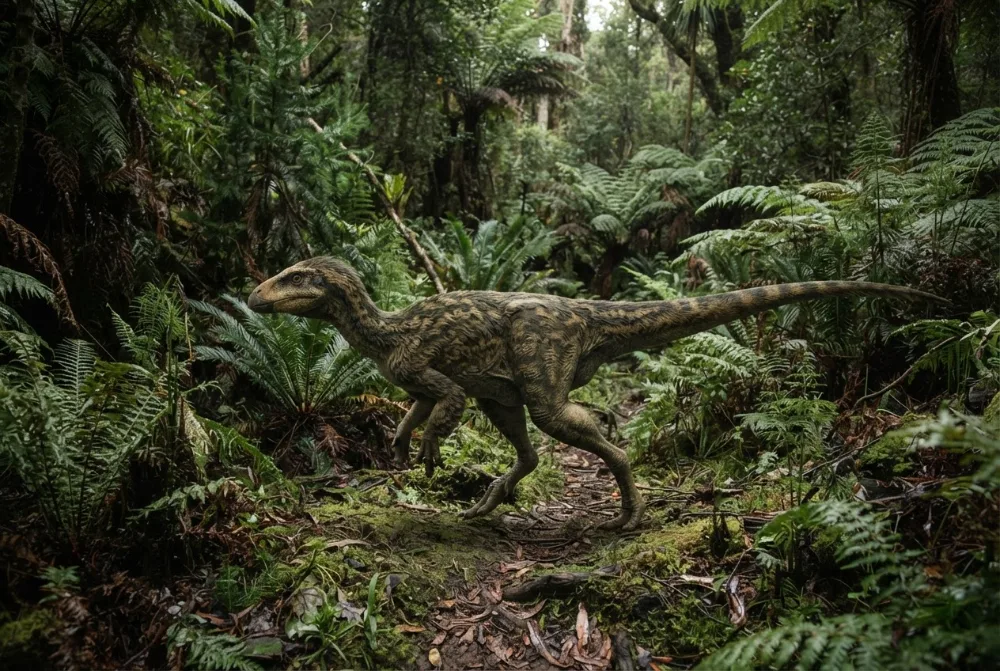
Galleonosaurus was a small, plant-eating dinosaur that lived in Australia during the Early Cretaceous. It had a beaked mouth and walked on two legs, probably running through ancient forests near the rift between Australia and Antarctica.1
Kañ la dundoon?
Naka la réyoon?
Naka la guddoon?
Naka la kawewoon?
jortu
Naka la diisoon?
 gudd ni 5 muusu kër, bakkan ba geen🍌gudd ni 13 banaana yu ñu topp-toppale🍉diis ni 4 xaal🏃mënoon na daw 100 meetar ci 9 segond (nit ki gën a gaaw dafay soxla 9,6)
Naka la Galleonosaurus réyoon, bu ñu ko méngalee ak YAW?
Ay kalkil rekk ci sa navigatëer. Dara du ñu denc, dara du ñu yónne fenn.
Naka la gaawoon?


Xibaar yu neex
Galleonosaurus is known from five upper jaw bones (maxillae), and the holotype is the most complete dinosaur upper jaw ever found in Victoria, Australia.1
Scientists used micro-CT scans to see the inside of its jaw, revealing a complex network of nerves and blood vessels.1
It lived between about 125 and 110 million years ago, during the Barremian to Albian ages of the Early Cretaceous.6
Galleonosaurus belonged to a group of dinosaurs called Elasmaria, which were only found on the southern supercontinent Gondwana.61
Its fossils were found in rocks that were once part of a large river system with floodplains, where Galleonosaurus likely roamed.1
The name Galleonosaurus means 'galleon lizard', inspired by the shape of its upper jaw bone that resembles a sailing ship.1
Laaj yi ñu gën a laaj ci Galleonosaurus
?How big was Galleonosaurus?
About the size of a wallaby, roughly 1 metre tall. It was a small, two-legged dinosaur.34
?What did Galleonosaurus eat?
It was a plant-eating dinosaur. Its teeth suggest it fed on different plant material than other similar dinosaurs.3
Ngir ñi xam dino lool
- Turu xam-xam
- Galleonosaurus
- Ku ko tudde
- Herne et al. 20196
- Kurél
- Dino yu lekk gàncax te am gémmiñu picc
- Njaboot / klad
- Elasmaria6
- Klasifikasiyoŋ
- Ornithischia > Ornithopoda > Iguanodontia6
- Màggaayu doj yi
- 126 ba 110 milyoŋ at (Barremian / Albian)6
- Formasiyoŋi doj
- Wonthaggi, Eumeralla6
- Réew yi
- Ostarali6
- Fosil yu ñu gis
- 3 ci The Paleobiology Database6
- Gisees
- Galleonosaurus was named in 2019 by paleontologist Matthew Herne and colleagues, based on fossils collected from the Flat Rocks site in Victoria, Australia. The species name dorisae honors Doris, a volunteer who helped with fossil hunting.1
- Ñu ngi koy werante ba tey
- Scientists are not sure exactly how big Galleonosaurus was, because only jaw bones have been found so far.1
Fa xibaar yi jóge
- New small-bodied ornithopods (Dinosauria, Neornithischia) from the Early Cretaceous Wonthaggi Formation (Strzelecki Group) of the Australian-Antarctic rift system, with revision of Qantassaurus intrepidus Rich and Vickers-Rich, 1999 | Journal of Paleontology | Cambridge Core (cambridge.org)
- Galleonosaurus dorisae | Dinosaur Database by DinoAnimals.com (dinoanimals.com)
- New wallaby-sized dinosaur identified from fossils found along Victorian coast - ABC News (abc.net.au)
- Galleonosaurus dorisae: New dinosaur discovered in Australia (bbc.com)
- Galleonosaurus (en.wikipedia.org)
- Galleonosaurus in The Paleobiology Database (CC BY 4.0): at, béréb yi, formasiyoŋi doj, klasifikasiyoŋ.
Bépp xibaar ci xët wii am na lim bu wone fa mu jóge. Su nu juumee, baal nu, nun ñu bëgg dino lanu, du ab sërnaalu xam-xam. Wax nu ko ci [email protected] nu defar ko.
 Rex xiif na! Dino Wiki, mbiru ab baay la ngir doomam ju góor ju bëgg dinosoor, ci neen te amul kaamuñaate, amul tracker. Mag ñi mën nañu jox Rex tuuti ñam ngir dimbali ko mu des ci internet.Dundal Rex
 Iguanodon
 Tenontosaurus
 Thescelosaurus
 Zalmoxes
 Camptosaurus
 Rhabdodon
 Stegosaurus
 Archaeopteryx
 Giganotosaurus
 Microraptor
 Deinonychus
 Baryonyx