 Ban dino nga? Kiis
 Xeexu dino
 Rawante dino
 Fo yu ndaw yu dino
 Albomu sitikeer
 Limu TOP yu dino
 Bett ma!
Kañ la dundoon?

Naka la réyoon?
Naka la guddoon?
Naka la kawewoon?
jortu
Naka la diisoon?
Naka la Gretcheniao réyoon, bu ñu ko méngalee ak YAW?
Ay kalkil rekk ci sa navigatëer. Dara du ñu denc, dara du ñu yónne fenn.
Naka la gaawoon?


Xibaar yu neex
Gretcheniao had a very long hand bone called a carpometacarpus, the longest of any of its relatives, even though its upper arm bone was only the third largest.1
Its breastbone had special projections that pointed backward and to the sides, which helped support its flight muscles.1
Gretcheniao's toes had long, curved claws, perfect for grabbing onto branches or prey.1
Scientists think Gretcheniao flew by flapping its wings continuously, but it could not fly for long distances, similar to modern chickens or quails.21
The fossil of Gretcheniao was so well preserved that some of its feathers left dark marks on the rock, especially around its neck and wing.1
Gretcheniao had a strong beak and thick lower jaw, which helped it bite into tough food.1
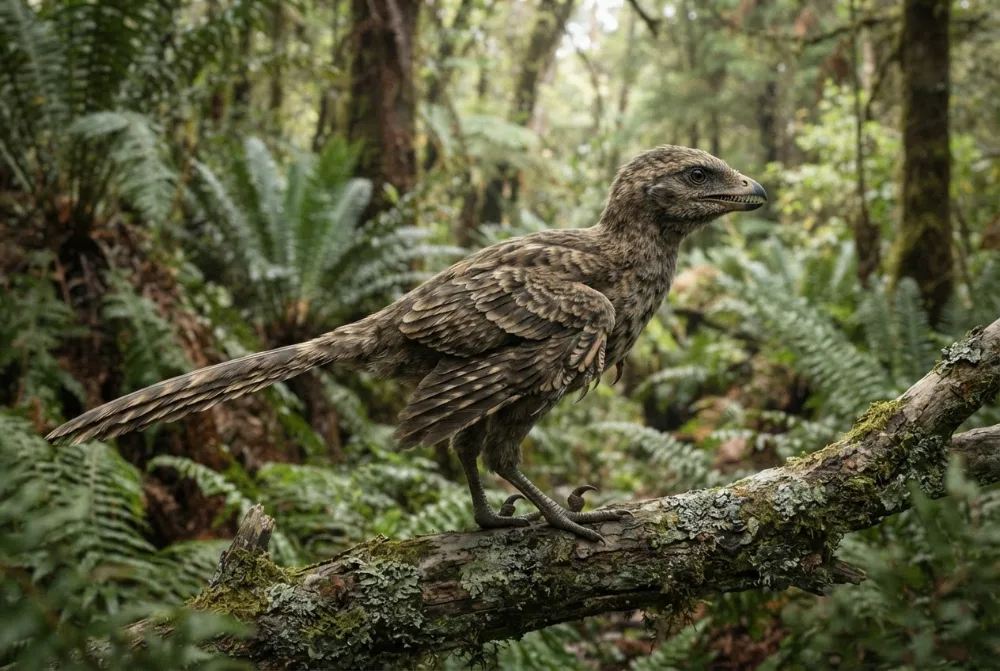
Ku tas léeb yu dul dëgg
Léeb: Some people think Gretcheniao was a dinosaur like T. rex, but it was actually a bird.
Dëgg: Gretcheniao was a type of bird called an enantiornithine, which is a group of ancient birds that lived alongside dinosaurs. Birds are related to dinosaurs, but they are not the same as the giant meat-eaters.31
Ngir ñi xam dino lool
- Turu xam-xam
- Gretcheniao
- Ku ko tudde
- Chiappe et al. 20193
- Kurél
- Picc yu jëkk yi
- Njaboot / klad
- Enantiornithes3
- Klasifikasiyoŋ
- Theropoda > Avialae3
- Màggaayu doj yi
- 126 ba 120 milyoŋ at (Barremian / Aptian)3
- Formasiyoŋi doj
- Yixian3
- Réew yi
- Siin3
- Fosil yu ñu gis
- 1 ci The Paleobiology Database3
- Gisees
- Gretcheniao was named in 2019 by scientists studying a nearly complete skeleton found in China. The fossil was named after Mrs. Gretchen Augustyn, who supported the Dinosaur Institute, and 'sinensis' means 'from China'.1
- Ñu ngi koy werante ba tey
- Scientists are still debating how Gretcheniao and its close relatives are related to each other. Some think they all belong to one group, but others think they evolved separately.21
Fa xibaar yi jóge
- New Bohaiornis-like bird from the Early Cretaceous of China: enantiornithine interrelationships and flight performance (dinodata.de)
- New Bohaiornis -like bird from the Early Cretaceous of China: enantiornithine interrelationships and flight performance (pubmed.ncbi.nlm.nih.gov)
- Gretcheniao in The Paleobiology Database (CC BY 4.0): at, béréb yi, formasiyoŋi doj, klasifikasiyoŋ.
Bépp xibaar ci xët wii am na lim bu wone fa mu jóge. Su nu juumee, baal nu, nun ñu bëgg dino lanu, du ab sërnaalu xam-xam. Wax nu ko ci [email protected] nu defar ko.
 Rex xiif na! Dino Wiki, mbiru ab baay la ngir doomam ju góor ju bëgg dinosoor, ci neen te amul kaamuñaate, amul tracker. Mag ñi mën nañu jox Rex tuuti ñam ngir dimbali ko mu des ci internet.Dundal Rex
 Archaeopteryx
 Hesperornis
 Ichthyornis
 Baptornis
 Jurapteryx
 Gobipteryx
 Stegosaurus
 Iguanodon
 Giganotosaurus
 Microraptor
 Deinonychus
 Baryonyx