 Ban dino nga? Kiis
 Xeexu dino
 Rawante dino
 Fo yu ndaw yu dino
 Albomu sitikeer
 Limu TOP yu dino
 Bett ma!
Hamipterus
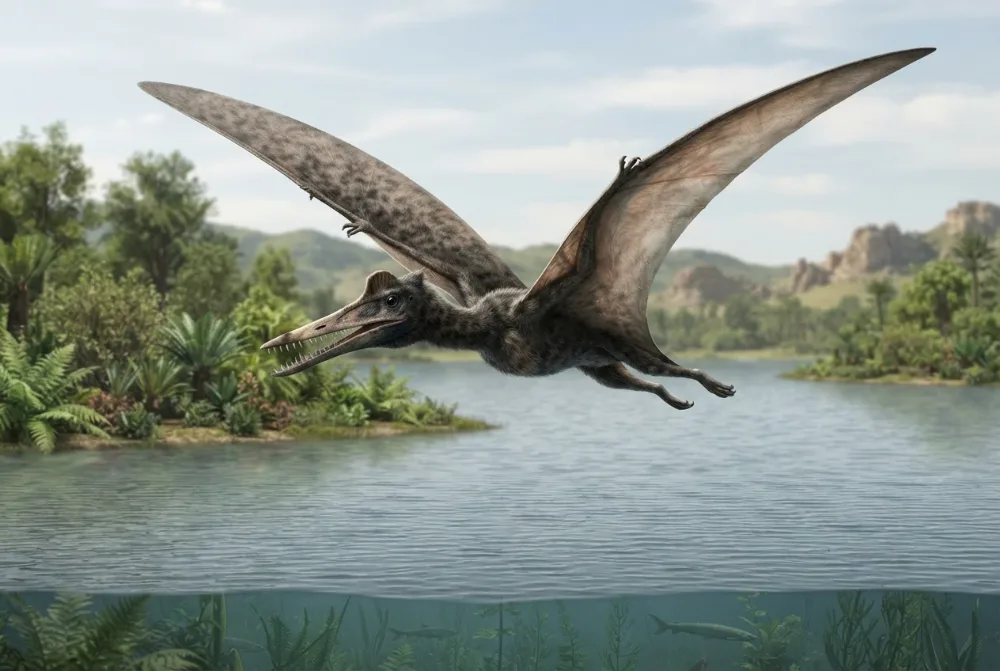
Hamipterus was a flying reptile with a wingspan as wide as a car! It lived in a big lake area in China and ate fish. Hundreds of Hamipterus fossils were found together, including eggs and soft parts like skin.12
Kañ la dundoon?
Naka la réyoon?
Naka la ay laafam yaatuwoon?
 laaf yu yaatu ni 2 welo ci benn rëdd⚽mënoon na naaw ci kaw teraŋ futbal bépp ci 6,4 segond
Naka la Hamipterus réyoon, bu ñu ko méngalee ak YAW?
Ay kalkil rekk ci sa navigatëer. Dara du ñu denc, dara du ñu yónne fenn.
Naka la gaawoon?


Xibaar yu neex
Hamipterus fossils were found in huge numbers, probably from a nesting colony that was buried by a storm. Over 40 individuals were collected, and there may have been hundreds.1
Unlike most pterosaurs, Hamipterus bones are three-dimensional and not squashed flat. Scientists even found the horny sheaths that covered its head crests.1
Five uncrushed eggs were found with the Hamipterus fossils. That is very rare for pterosaurs.1
Hamipterus had a hook-shaped bony process on the tip of its lower jaw, which scientists think helped it grab slippery fish.3
Male and female Hamipterus looked different. The paratype skull is thought to be from a male, while the holotype is probably a female.1
The tooth enamel of Hamipterus was very thin, only covering about half of each tooth crown.1
Laaj yi ñu gën a laaj ci Hamipterus
?How big was Hamipterus?
Hamipterus had a wingspan of 1.5 to 3.5 metres, which is about as wide as a small car.1
?Did Hamipterus have feathers?
No, Hamipterus was a pterosaur, a flying reptile, not a dinosaur. Pterosaurs did not have feathers; they had a fur-like covering called pycnofibers.1
?What did Hamipterus eat?
Hamipterus ate fish. It had a hook-shaped bony process on the tip of its lower jaw that helped it grab slippery fish.1
Ngir ñi xam dino lool
- Turu xam-xam
- Hamipterus
- Ku ko tudde
- Wang et al. 20144
- Kurél
- Reptil yuy naaw
- Njaboot / klad
- Pteranodontoidea4
- Klasifikasiyoŋ
- Pterosauria > Pterodactyloidea4
- Màggaayu doj yi
- 137 ba 133 milyoŋ at (Valanginian)4
- Formasiyoŋi doj
- Shengjinkou4
- Réew yi
- Siin4
- Fosil yu ñu gis
- 4 ci The Paleobiology Database4
- Gisees
- Hamipterus was named in 2014 by Wang Xiaolin and a team of scientists. The fossils were found in the Hami region of Xinjiang, China, starting in 2006.1
- Ñu ngi koy werante ba tey
- Scientists are not sure exactly where Hamipterus fits in the pterosaur family tree. It may be close to Istiodactylus, Ludodactylus, or the Anhangueridae.1
Fa xibaar yi jóge
- Hamipterus (en.wikipedia.org)
- The first dinosaurs from the Early Cretaceous Hami Pterosaur Fauna, China (pmc.ncbi.nlm.nih.gov)
- PBDB Taxon (paleobiodb.org)
- Hamipterus in The Paleobiology Database (CC BY 4.0): at, béréb yi, formasiyoŋi doj, klasifikasiyoŋ.
Bépp xibaar ci xët wii am na lim bu wone fa mu jóge. Su nu juumee, baal nu, nun ñu bëgg dino lanu, du ab sërnaalu xam-xam. Wax nu ko ci [email protected] nu defar ko.
 Rex xiif na! Dino Wiki, mbiru ab baay la ngir doomam ju góor ju bëgg dinosoor, ci neen te amul kaamuñaate, amul tracker. Mag ñi mën nañu jox Rex tuuti ñam ngir dimbali ko mu des ci internet.Dundal Rex
 Pteranodon
 Quetzalcoatlus
 Dorygnathus
 Rhamphorhynchus
 Anhanguera
 Pterodactylus
 Stegosaurus
 Iguanodon
 Archaeopteryx
 Giganotosaurus
 Microraptor
 Deinonychus