 Ban dino nga? Kiis
 Xeexu dino
 Rawante dino
 Fo yu ndaw yu dino
 Albomu sitikeer
 Limu TOP yu dino
 Bett ma!
Iyuku
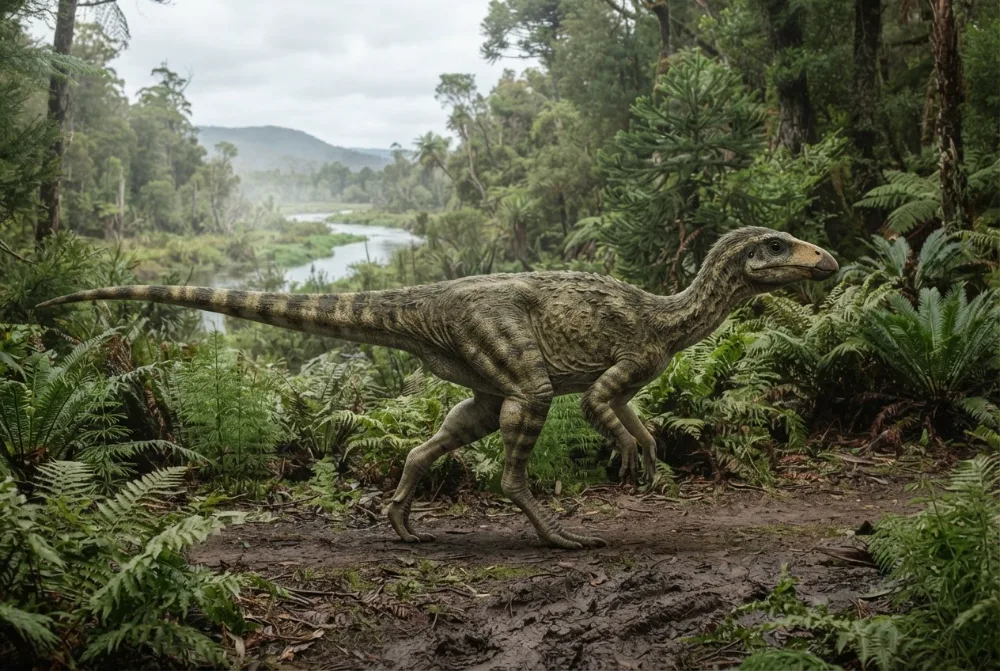
Iyuku was a small, plant-eating dinosaur that lived in what is now South Africa. What makes it really special is that almost all the fossils found are from babies and very young dinosaurs! Scientists think a whole group of Iyuku hatchlings died together during a dry season.21
Kañ la dundoon?
Naka la gaawoon?


Xibaar yu neex
All the juvenile Iyuku bones were found in a single, small bonebed, suggesting a group of hatchlings died together.21
The name Iyuku comes from the Xhosa language and means 'hatchling', because almost all the fossils are from very young animals.1
Iyuku lived during the Early Cretaceous period, about 137 to 132 million years ago.4
The bonebed where Iyuku was found also contained rare theropod teeth, crocodile teeth, turtle shell fragments, and fish bones.1
Laaj yi ñu gën a laaj ci Iyuku
?How big was Iyuku?
Iyuku was a small dinosaur. A subadult's shin bone was about 35 to 42 centimetres long, so the whole animal was probably the size of a large dog.3
?What did Iyuku eat?
Iyuku was a plant-eating dinosaur. It ate plants like ferns and leaves.3
?Why is Iyuku called a hatchling?
Its name comes from the Xhosa word for 'hatchling' because almost all the fossils found are from babies and very young dinosaurs.3
?When did Iyuku live?
Iyuku lived during the Early Cretaceous period, about 137 to 132 million years ago.3
Ngir ñi xam dino lool
- Turu xam-xam
- Iyuku
- Ku ko tudde
- Forster et al. 20224
- Kurél
- Dino yu lekk gàncax te am gémmiñu picc
- Njaboot / klad
- Euiguanodontia4
- Klasifikasiyoŋ
- Ornithischia > Ornithopoda > Iguanodontia4
- Màggaayu doj yi
- 137 ba 133 milyoŋ at (Valanginian)4
- Formasiyoŋi doj
- Kirkwood4
- Réew yi
- Afrig di Sid4
- Fosil yu ñu gis
- 1 ci The Paleobiology Database4
- Gisees
- Iyuku was named in 2022 by Catherine Forster and her team based on fossils collected from 1995 to 1999 in the Kirkwood Formation, South Africa. The species name honors Dr. Michael Raath for his work on southern African fossils.1
- Ñu ngi koy werante ba tey
- Scientists are not sure exactly how big Iyuku grew, because almost all the fossils are from babies and juveniles, not adults.1
Fa xibaar yi jóge
- Iyuku raathi , a new iguanodontian dinosaur from the Early Cretaceous Kirkwood Formation, South Africa (anatomypubs.onlinelibrary.wiley.com)
- Iyuku raathi, a new iguanodontian dinosaur from the Early Cretaceous Kirkwood Formation, South Africa (pubmed.ncbi.nlm.nih.gov)
- Iyuku (en.wikipedia.org)
- Iyuku in The Paleobiology Database (CC BY 4.0): at, béréb yi, formasiyoŋi doj, klasifikasiyoŋ.
Bépp xibaar ci xët wii am na lim bu wone fa mu jóge. Su nu juumee, baal nu, nun ñu bëgg dino lanu, du ab sërnaalu xam-xam. Wax nu ko ci [email protected] nu defar ko.
 Rex xiif na! Dino Wiki, mbiru ab baay la ngir doomam ju góor ju bëgg dinosoor, ci neen te amul kaamuñaate, amul tracker. Mag ñi mën nañu jox Rex tuuti ñam ngir dimbali ko mu des ci internet.Dundal Rex
 Iguanodon
 Tenontosaurus
 Thescelosaurus
 Zalmoxes
 Camptosaurus
 Rhabdodon
 Stegosaurus
 Archaeopteryx
 Giganotosaurus
 Microraptor
 Deinonychus
 Baryonyx