 Ban dino nga? Kiis
 Xeexu dino
 Rawante dino
 Fo yu ndaw yu dino
 Albomu sitikeer
 Limu TOP yu dino
 Bett ma!
Kañ la dundoon?

Naka la réyoon?
Naka la guddoon?
Naka la Jeholosaurus réyoon, bu ñu ko méngalee ak YAW?
Ay kalkil rekk ci sa navigatëer. Dara du ñu denc, dara du ñu yónne fenn.
Naka la gaawoon?


Xibaar yu neex
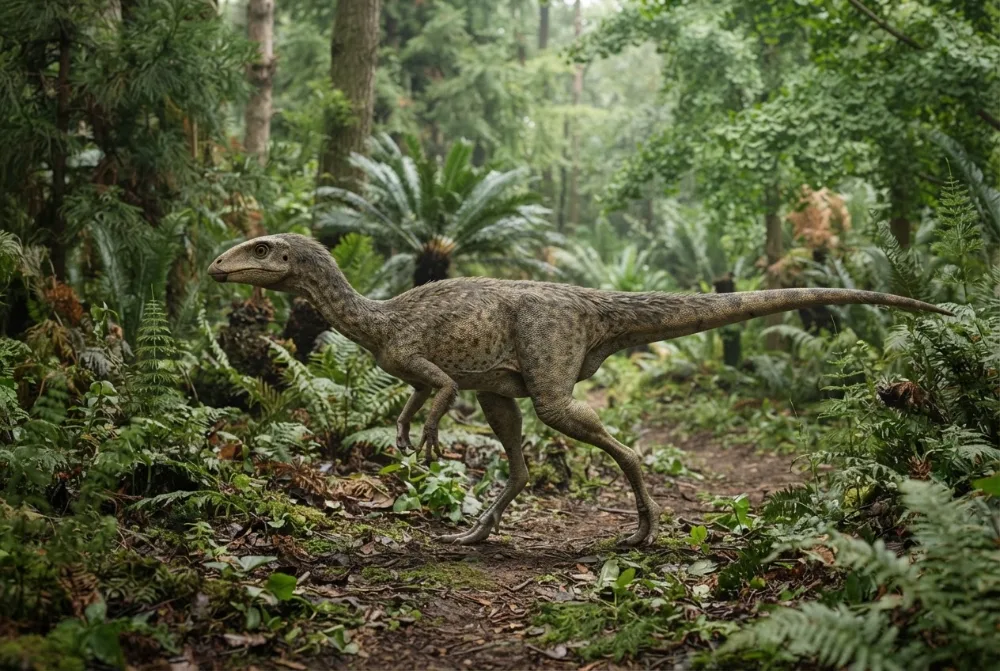
Jeholosaurus had a very fast tooth replacement rate, with new teeth growing every 46 days, faster than most early plant-eaters.1
Its eye socket was huge, making up 40% of the skull length, which is a sign it was a young animal.1
The front teeth were narrow and long, like a meat-eater's, but the back teeth were fan-shaped for chewing plants.1
The hip bone pointed backward, which is typical for ornithischian dinosaurs, but it also had a forward-pointing bone that supported its belly.1
All known fossils are from young animals, so scientists don't know exactly how big an adult could get.1
Laaj yi ñu gën a laaj ci Jeholosaurus
?How big was Jeholosaurus?
The known fossils are from young animals, so the adult size is unknown. The largest specimen is about 71 centimetres long, with a skull of 6.3 centimetres.1
?What did Jeholosaurus eat?
It mostly ate plants, using its beak and fan-shaped cheek teeth. But its front teeth were sharp like a meat-eater's, so it might have also eaten small animals or bugs.1
?Was Jeholosaurus a dinosaur?
Yes, Jeholosaurus was a small ornithischian dinosaur, a group of plant-eating dinosaurs with bird-like hips.1
?Why did Jeholosaurus have a beak?
The beak helped it nip off plants. Its cheek teeth were fan-shaped for grinding them up, and it may have had fleshy cheeks to hold food while chewing.1
Ku tas léeb yu dul dëgg
Léeb: Jeholosaurus was a meat-eater because it had sharp front teeth.
Dëgg: Its back teeth were for chewing plants, and it likely ate plants, though it might have eaten some insects or small animals too.1
Ngir ñi xam dino lool
- Turu xam-xam
- Jeholosaurus
- Ku ko tudde
- Xu et al. 20003
- Kurél
- Dino yu lekk gàncax te am gémmiñu picc
- Njaboot / klad
- Thescelosauridae3
- Klasifikasiyoŋ
- Ornithischia3
- Màggaayu doj yi
- 126 ba 120 milyoŋ at (Barremian / Aptian)3
- Formasiyoŋi doj
- Yixian3
- Réew yi
- Siin3
- Fosil yu ñu gis
- 2 ci The Paleobiology Database3
- Gisees
- The first fossils were found in 2000 at Lujiatun near Beipiao City, China, and named by Xu Xing and colleagues the same year.1
- Ñu ngi koy werante ba tey
- Scientists still debate whether Jeholosaurus was a plant-eater or an omnivore, because its front teeth were sharp and its back teeth were for plants.1
Fa xibaar yi jóge
- Jeholosaurus (en.wikipedia.org)
- Cranial anatomy of Jeholosaurus shangyuanensis (Dinosauria: Ornithischia) from the Early Cretaceous of China | Zootaxa (mapress.com)
- Jeholosaurus in The Paleobiology Database (CC BY 4.0): at, béréb yi, formasiyoŋi doj, klasifikasiyoŋ.
Bépp xibaar ci xët wii am na lim bu wone fa mu jóge. Su nu juumee, baal nu, nun ñu bëgg dino lanu, du ab sërnaalu xam-xam. Wax nu ko ci [email protected] nu defar ko.
 Rex xiif na! Dino Wiki, mbiru ab baay la ngir doomam ju góor ju bëgg dinosoor, ci neen te amul kaamuñaate, amul tracker. Mag ñi mën nañu jox Rex tuuti ñam ngir dimbali ko mu des ci internet.Dundal Rex
 Iguanodon
 Tenontosaurus
 Thescelosaurus
 Zalmoxes
 Camptosaurus
 Rhabdodon
 Stegosaurus
 Archaeopteryx
 Giganotosaurus
 Microraptor
 Deinonychus
 Baryonyx