 Ban dino nga? Kiis
 Xeexu dino
 Rawante dino
 Fo yu ndaw yu dino
 Albomu sitikeer
 Limu TOP yu dino
 Bett ma!
Kañ la dundoon?

Naka la réyoon?
Naka la guddoon?
Naka la kawewoon?
jortu
Naka la diisoon?
 gudd ni 4 muusu kër, bakkan ba geen🍌gudd ni 12 banaana yu ñu topp-toppale🍌diis ni 110 banaana🏃mënoon na daw 100 meetar ci 9,2 segond (nit ki gën a gaaw dafay soxla 9,6)
Naka la Megapnosaurus réyoon, bu ñu ko méngalee ak YAW?
Ay kalkil rekk ci sa navigatëer. Dara du ñu denc, dara du ñu yónne fenn.
Naka la gaawoon?


Xibaar yu neex
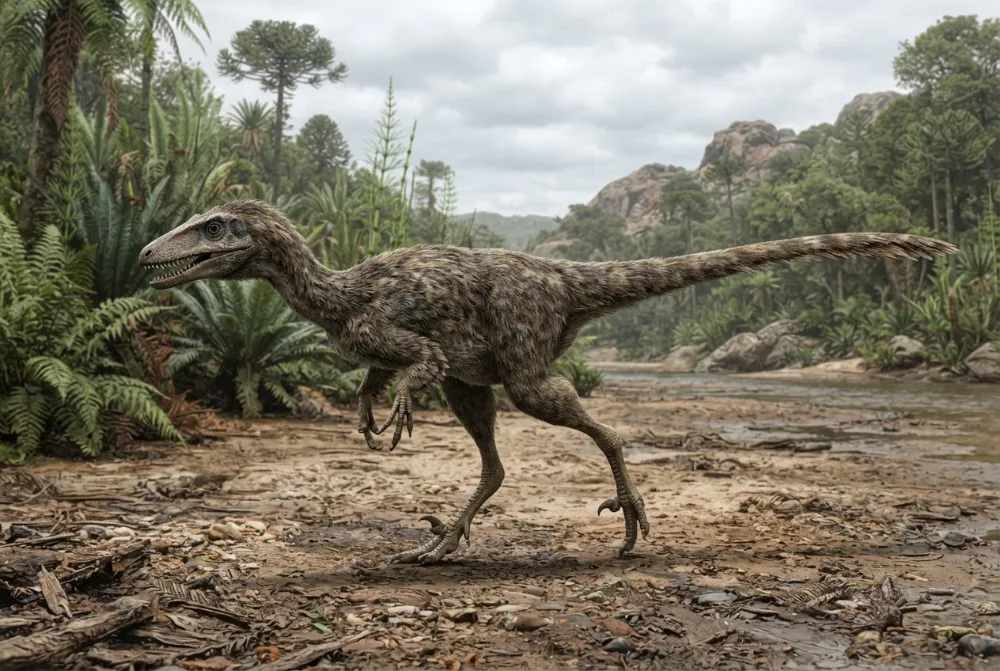
Megapnosaurus was one of the first dinosaurs ever shown with feathers in pictures, even though no one has found actual feathers with its fossils.1
At least 30 Megapnosaurus skeletons were found together in Zimbabwe, which suggests they might have lived or hunted in groups.1
Its name changed over time: first it was called Syntarsus, but that name was already used for a beetle, so scientists gave it a new name in 2001.1
Megapnosaurus had an S-shaped neck and long hind legs that looked like the legs of a secretary bird.1
Its hands had four fingers, which is more than most later meat-eating dinosaurs had.1
Some scientists think Megapnosaurus might actually belong to the genus Coelophysis, but most recent studies say it is its own genus.1
Laaj yi ñu gën a laaj ci Megapnosaurus
?How big was Megapnosaurus?
Megapnosaurus grew up to about 2.2 metres (7.2 feet) long and weighed up to 13 kilograms (29 pounds).1
?What did Megapnosaurus eat?
Megapnosaurus was a carnivore, meaning it ate meat. It may have hunted in packs and preyed on early plant-eating dinosaurs and lizards.1
?When did Megapnosaurus live?
Megapnosaurus lived during the Early Jurassic Period, about 199 to 188 million years ago.1
?Where was Megapnosaurus found?
Fossils of Megapnosaurus were found in Zimbabwe and South Africa in Africa.1
?Did Megapnosaurus have feathers?
Nobody knows for sure. It was one of the first dinosaurs shown with feathers in pictures, but no actual feathers have been found with its fossils.1
?Why is it called Megapnosaurus?
Megapnosaurus means 'big dead lizard' in Greek. It got this name after its first name, Syntarsus, was already used for a beetle.1
Ngir ñi xam dino lool
- Turu xam-xam
- Megapnosaurus
- Ku ko tudde
- Ivie et al. 20012
- Kurél
- Dino yuy lekk yàpp
- Njaboot / klad
- Coelophysidae2
- Klasifikasiyoŋ
- Theropoda > Coelophysoidea2
- Màggaayu doj yi
- 201 ba 193 milyoŋ at (Hettangian / Sinemurian)2
- Formasiyoŋi doj
- Forest Sandstone, Nyamandhlovu Sandstones, Elliot2
- Réew yi
- Simbabwe, Afrig di Sid, Siin, Amerig2
- Fosil yu ñu gis
- 8 ci The Paleobiology Database2
- Gisees
- The first fossils were found in 1963 by students in Zimbabwe. Scientist Michael Raath named it Syntarsus rhodesiensis in 1969, and later it was renamed Megapnosaurus in 2001.1
- Ñu ngi koy werante ba tey
- Scientists still debate whether Megapnosaurus should be its own genus or just a species of Coelophysis.1
Fa xibaar yi jóge
- Megapnosaurus (en.wikipedia.org)
- Megapnosaurus in The Paleobiology Database (CC BY 4.0): at, béréb yi, formasiyoŋi doj, klasifikasiyoŋ.
Bépp xibaar ci xët wii am na lim bu wone fa mu jóge. Su nu juumee, baal nu, nun ñu bëgg dino lanu, du ab sërnaalu xam-xam. Wax nu ko ci [email protected] nu defar ko.
 Rex xiif na! Dino Wiki, mbiru ab baay la ngir doomam ju góor ju bëgg dinosoor, ci neen te amul kaamuñaate, amul tracker. Mag ñi mën nañu jox Rex tuuti ñam ngir dimbali ko mu des ci internet.Dundal Rex
 Allosaurus
 Carnotaurus
 Dilophosaurus
 Giganotosaurus
 Compsognathus
 Paronychodon
 Stenopterygius
 Dorygnathus
 Lufengosaurus
 Scutellosaurus
 Yunnanosaurus
 Temnodontosaurus