 Ban dino nga? Kiis
 Xeexu dino
 Rawante dino
 Fo yu ndaw yu dino
 Albomu sitikeer
 Limu TOP yu dino
 Bett ma!
Ornithocheirus
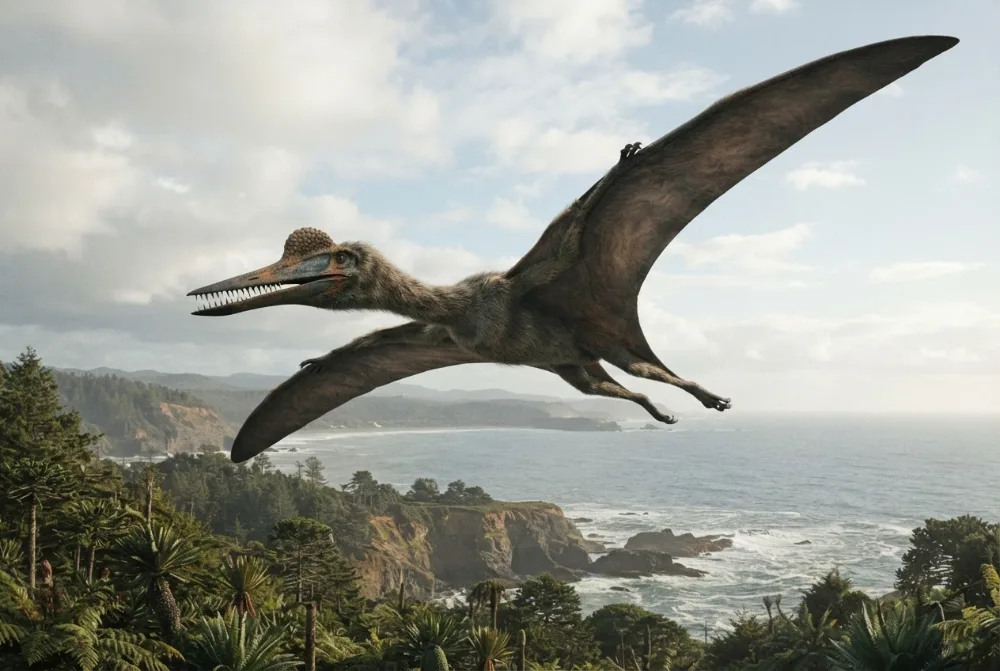
Ornithocheirus was a flying reptile that lived during the Early Cretaceous, about 110 million years ago. It had a long, narrow beak with a bumpy crest on top and sharp teeth for catching fish. Even though it was not a dinosaur, it was one of the biggest flying animals of its time.1
Kañ la dundoon?
Naka la réyoon?
Naka la guddoon?
Naka la diisoon?
 gudd ni 2,5 xaj, bakkan ba geen🍌gudd ni 14 banaana yu ñu topp-toppale
 diis ni 11 muusu kër🍉diis ni 9 xaal🧸diis ni 2,5 xale yu maternel🎒diis ni 1,5 xale yu lekkool⚽mënoon na naaw ci kaw teraŋ futbal bépp ci 5,1 segond
Naka la Ornithocheirus réyoon, bu ñu ko méngalee ak YAW?
Ay kalkil rekk ci sa navigatëer. Dara du ñu denc, dara du ñu yónne fenn.
Naka la gaawoon?


Xibaar yu neex
Ornithocheirus means 'bird hand' because scientists first thought its wing bones looked like a bird's hand.1
Only one species is considered valid today: Ornithocheirus simus. Many other fossils once called Ornithocheirus are now placed in different genera.1
Its fossils were found in the Cambridge Greensand of England, a layer of rock that was once a sandy seabed about 110 million years old.1
Ornithocheirus had a keel-shaped crest on its snout, which may have been used for display or to help it steer in flight.1
Its teeth were mostly straight up and down, not angled outward like those of some of its relatives.1
Early paleontologists like Richard Owen argued about its name. Owen preferred Criorhynchus ('ram beak') because he did not like the idea of evolution.1
Some fossils once thought to be birds, like Cimoliornis and Palaeornis, turned out to be Ornithocheirus or its relatives.1
Laaj yi ñu gën a laaj ci Ornithocheirus
?How big was Ornithocheirus?
It was a medium-sized pterosaur with a wingspan of about 5 metres (16 feet) and a body mass of about 20 kilograms (44 pounds).1
?Was Ornithocheirus a dinosaur?
No, Ornithocheirus was a pterosaur, a flying reptile, not a dinosaur.1
?What did Ornithocheirus eat?
It ate fish, which it caught with its sharp teeth while flying over the sea.1
?When did Ornithocheirus live?
It lived during the Early Cretaceous period, about 110 million years ago.1
?Where was Ornithocheirus found?
Its fossils were found in the Cambridge Greensand of England, and possibly also in Morocco.1
?Why did Ornithocheirus have a crest?
Scientists think the keel-shaped crest on its snout may have been used for display or to help it steer in flight.1
?How fast could Ornithocheirus fly?
Nobody knows for sure, but as a large pterosaur it was probably a strong flier that could cover long distances.1
?Is Ornithocheirus the biggest pterosaur?
No, it was not the biggest. A related pterosaur called Tropeognathus had a wingspan of about 8.2 metres (27 feet), making it the largest toothed pterosaur known.1
Ku tas léeb yu dul dëgg
Léeb: Many people think Ornithocheirus had a wingspan of 12 metres (40 feet), making it the largest flying reptile ever.
Dëgg: That number is exaggerated. Scientists now estimate its wingspan was about 4.5 to 6.1 metres (15 to 20 feet), making it a medium-sized pterosaur.1
Ngir ñi xam dino lool
- Turu xam-xam
- Ornithocheirus
- Ku ko tudde
- Seeley 18695
- Kurél
- Reptil yuy naaw
- Njaboot / klad
- Ornithocheiroidea5
- Klasifikasiyoŋ
- Pterosauria > Pterodactyloidea5
- Màggaayu doj yi
- 133 ba 90 milyoŋ at (Hauterivian / Turonian)5
- Formasiyoŋi doj
- West Melbury Marly Chalk, Calcaires à Spatangues, Zig Zag Chalk5
- Réew yi
- Angalteer, Faraas, Portigaal, RD Kongo, Riisi, Almaañ5
- Fosil yu ñu gis
- 12 ci The Paleobiology Database5
- Ñu ngi koy wooye itam
- Cimoliornis, Criorhynchus, Palaeornis (tur yu njëkk yi, léegi ñu ngi leen jàppe ni benn rab rekk)5
- Gisees
- The first fossils were found in the 1800s in England and named Pterodactylus simus by Richard Owen in 1861. Harry Seeley later gave it the genus name Ornithocheirus in 1869.12
- Ñu ngi koy werante ba tey
- Scientists still debate which fossils truly belong to Ornithocheirus and which belong to similar pterosaurs like Coloborhynchus or Tropeognathus.13
Fa xibaar yi jóge
- Ornithocheirus (en.wikipedia.org)
- PBDB Taxon (paleobiodb.org)
- Taxonomic review of the Ornithocheirus complex (Pterosauria) from the Cretaceous of England (zookeys.pensoft.net)
- Ornithocheirus — size, diet & habitat | DinoLifePedia (dinolifepedia.com)
- Ornithocheirus in The Paleobiology Database (CC BY 4.0): at, béréb yi, formasiyoŋi doj, klasifikasiyoŋ.
Bépp xibaar ci xët wii am na lim bu wone fa mu jóge. Su nu juumee, baal nu, nun ñu bëgg dino lanu, du ab sërnaalu xam-xam. Wax nu ko ci [email protected] nu defar ko.
 Rex xiif na! Dino Wiki, mbiru ab baay la ngir doomam ju góor ju bëgg dinosoor, ci neen te amul kaamuñaate, amul tracker. Mag ñi mën nañu jox Rex tuuti ñam ngir dimbali ko mu des ci internet.Dundal Rex
 Pteranodon
 Quetzalcoatlus
 Dorygnathus
 Rhamphorhynchus
 Anhanguera
 Pterodactylus
 Stegosaurus
 Iguanodon
 Archaeopteryx
 Giganotosaurus
 Microraptor
 Deinonychus