 Ban dino nga? Kiis
 Xeexu dino
 Rawante dino
 Fo yu ndaw yu dino
 Albomu sitikeer
 Limu TOP yu dino
 Bett ma!
Kañ la dundoon?

Naka la réyoon?
Naka la guddoon?
Naka la kawewoon?
jortu
Naka la diisoon?
 gudd ni 5 xaj, bakkan ba geen🍌gudd ni 28 banaana yu ñu topp-toppale🍉diis ni 100 xaal🧸diis ni 26 xale yu maternel🎒diis ni 16 xale yu lekkool🏃mënoon na daw 100 meetar ci 9,5 segond (nit ki gën a gaaw dafay soxla 9,6)
Naka la Owenodon réyoon, bu ñu ko méngalee ak YAW?
Ay kalkil rekk ci sa navigatëer. Dara du ñu denc, dara du ñu yónne fenn.
Naka la gaawoon?


Xibaar yu neex
Owenodon is known mostly from a partial lower jaw with ten teeth, found in a limestone block.1
It was first named Iguanodon hoggii by Richard Owen in 1874, honoring naturalist A.J. Hogg who collected the fossil.1
The jaw was damaged while stored in a museum collection, breaking one tooth crown and part of the bone.1
Owenodon lived in a warm, Mediterranean-like climate with lakes, lagoons, and salty marshes.1
Scientists think Owenodon was an intermediate ornithopod, between Camptosaurus and Iguanodon in evolution.1
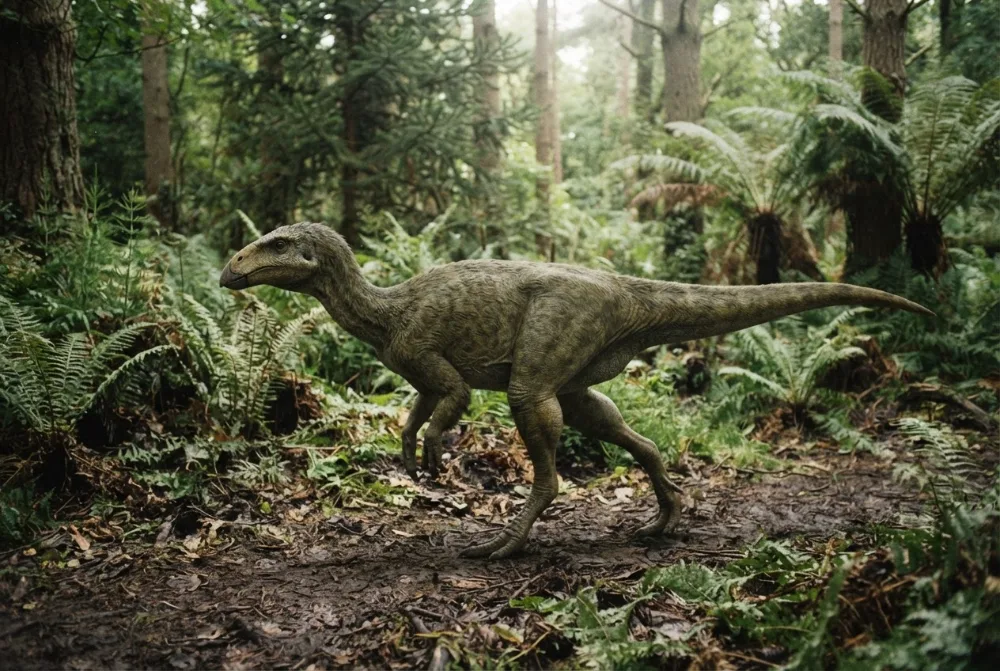
Laaj yi ñu gën a laaj ci Owenodon
?How big was Owenodon?
Scientists do not know for sure, because only a partial lower jaw has been found. It was probably a small ornithopod, but no exact size is known.1
?When did Owenodon live?
Owenodon lived during the Early Cretaceous, about 140 million years ago, in the Berriasian stage.1
?Where was Owenodon found?
The only definite Owenodon fossil was found in Dorset, United Kingdom, in the Lulworth Formation. Some teeth from Romania and Spain may also belong to it.1
Ngir ñi xam dino lool
- Turu xam-xam
- Owenodon
- Ku ko tudde
- Galton 20093
- Kurél
- Dino yu lekk gàncax te am gémmiñu picc
- Njaboot / klad
- Dryomorpha3
- Klasifikasiyoŋ
- Ornithischia > Ornithopoda > Iguanodontia3
- Màggaayu doj yi
- 149 ba 137 milyoŋ at (Tithonian / Berriasian)3
- Formasiyoŋi doj
- Lower Bauxite, Lulworth3
- Réew yi
- Rumani, Angalteer3
- Fosil yu ñu gis
- 6 ci The Paleobiology Database3
- Gisees
- The fossil was discovered by A.J. Hogg in the Purbeck Limestone of Dorset, England, and described by Richard Owen in 1874 as Iguanodon hoggii. It was given its own genus Owenodon by Peter Galton in 2009.1
- Ñu ngi koy werante ba tey
- Scientists are not sure exactly where Owenodon fits in the ornithopod family tree, because the fossils are so few and incomplete.1
Fa xibaar yi jóge
- Owenodon (en.wikipedia.org)
- Owenodon hoggii | Dinosaur Database by DinoAnimals.com (dinoanimals.com)
- Owenodon in The Paleobiology Database (CC BY 4.0): at, béréb yi, formasiyoŋi doj, klasifikasiyoŋ.
Bépp xibaar ci xët wii am na lim bu wone fa mu jóge. Su nu juumee, baal nu, nun ñu bëgg dino lanu, du ab sërnaalu xam-xam. Wax nu ko ci [email protected] nu defar ko.
 Rex xiif na! Dino Wiki, mbiru ab baay la ngir doomam ju góor ju bëgg dinosoor, ci neen te amul kaamuñaate, amul tracker. Mag ñi mën nañu jox Rex tuuti ñam ngir dimbali ko mu des ci internet.Dundal Rex
 Iguanodon
 Tenontosaurus
 Thescelosaurus
 Zalmoxes
 Camptosaurus
 Rhabdodon
 Stegosaurus
 Archaeopteryx
 Giganotosaurus
 Microraptor
 Deinonychus
 Baryonyx