 Ban dino nga? Kiis
 Xeexu dino
 Rawante dino
 Fo yu ndaw yu dino
 Albomu sitikeer
 Limu TOP yu dino
 Bett ma!
Pengornis
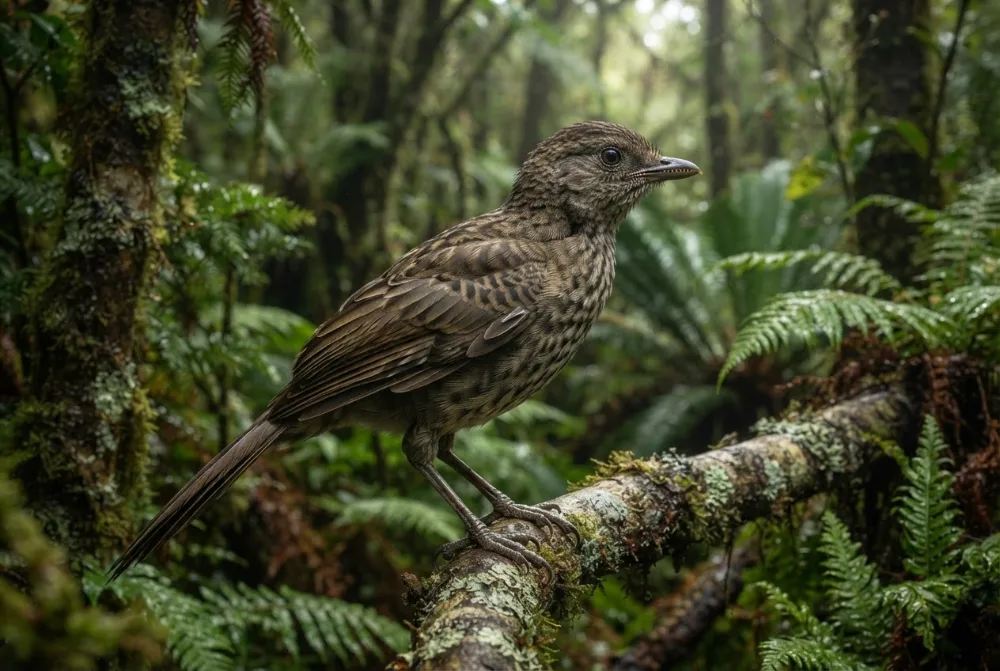
Pengornis was a bird that lived in the Early Cretaceous, about 120 million years ago. It was one of the biggest birds of its time, with a wingspan as wide as a small car. It had tiny teeth and ate meat.21
Kañ la dundoon?
Naka la gaawoon?


Xibaar yu neex
Pengornis is the largest known enantiornithine bird from the Early Cretaceous of northeast China.1
Its skull is one of the best preserved among all Mesozoic birds, showing details like tiny teeth and wear facets.2
Pengornis had a globose humeral head that stuck out further than its deltopectoral crest, a feature not seen in other enantiornithines.2
The name comes from 'Peng', a giant mythological bird in Chinese folklore, and 'ornis' meaning bird in Greek.1
Its teeth were small, conical, and not curved, similar to those of the early bird Archaeopteryx.2
Pengornis had a long tail with a pygostyle, a fused bone at the tip that helped control flight.2
Laaj yi ñu gën a laaj ci Pengornis
?How big was Pengornis?
Pengornis was a small bird with a wingspan of roughly 1 meter (3.3 feet). It is the largest known enantiornithine bird from the Early Cretaceous.13
?Did Pengornis have teeth?
Yes, Pengornis had tiny, conical teeth that were not curved, similar to those of the early bird Archaeopteryx. It had about 13 teeth in its lower jaw and used them to eat meat.13
?When did Pengornis live?
Pengornis lived during the Early Cretaceous period, about 120 million years ago.1
?What does the name Pengornis mean?
The name Pengornis comes from 'Peng', a giant mythological bird in Chinese folklore, and 'ornis', which means bird in Greek.1
Ngir ñi xam dino lool
- Turu xam-xam
- Pengornis
- Ku ko tudde
- Zhou et al. 20084
- Kurél
- Picc yu jëkk yi
- Njaboot / klad
- Pengornithidae4
- Klasifikasiyoŋ
- Theropoda > Avialae4
- Màggaayu doj yi
- 121 ba 113 milyoŋ at (Aptian)4
- Formasiyoŋi doj
- Jiufotang4
- Réew yi
- Siin4
- Fosil yu ñu gis
- 1 ci The Paleobiology Database4
- Gisees
- Pengornis was named in 2008 by Zhou, Clarke, and Zhang based on a nearly complete skeleton found in the Jiufotang Formation in Liaoning, China. The species name 'houi' honors the pioneering paleo-ornithologist Lianhai Hou.12
- Ñu ngi koy werante ba tey
- Scientists debate whether Enantiornithes and Ornithurae (the group including modern birds) are truly separate groups. Pengornis has features of both, which blurs the line.12
Fa xibaar yi jóge
- Pengornis (en.wikipedia.org)
- Insight into diversity, body size and morphological evolution from the largest Early Cretaceous enantiornithine bird (pmc.ncbi.nlm.nih.gov)
- Insight into diversity, body size and morphological evolution from the largest Early Cretaceous enantiornithine bird - Zhou - 2008 - Journal of Anatomy - Wiley Online Library (onlinelibrary.wiley.com)
- Pengornis in The Paleobiology Database (CC BY 4.0): at, béréb yi, formasiyoŋi doj, klasifikasiyoŋ.
Bépp xibaar ci xët wii am na lim bu wone fa mu jóge. Su nu juumee, baal nu, nun ñu bëgg dino lanu, du ab sërnaalu xam-xam. Wax nu ko ci [email protected] nu defar ko.
 Rex xiif na! Dino Wiki, mbiru ab baay la ngir doomam ju góor ju bëgg dinosoor, ci neen te amul kaamuñaate, amul tracker. Mag ñi mën nañu jox Rex tuuti ñam ngir dimbali ko mu des ci internet.Dundal Rex
 Archaeopteryx
 Hesperornis
 Ichthyornis
 Baptornis
 Jurapteryx
 Gobipteryx
 Stegosaurus
 Iguanodon
 Giganotosaurus
 Microraptor
 Deinonychus
 Baryonyx