 Ban dino nga? Kiis
 Xeexu dino
 Rawante dino
 Fo yu ndaw yu dino
 Albomu sitikeer
 Limu TOP yu dino
 Bett ma!
Plesiopharos
Plesiopharos was an early plesiosaur that swam in the warm seas of Portugal about 195 million years ago. It had a long body, four flippers, and a short tail, and it used its sharp teeth to catch fish and other sea creatures.31
Kañ la dundoon?
Naka la réyoon?
Naka la guddoon?
 gudd ni 3 xaj, bakkan ba geen🍌gudd ni 16 banaana yu ñu topp-toppale🏊mënoon na féey guddaayu pisin bu mag (50 m) ci 6,7 segond
Naka la Plesiopharos réyoon, bu ñu ko méngalee ak YAW?
Ay kalkil rekk ci sa navigatëer. Dara du ñu denc, dara du ñu yónne fenn.
Naka la gaawoon?


Xibaar yu neex
Plesiopharos is one of the oldest and most complete plesiosaurs ever found in the Iberian Peninsula, which includes Portugal and Spain.1
Its name comes from the Greek words for 'near' and 'lighthouse', because it was discovered near a lighthouse called Penedo da Saudade.1
The fossil was found by two fossil hunters, Vitor Teixeira and António Silva, who donated it to the Museu da Lourinhã in 2017.1
Plesiopharos lived during the Sinemurian age of the Early Jurassic, about 199 to 193 million years ago, when the Atlantic Ocean was just beginning to form.31
Scientists think Plesiopharos was a very early member of the group Plesiosauroidea, which includes the long-necked plesiosaurs that came later.1
The only known skeleton of Plesiopharos includes 22 vertebrae, ribs, parts of the hips and shoulders, and bones from its flippers.1
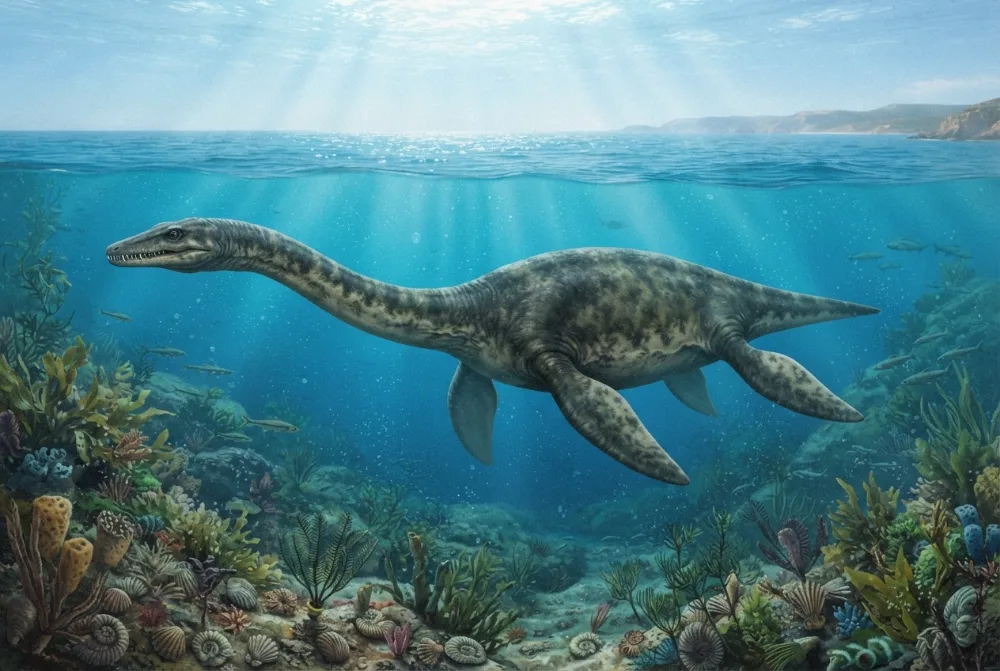
Ngir ñi xam dino lool
- Turu xam-xam
- Plesiopharos
- Ku ko tudde
- Puértolas-Pascual et al. 20213
- Kurél
- Plesiyosoor yi
- Njaboot / klad
- Plesiosauroidea3
- Klasifikasiyoŋ
- Plesiosauria > Sauropterygia3
- Màggaayu doj yi
- 200 ba 193 milyoŋ at (Sinemurian)3
- Réew yi
- Portigaal3
- Fosil yu ñu gis
- 1 ci The Paleobiology Database3
- Gisees
- Plesiopharos was named in 2021 by a team of scientists led by Eduardo Puértolas-Pascual. The fossil was found at Praia da Concha in Portugal and donated to the Museu da Lourinhã.31
- Ñu ngi koy werante ba tey
- Scientists are not sure whether Plesiopharos belongs more closely to the long-necked plesiosauroids or to other early plesiosaur groups, because its skeleton has a mix of features from different lineages.1
Fa xibaar yi jóge
- A new plesiosaur from the Lower Jurassic of Portugal and the early radiation of Plesiosauroidea (dinodata.de)
- Plesiopharos (en.wikipedia.org)
- Plesiopharos in The Paleobiology Database (CC BY 4.0): at, béréb yi, formasiyoŋi doj, klasifikasiyoŋ.
Bépp xibaar ci xët wii am na lim bu wone fa mu jóge. Su nu juumee, baal nu, nun ñu bëgg dino lanu, du ab sërnaalu xam-xam. Wax nu ko ci [email protected] nu defar ko.
 Rex xiif na! Dino Wiki, mbiru ab baay la ngir doomam ju góor ju bëgg dinosoor, ci neen te amul kaamuñaate, amul tracker. Mag ñi mën nañu jox Rex tuuti ñam ngir dimbali ko mu des ci internet.Dundal Rex
 Elasmosaurus
 Pliosaurus
 Plesiosaurus
 Cimoliasaurus
 Colymbosaurus
 Trinacromerum
 Dilophosaurus
 Stenopterygius
 Dorygnathus
 Lufengosaurus
 Scutellosaurus
 Yunnanosaurus