 Ban dino nga? Kiis
 Xeexu dino
 Rawante dino
 Fo yu ndaw yu dino
 Albomu sitikeer
 Limu TOP yu dino
 Bett ma!
Pterodaustro
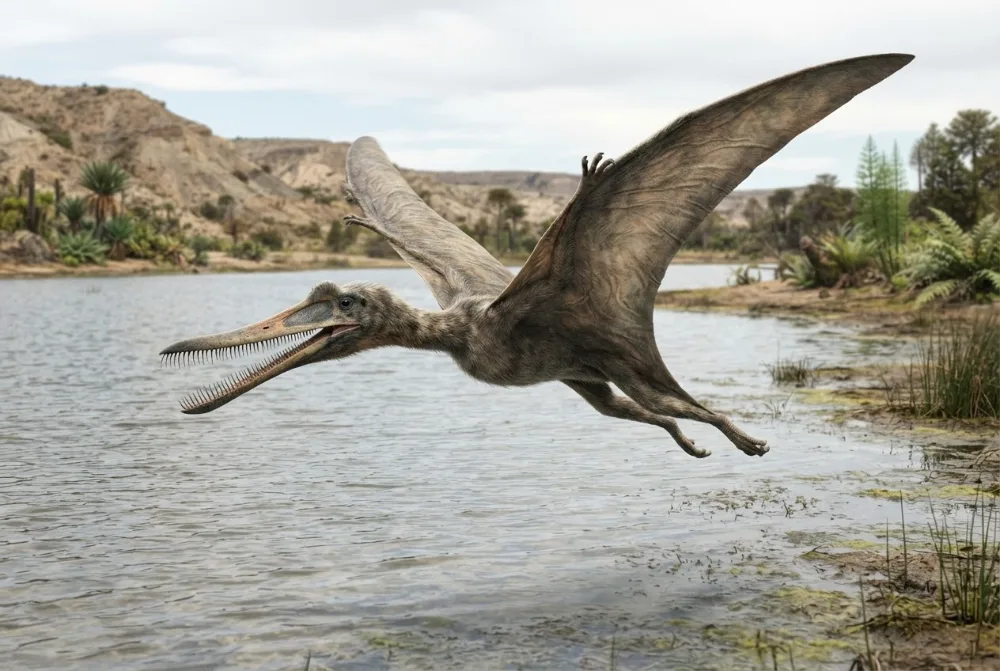
Pterodaustro was a flying reptile that lived near lakes in what is now Argentina. It had a weird mouth with about 1,000 long, bristle-like teeth in its lower jaw, just like a comb! It used those teeth to strain tiny shrimp and other small animals from the water, just like flamingos do today.12
Kañ la dundoon?
Naka la réyoon?
Naka la ay laafam yaatuwoon?
Naka la diisoon?

 laaf yu yaatu ni 1,5 welo ci benn rëdd🍌diis ni 77 banaana⚽mënoon na naaw ci kaw teraŋ futbal bépp ci 6,8 segond
Naka la Pterodaustro réyoon, bu ñu ko méngalee ak YAW?
Ay kalkil rekk ci sa navigatëer. Dara du ñu denc, dara du ñu yónne fenn.
Naka la gaawoon?


Xibaar yu neex
Pterodaustro had about 1,000 teeth in its lower jaw, each only 0.2 to 0.3 millimeters wide. That's thinner than a human hair!12
Scientists have found over 750 fossils of Pterodaustro, including eggs and embryos, making it one of the best-known pterosaurs.1
Pterodaustro had a long tail with 22 vertebrae, which is unusual for a pterodactyloid pterosaur. Most others have at most 16.1
Two Pterodaustro fossils were found with gizzard stones in their stomachs. These are the first gizzard stones ever reported for any pterosaur.1
Pterodaustro may have been pink like a flamingo! Its diet of tiny crustaceans could have given it a pink color, just like flamingos get from eating brine shrimp.12
Pterodaustro had a hard time taking off from the ground. Because of its long body and short legs, it needed a lot of open space to launch, like modern geese and swans.1
Juvenile Pterodaustro grew quickly in their first two years, reaching about half of adult size. They then grew more slowly for four to five years until they were fully grown.1
Laaj yi ñu gën a laaj ci Pterodaustro
?How big was Pterodaustro?
It had a wingspan of about 3 metres (9 ft 10 in) and weighed about 9.2 kilograms (20 lb).1
?What did Pterodaustro eat?
It ate tiny shrimp, crustaceans, and other small water animals. It used its comb-like teeth to strain them from the water, just like flamingos do.214
?Could Pterodaustro swim?
Yes, it had a long body and large, splayed feet that were adaptations for swimming and wading in lakes.1
Ku tas léeb yu dul dëgg
Léeb: Pterodaustro was a dinosaur.
Dëgg: Pterodaustro was a pterosaur, a flying reptile that lived at the same time as dinosaurs but is not a dinosaur.1
Ngir ñi xam dino lool
- Turu xam-xam
- Pterodaustro
- Ku ko tudde
- Bonaparte 19705
- Kurél
- Reptil yuy naaw
- Njaboot / klad
- Lophocratia5
- Klasifikasiyoŋ
- Pterosauria > Pterodactyloidea5
- Màggaayu doj yi
- 121 ba 100 milyoŋ at (Aptian / Albian)5
- Formasiyoŋi doj
- Lagarcito, La Cruz5
- Réew yi
- Arsantin5
- Fosil yu ñu gis
- 2 ci The Paleobiology Database5
- Gisees
- The first fossils of Pterodaustro were discovered in the late 1960s by paleontologist José Bonaparte in the Lagarcito Formation of San Luis Province, Argentina. Bonaparte named the genus in 1970, with the species name P. guinazui honoring Román Guiñazú.1
- Ñu ngi koy werante ba tey
- Scientists are still debating whether Pterodaustro was actually pink like a flamingo. While its diet suggests it could have been, no direct fossil evidence of color has been found.12
Fa xibaar yi jóge
- Pterodaustro (en.wikipedia.org)
- Pterosaur of the Day: Pterodaustro | AMNH (amnh.org)
- PBDB Taxon (paleobiodb.org)
- Pterodaustro guinazui (amnh.org)
- Pterodaustro in The Paleobiology Database (CC BY 4.0): at, béréb yi, formasiyoŋi doj, klasifikasiyoŋ.
Bépp xibaar ci xët wii am na lim bu wone fa mu jóge. Su nu juumee, baal nu, nun ñu bëgg dino lanu, du ab sërnaalu xam-xam. Wax nu ko ci [email protected] nu defar ko.
 Rex xiif na! Dino Wiki, mbiru ab baay la ngir doomam ju góor ju bëgg dinosoor, ci neen te amul kaamuñaate, amul tracker. Mag ñi mën nañu jox Rex tuuti ñam ngir dimbali ko mu des ci internet.Dundal Rex
 Pteranodon
 Quetzalcoatlus
 Dorygnathus
 Rhamphorhynchus
 Anhanguera
 Pterodactylus
 Stegosaurus
 Iguanodon
 Archaeopteryx
 Giganotosaurus
 Microraptor
 Deinonychus