 Ban dino nga? Kiis
 Xeexu dino
 Rawante dino
 Fo yu ndaw yu dino
 Albomu sitikeer
 Limu TOP yu dino
 Bett ma!
Kañ la dundoon?

Naka la gaawoon?


Xibaar yu neex
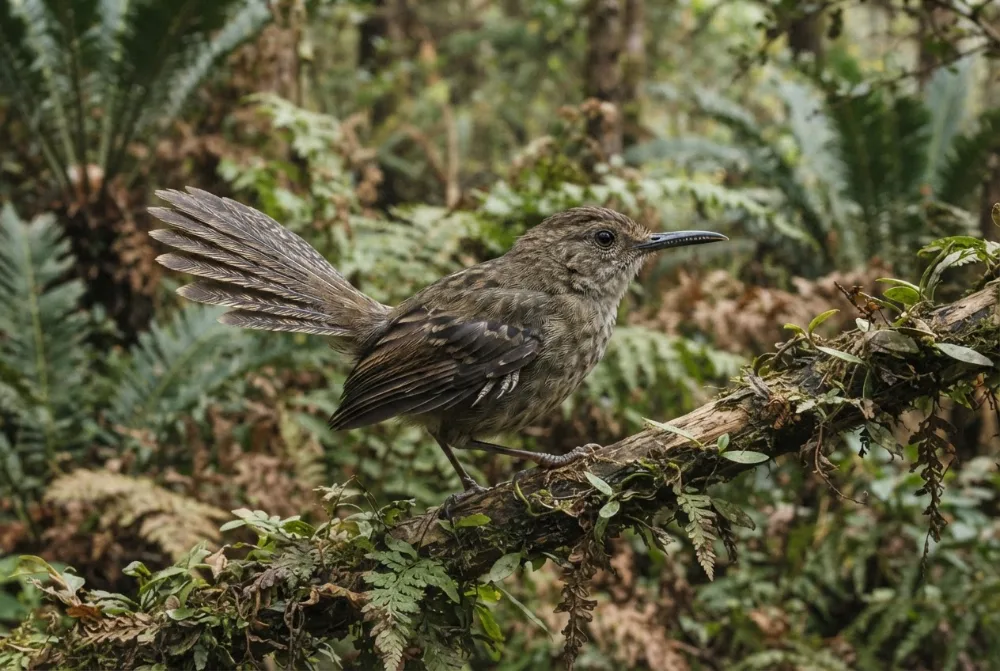
Shanweiniao is the only enantiornithine bird known with a tail that could generate lift, like the tails of modern birds.1
Its name means 'fan-tailed bird' in Chinese, because of its special tail feathers.1
Scientists are not sure if its tail really was a fan. Some think the feathers might have been ornamental, like streamers.2
Shanweiniao had a very strong pygostyle, the bone that supports the tail feathers, even stronger than in other enantiornithines.2
It lived about 122 million years ago, during the Early Cretaceous period.1
Only one fossil of Shanweiniao has been found, and it is kept at the Dalian Natural History Museum in China.1
Laaj yi ñu gën a laaj ci Shanweiniao
?What did Shanweiniao eat?
Shanweiniao had a long beak, which suggests it may have eaten insects or small animals, but scientists are not sure exactly what it ate.1
?Was Shanweiniao a dinosaur?
Yes, Shanweiniao was a type of bird that belonged to a group called avialan dinosaurs, so it is considered a dinosaur.1
?How big was Shanweiniao?
Shanweiniao was tiny, about the size of a sparrow, but the exact size is not known from the fossil.1
Ku tas léeb yu dul dëgg
Léeb: Shanweiniao definitely had a fan-shaped tail like modern birds.
Dëgg: Scientists are not sure. The tail feathers are poorly preserved, and some think they might have been ornamental streamers instead of a lift-generating fan.2
Ngir ñi xam dino lool
- Turu xam-xam
- Shanweiniao
- Ku ko tudde
- O'Connor et al. 20093
- Kurél
- Picc yu jëkk yi
- Njaboot / klad
- Longipterygidae3
- Klasifikasiyoŋ
- Theropoda > Avialae3
- Màggaayu doj yi
- 126 ba 120 milyoŋ at (Barremian / Aptian)3
- Formasiyoŋi doj
- Yixian3
- Réew yi
- Siin3
- Fosil yu ñu gis
- 1 ci The Paleobiology Database3
- Gisees
- Shanweiniao was named in 2009 by Jingmai O'Connor and colleagues. The species name, cooperorum, honors Carl and Lynn Cooper, who helped fund the research.1
- Ñu ngi koy werante ba tey
- Scientists still debate whether Shanweiniao's tail feathers formed an aerodynamic fan or were just for display.2
Fa xibaar yi jóge
- Shanweiniao (en.wikipedia.org)
- An Enantiornithine with a Fan-Shaped Tail, and the Evolution of the Rectricial Complex in Early Birds: Current Biology (cell.com)
- Shanweiniao in The Paleobiology Database (CC BY 4.0): at, béréb yi, formasiyoŋi doj, klasifikasiyoŋ.
Bépp xibaar ci xët wii am na lim bu wone fa mu jóge. Su nu juumee, baal nu, nun ñu bëgg dino lanu, du ab sërnaalu xam-xam. Wax nu ko ci [email protected] nu defar ko.
 Rex xiif na! Dino Wiki, mbiru ab baay la ngir doomam ju góor ju bëgg dinosoor, ci neen te amul kaamuñaate, amul tracker. Mag ñi mën nañu jox Rex tuuti ñam ngir dimbali ko mu des ci internet.Dundal Rex
 Archaeopteryx
 Hesperornis
 Ichthyornis
 Baptornis
 Jurapteryx
 Gobipteryx
 Stegosaurus
 Iguanodon
 Giganotosaurus
 Microraptor
 Deinonychus
 Baryonyx