 Ban dino nga? Kiis
 Xeexu dino
 Rawante dino
 Fo yu ndaw yu dino
 Albomu sitikeer
 Limu TOP yu dino
 Bett ma!
Kañ la dundoon?

Naka la réyoon?
Naka la guddoon?
Naka la kawewoon?
jortu
Naka la diisoon?
 gudd ni 5 xaj, bakkan ba geen🍌gudd ni 26 banaana yu ñu topp-toppale🍉diis ni 60 xaal🧸diis ni 16 xale yu maternel🎒diis ni 9 xale yu lekkool🏃mënoon na daw 100 meetar ci 8,8 segond (nit ki gën a gaaw dafay soxla 9,6)
Naka la Talenkauen réyoon, bu ñu ko méngalee ak YAW?
Ay kalkil rekk ci sa navigatëer. Dara du ñu denc, dara du ñu yónne fenn.
Naka la gaawoon?


Xibaar yu neex
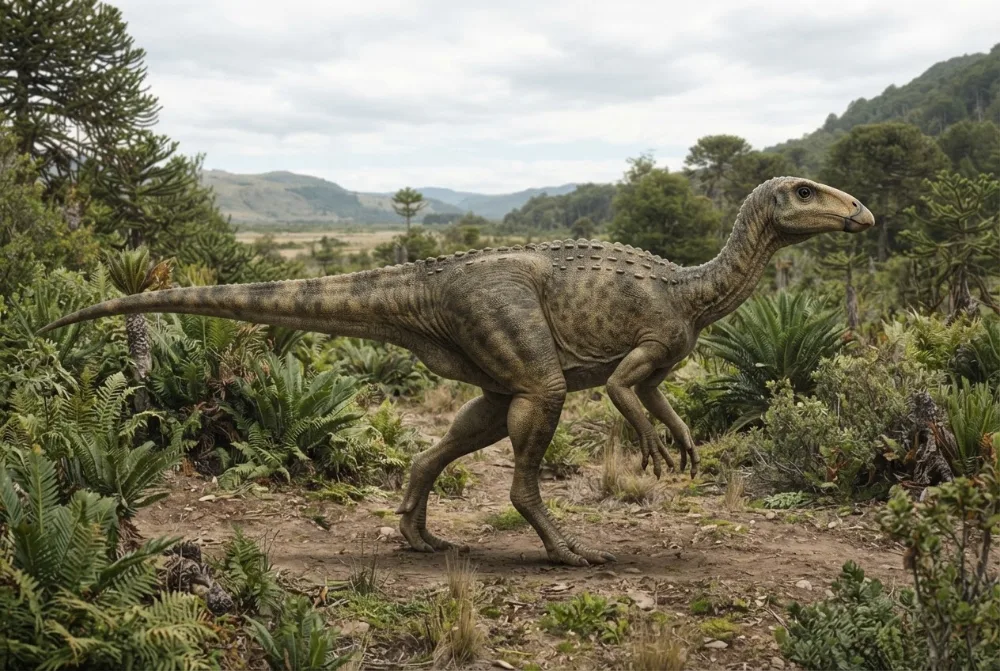
Talenkauen had smooth, oval plates along its ribcage. These plates were very thin, only about 3 millimeters thick, and may have helped with breathing, like similar structures in birds.1
Unlike many other plant-eating dinosaurs, Talenkauen still had teeth in the front of its beak and a first toe. More advanced relatives lost these features.1
A tiny baby Talenkauen was found with an adult. The baby had already hatched and eaten food, because its teeth showed wear. This is one of the few baby ornithopod fossils found in the southern hemisphere.1
Talenkauen lived alongside giant dinosaurs like Dreadnoughtus and Puertasaurus, which were huge long-necked plant-eaters, and the predator Orkoraptor.1
The plates on Talenkauen's ribs were too thin and small to be useful for defense, so scientists think they had another job, like helping the dinosaur breathe.1
Laaj yi ñu gën a laaj ci Talenkauen
?How big was Talenkauen?
About 4 meters (13 feet) long, maybe up to 4.7 meters (15 feet) and 300 kilograms (660 pounds).1
?What did Talenkauen eat?
It ate plants, using its beak and teeth to chew leaves and other vegetation.1
?Did Talenkauen have feathers?
No one knows for sure. No fossils of feathers have been found with Talenkauen, and it is not closely related to feathered dinosaurs.1
?When did Talenkauen live?
It lived during the Late Cretaceous period, about 72 to 66 million years ago.1
Ku tas léeb yu dul dëgg
Léeb: Some people think Talenkauen's rib plates were armor for protection.
Dëgg: Scientists think the plates were more like uncinate processes, which help with breathing, not armor.1
Ngir ñi xam dino lool
- Turu xam-xam
- Talenkauen
- Ku ko tudde
- Novas et al. 20042
- Kurél
- Dino yu lekk gàncax te am gémmiñu picc
- Njaboot / klad
- Elasmaria2
- Klasifikasiyoŋ
- Ornithischia > Ornithopoda > Iguanodontia2
- Màggaayu doj yi
- 84 ba 72 milyoŋ at (Campanian)2
- Formasiyoŋi doj
- Cerro Fortaleza2
- Réew yi
- Arsantin2
- Fosil yu ñu gis
- 2 ci The Paleobiology Database2
- Gisees
- Talenkauen was found in February 2000 on Los Hornos Hill near Viedma Lake in Argentina. It was named and described by Fernando Novas and colleagues in 2004.1
- Ñu ngi koy werante ba tey
- Scientists debate whether the rib plates of Talenkauen are related to the uncinate processes of birds and other animals, or if they are a different feature.1
Fa xibaar yi jóge
- Talenkauen (en.wikipedia.org)
- Talenkauen in The Paleobiology Database (CC BY 4.0): at, béréb yi, formasiyoŋi doj, klasifikasiyoŋ.
Bépp xibaar ci xët wii am na lim bu wone fa mu jóge. Su nu juumee, baal nu, nun ñu bëgg dino lanu, du ab sërnaalu xam-xam. Wax nu ko ci [email protected] nu defar ko.
 Rex xiif na! Dino Wiki, mbiru ab baay la ngir doomam ju góor ju bëgg dinosoor, ci neen te amul kaamuñaate, amul tracker. Mag ñi mën nañu jox Rex tuuti ñam ngir dimbali ko mu des ci internet.Dundal Rex
 Iguanodon
 Tenontosaurus
 Thescelosaurus
 Zalmoxes
 Camptosaurus
 Rhabdodon
 Tyrannosaurus
 Triceratops
 Velociraptor
 Spinosaurus
 Ankylosaurus
 Parasaurolophus