 Ban dino nga? Kiis
 Xeexu dino
 Rawante dino
 Fo yu ndaw yu dino
 Albomu sitikeer
 Limu TOP yu dino
 Bett ma!
Kañ la dundoon?

Naka la réyoon?
Naka la guddoon?
Naka la kawewoon?
Naka la diisoon?
 gudd ni 4 xaj, bakkan ba geen🍌gudd ni 25 banaana yu ñu topp-toppale🍉diis ni 120 xaal🧸diis ni 31 xale yu maternel🎒diis ni 18 xale yu lekkool🏃mënoon na daw 100 meetar ci 9,2 segond (nit ki gën a gaaw dafay soxla 9,6)
Naka la Tethyshadros réyoon, bu ñu ko méngalee ak YAW?
Ay kalkil rekk ci sa navigatëer. Dara du ñu denc, dara du ñu yónne fenn.
Naka la gaawoon?


Xibaar yu neex
Tethyshadros lived on a large island in the ancient Tethys Ocean, which is why it was named after that sea.1
The first skeleton, nicknamed Antonio, was found in a vertical rockface and took years to dig out.1
Tethyshadros had a mix of old-fashioned features, like a short neck and a skull like Iguanodon, and advanced features, like teeth arranged in batteries like true hadrosaurs.1
Scientists once thought Tethyshadros was a dwarf dinosaur, but later bone studies showed the main skeleton was from a teenager, not a full-grown adult.1
A second skeleton, nicknamed Bruno, is bigger and more complete, with a full skull and many bones.1
Tethyshadros is one of the latest surviving non-hadrosaurid hadrosauromorphs, meaning it lived just before true hadrosaurs became common.1
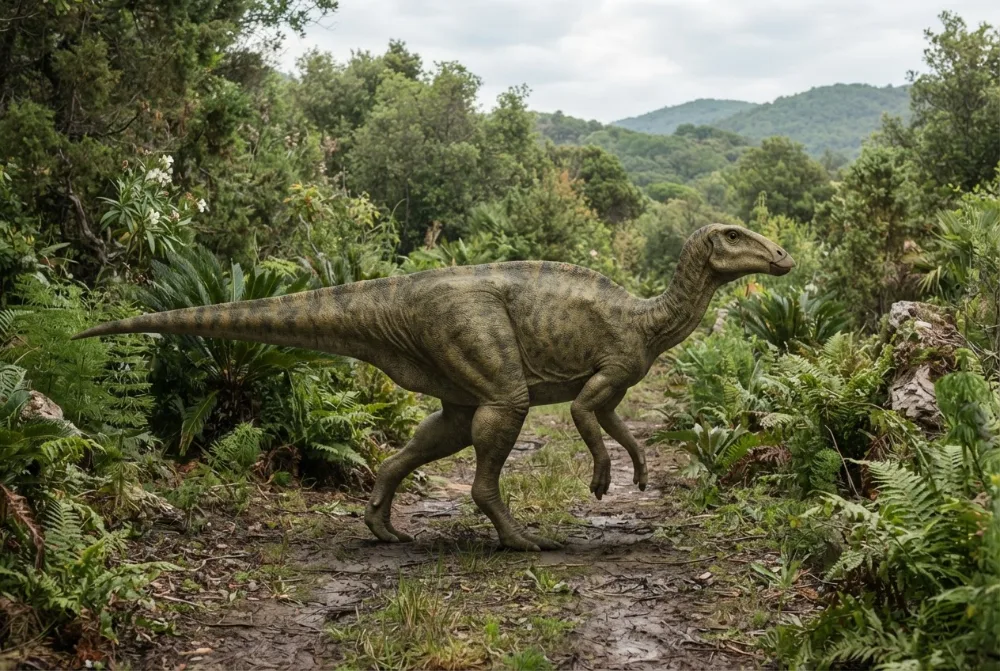
Laaj yi ñu gën a laaj ci Tethyshadros
?How big was Tethyshadros?
About 4.5 metres (15 feet) long, though some scientists think that estimate might be too high. The adult skeleton Bruno was 15 to 20% larger than the subadult Antonio.1
?What did Tethyshadros eat?
It was a plant-eater. Its beak and teeth were adapted for eating plants, and it may have used its strange serrated beak to bite specific food items.13
?Why did Tethyshadros have a strange beak?
Nobody knows for sure. It might have helped it bite certain plants, or been used for grooming or display.3
?Was Tethyshadros a dwarf dinosaur?
It was originally thought to be a dwarf, but later bone studies showed the main skeleton (Antonio) was a teenager, not a full-grown adult. The adult Bruno was larger.1
?When did Tethyshadros live?
It lived during the Late Cretaceous, about 81.5 to 80.5 million years ago.1
?Where was Tethyshadros found?
In an abandoned quarry at Villaggio del Pescatore, near Trieste, Italy. It lived on a large island in the ancient Tethys Ocean.1
Ku tas léeb yu dul dëgg
Léeb: Tethyshadros was a dwarf dinosaur.
Dëgg: The first skeleton was a subadult, not a full-grown adult, so it was not a dwarf species.1
Ngir ñi xam dino lool
- Turu xam-xam
- Tethyshadros
- Ku ko tudde
- Dalla Vecchia 20094
- Kurél
- Dino yu lekk gàncax te am gémmiñu picc
- Njaboot / klad
- Telmatosauridae4
- Klasifikasiyoŋ
- Ornithischia > Ornithopoda > Iguanodontia4
- Màggaayu doj yi
- 84 ba 72 milyoŋ at (Campanian)4
- Formasiyoŋi doj
- Aurisina4
- Réew yi
- Itali4
- Fosil yu ñu gis
- 1 ci The Paleobiology Database4
- Gisees
- Fossil fragments were found in the 1980s by Alceo Tarlao and Giorgio Rimoli. A nearly complete skeleton was discovered in 1994 and excavated by 1999. The dinosaur was named Tethyshadros insularis by Fabio Dalla Vecchia in 2009.1
- Ñu ngi koy werante ba tey
- Scientists still debate the exact total length of Tethyshadros, because the tail of the first skeleton was missing and its length had to be estimated.1
Fa xibaar yi jóge
- Tethyshadros (en.wikipedia.org)
- Friuli-Venezia Giulia - Fossili Regionali (fossiliregionali.it)
- The “Duck-billed” Dinosaur That Wasn’t (smithsonianmag.com)
- Tethyshadros in The Paleobiology Database (CC BY 4.0): at, béréb yi, formasiyoŋi doj, klasifikasiyoŋ.
Bépp xibaar ci xët wii am na lim bu wone fa mu jóge. Su nu juumee, baal nu, nun ñu bëgg dino lanu, du ab sërnaalu xam-xam. Wax nu ko ci [email protected] nu defar ko.
 Rex xiif na! Dino Wiki, mbiru ab baay la ngir doomam ju góor ju bëgg dinosoor, ci neen te amul kaamuñaate, amul tracker. Mag ñi mën nañu jox Rex tuuti ñam ngir dimbali ko mu des ci internet.Dundal Rex
 Iguanodon
 Tenontosaurus
 Thescelosaurus
 Zalmoxes
 Camptosaurus
 Rhabdodon
 Tyrannosaurus
 Triceratops
 Velociraptor
 Spinosaurus
 Ankylosaurus
 Parasaurolophus