 Ban dino nga? Kiis
 Xeexu dino
 Rawante dino
 Fo yu ndaw yu dino
 Albomu sitikeer
 Limu TOP yu dino
 Bett ma!
Wukongopterus
Wukongopterus was a small flying reptile that lived in what is now China. It had a long tail and a long neck, which made it look a bit like a dragon. It soared over ancient lakes and caught fish with its sharp teeth.1
Kañ la dundoon?
Naka la réyoon?
Naka la ay laafam yaatuwoon?
Naka la Wukongopterus réyoon, bu ñu ko méngalee ak YAW?
Ay kalkil rekk ci sa navigatëer. Dara du ñu denc, dara du ñu yónne fenn.
Naka la gaawoon?


Xibaar yu neex
Wukongopterus had a broken leg bone that healed while it was alive, showing it survived an injury.1
It had at least 16 short, peg-like teeth on each side of its upper jaw, perfect for catching slippery fish.1
Its neck bones were longer than those of any other known non-pterodactyloid pterosaur, which is a bit like a giraffe's neck among its relatives.1
The first two pairs of teeth in its upper jaw stuck out beyond its lower jaw, a unique feature not seen in other pterosaurs.1
It had a membrane between its hind legs, called a uropatagium, which helped it glide and steer in the air.1
Wukongopterus is one of the youngest long-tailed pterosaurs known, living near the end of the Jurassic period.1
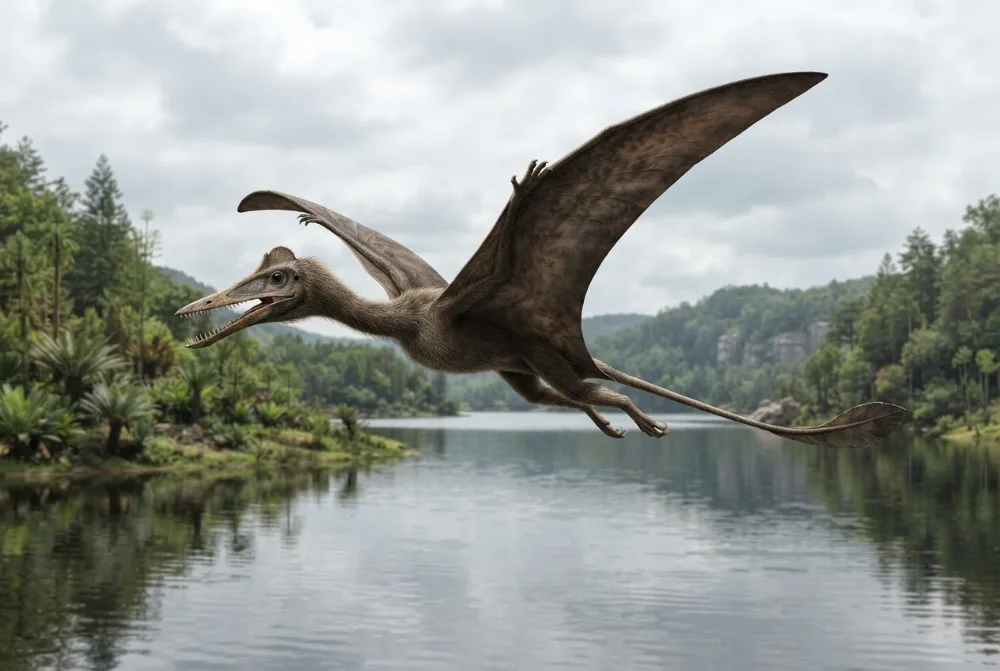
Laaj yi ñu gën a laaj ci Wukongopterus
?How big was Wukongopterus?
It was small, with a wingspan of about 73 centimetres (29 inches).2
?What did Wukongopterus eat?
It ate fish, catching them with its sharp, peg-like teeth.2
?When did Wukongopterus live?
It lived during the Middle or Late Jurassic period, about 164 million years ago.2
?Is Wukongopterus a dinosaur?
No, it is a pterosaur, a flying reptile that is not a dinosaur.2
Ku tas léeb yu dul dëgg
Léeb: Some people think Wukongopterus was a dinosaur because it lived with dinosaurs.
Dëgg: It was actually a pterosaur, a flying reptile that is a close cousin of dinosaurs, but not a dinosaur itself.1
Ngir ñi xam dino lool
- Turu xam-xam
- Wukongopterus
- Ku ko tudde
- Wang et al. 20093
- Kurél
- Reptil yuy naaw
- Njaboot / klad
- Monofenestrata3
- Klasifikasiyoŋ
- Pterosauria3
- Màggaayu doj yi
- 168 ba 152 milyoŋ at (Bathonian / Kimmeridgian)3
- Formasiyoŋi doj
- Tiaojishan3
- Réew yi
- Siin3
- Fosil yu ñu gis
- 1 ci The Paleobiology Database3
- Gisees
- It was named by Wang and colleagues in 2009 based on an almost complete skeleton found in China. The fossil was discovered in rocks that may be from the Daohugou Bed, and it was given the species name lii.1
- Ñu ngi koy werante ba tey
- Scientists are still debating exactly how old the rocks are where Wukongopterus was found, with some saying Late Jurassic and others Early Cretaceous.1
Fa xibaar yi jóge
- Brasil - An unusual long-tailed pterosaur with elongated neck from western Liaoning of China An unusual long-tailed pterosaur with elongated neck from western Liaoning of China (scielo.br)
- Wukongopterus (en.wikipedia.org)
- Wukongopterus in The Paleobiology Database (CC BY 4.0): at, béréb yi, formasiyoŋi doj, klasifikasiyoŋ.
Bépp xibaar ci xët wii am na lim bu wone fa mu jóge. Su nu juumee, baal nu, nun ñu bëgg dino lanu, du ab sërnaalu xam-xam. Wax nu ko ci [email protected] nu defar ko.
 Rex xiif na! Dino Wiki, mbiru ab baay la ngir doomam ju góor ju bëgg dinosoor, ci neen te amul kaamuñaate, amul tracker. Mag ñi mën nañu jox Rex tuuti ñam ngir dimbali ko mu des ci internet.Dundal Rex
 Pteranodon
 Quetzalcoatlus
 Dorygnathus
 Rhamphorhynchus
 Anhanguera
 Pterodactylus
 Brachiosaurus
 Diplodocus
 Allosaurus
 Brontosaurus
 Compsognathus
 Camarasaurus