 Ban dino nga? Kiis
 Xeexu dino
 Rawante dino
 Fo yu ndaw yu dino
 Albomu sitikeer
 Limu TOP yu dino
 Bett ma!
Zhengheornis
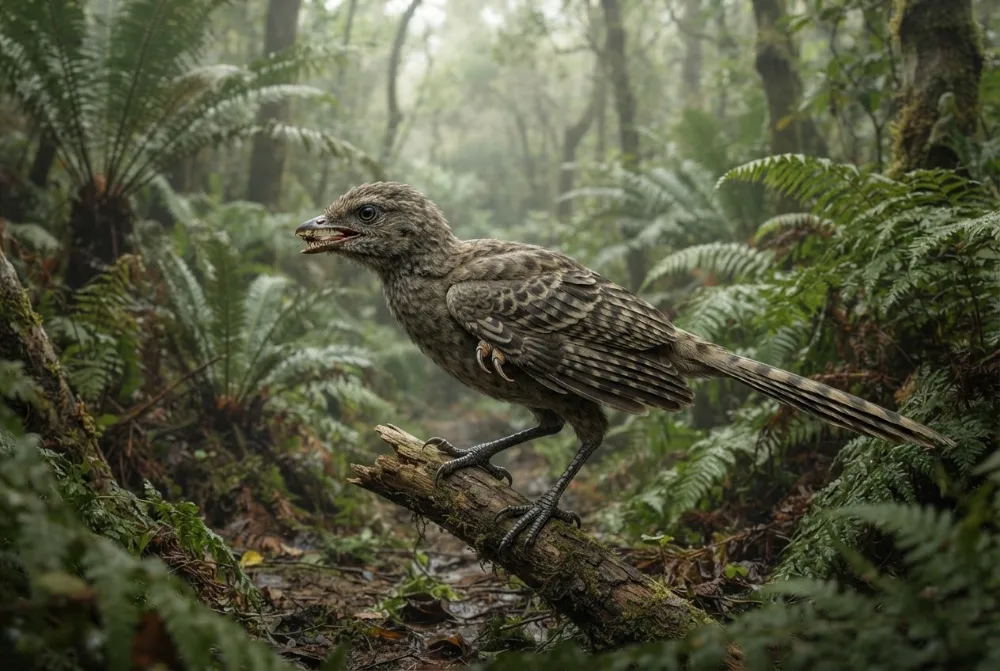
Zhengheornis was a tiny bird-like dinosaur that lived about 150 million years ago in what is now China. It had a short tail made of 15 bones, but no pygostyle, which is the fused tailbone modern birds have. This little creature helps scientists understand how bird tails evolved step by step.21
Kañ la dundoon?
Naka la réyoon?
Naka la diisoon?
Naka la Zhengheornis réyoon, bu ñu ko méngalee ak YAW?
Ay kalkil rekk ci sa navigatëer. Dara du ñu denc, dara du ñu yónne fenn.
Naka la gaawoon?


Xibaar yu neex
Zhengheornis is one of the smallest known early bird relatives, weighing only about as much as a modern robin (74 to 163 grams).2
Its tail had 15 short vertebrae but no pygostyle, showing that tail shortening happened before the bones fused together in bird evolution.2
The name 'buyu' means 'unexpected' in Mandarin, because scientists were surprised by its unusual tail and pelvis.1
Zhengheornis lived alongside other early birds like Fujianvenator and Baminornis in the Zhenghe Fauna of Late Jurassic China.2
Scientists think Zhengheornis was not especially good at climbing trees or walking on the ground, unlike some of its relatives.2
The only known fossil was found in 2024 and includes bones, feather traces, and parts of the arms, legs, and pelvis.1
Laaj yi ñu gën a laaj ci Zhengheornis
?How big was Zhengheornis?
Zhengheornis was incredibly tiny, weighing only about 74 to 163 grams, similar to a modern robin. It is one of the smallest known long-tailed early bird relatives.34
?When did Zhengheornis live?
Zhengheornis lived during the Early Cretaceous period, about 120 to 130 million years ago, in what is now China.13
Ngir ñi xam dino lool
- Turu xam-xam
- Zhengheornis
- Ku ko tudde
- Wang et al. 20265
- Kurél
- Picc yu jëkk yi
- Njaboot / klad
- Avialae5
- Klasifikasiyoŋ
- Theropoda > Avialae5
- Màggaayu doj yi
- 152 ba 145 milyoŋ at (Kimmeridgian / Tithonian)5
- Formasiyoŋi doj
- Nanyuan5
- Réew yi
- Siin5
- Fosil yu ñu gis
- 1 ci The Paleobiology Database5
- Gisees
- Zhengheornis was discovered in 2024 during fieldwork in Fujian Province, China, and named by Min Wang and colleagues in 2026.1
- Ñu ngi koy werante ba tey
- Scientists are still debating exactly where Zhengheornis fits on the family tree of early birds, though most agree it is one of the earliest avialans.2
Fa xibaar yi jóge
- Zhengheornis (en.wikipedia.org)
- Jurassic avialan reveals stepwise evolution of bony tail in birds (dinodata.de)
- China Jurassic Pocket-Sized Bird Fills a Puzzle of the Evolution of Bird Tail_Headline_Institute of Vertebrate Paleontology and Paleoanthropology, Chinese Academy of Sciences (english.ivpp.cas.cn)
- China Jurassic Pocket-Sized Bird Fills a Puzzle of the Evolution of Bird Tail_Research Progress_Institute of Vertebrate Paleontology and Paleoanthropology, Chinese Academy of Sciences (english.ivpp.cas.cn)
- Zhengheornis in The Paleobiology Database (CC BY 4.0): at, béréb yi, formasiyoŋi doj, klasifikasiyoŋ.
Bépp xibaar ci xët wii am na lim bu wone fa mu jóge. Su nu juumee, baal nu, nun ñu bëgg dino lanu, du ab sërnaalu xam-xam. Wax nu ko ci [email protected] nu defar ko.
 Rex xiif na! Dino Wiki, mbiru ab baay la ngir doomam ju góor ju bëgg dinosoor, ci neen te amul kaamuñaate, amul tracker. Mag ñi mën nañu jox Rex tuuti ñam ngir dimbali ko mu des ci internet.Dundal Rex
 Archaeopteryx
 Hesperornis
 Ichthyornis
 Baptornis
 Jurapteryx
 Gobipteryx
 Brachiosaurus
 Diplodocus
 Allosaurus
 Brontosaurus
 Compsognathus
 Camarasaurus