 Ban dino nga? Kiis
 Xeexu dino
 Rawante dino
 Fo yu ndaw yu dino
 Albomu sitikeer
 Limu TOP yu dino
 Bett ma!
Zhongjianornis
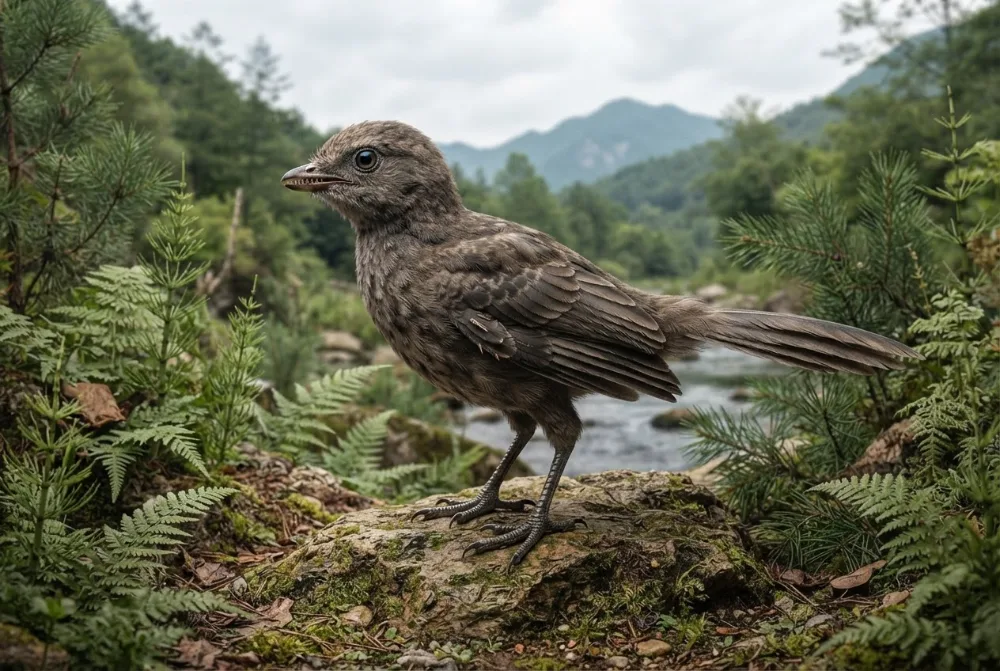
Zhongjianornis was a pigeon-sized bird that lived in China during the Early Cretaceous, about 120 million years ago. It had a toothless beak and strong wing muscles, making it a good flier. This little bird helps scientists understand how early birds evolved and lost their teeth.12
Kañ la dundoon?
Naka la réyoon?
Naka la guddoon?
Naka la kawewoon?
jortu
Naka la diisoon?
Naka la Zhongjianornis réyoon, bu ñu ko méngalee ak YAW?
Ay kalkil rekk ci sa navigatëer. Dara du ñu denc, dara du ñu yónne fenn.
Naka la gaawoon?


Xibaar yu neex
Zhongjianornis is one of the most primitive birds known to have completely lost its teeth, developing a beak instead.2
Its humerus had a large, robust deltopectoral crest, which was as wide as the bone shaft and more than one-third the total length of the humerus, indicating strong flight muscles.3
The only known fossil of Zhongjianornis is a nearly complete skeleton with some poorly preserved feather imprints.3
Zhongjianornis lived during the Aptian age of the Early Cretaceous, about 121 to 113 million years ago.3
Scientists initially thought Zhongjianornis was very primitive, but later research in 2012 suggested it was more similar to advanced euornithean birds like Chaoyangia.1
The species name yangi honors Yang Zhongjian, the founder of the Institute of Vertebrate Paleontology and Paleoanthropology in Beijing.1
Laaj yi ñu gën a laaj ci Zhongjianornis
?How big was Zhongjianornis?
About the size of a pigeon. It was a small bird.1
?Did Zhongjianornis have teeth?
No, it had a toothless beak. It is one of the most primitive birds known to have completely lost its teeth.12
?What did Zhongjianornis eat?
Scientists are not sure, but its toothless beak suggests it may have eaten seeds or small insects.1
Ku tas léeb yu dul dëgg
Léeb: Zhongjianornis was the most primitive toothless bird.
Dëgg: While initially thought to be very primitive, later analysis in 2012 showed that Zhongjianornis is more closely related to advanced euornithean birds, not the most primitive.1
Ngir ñi xam dino lool
- Turu xam-xam
- Zhongjianornis
- Ku ko tudde
- Zhou et al. 20104
- Kurél
- Picc yu jëkk yi
- Njaboot / klad
- Ornithuromorpha4
- Klasifikasiyoŋ
- Theropoda > Avialae4
- Màggaayu doj yi
- 121 ba 113 milyoŋ at (Aptian)4
- Formasiyoŋi doj
- Jiufotang4
- Réew yi
- Siin4
- Fosil yu ñu gis
- 1 ci The Paleobiology Database4
- Gisees
- Zhongjianornis was named and described by Zhou, Zhang, and Li in a paper published in January 2010 (though it appeared online in 2009). The only fossil, a nearly complete skeleton, was found at Jianchang in Liaoning Province, China.12
- Ñu ngi koy werante ba tey
- Scientists still debate whether Zhongjianornis was a very primitive bird or a more advanced euornithean, due to conflicting interpretations of its fossil's anatomy.1
Fa xibaar yi jóge
- Zhongjianornis (en.wikipedia.org)
- A new Lower Cretaceous bird from China and tooth reduction in early avian evolution (royalsocietypublishing.org)
- PBDB Taxon (paleobiodb.org)
- Zhongjianornis in The Paleobiology Database (CC BY 4.0): at, béréb yi, formasiyoŋi doj, klasifikasiyoŋ.
Bépp xibaar ci xët wii am na lim bu wone fa mu jóge. Su nu juumee, baal nu, nun ñu bëgg dino lanu, du ab sërnaalu xam-xam. Wax nu ko ci [email protected] nu defar ko.
 Rex xiif na! Dino Wiki, mbiru ab baay la ngir doomam ju góor ju bëgg dinosoor, ci neen te amul kaamuñaate, amul tracker. Mag ñi mën nañu jox Rex tuuti ñam ngir dimbali ko mu des ci internet.Dundal Rex
 Archaeopteryx
 Hesperornis
 Ichthyornis
 Baptornis
 Jurapteryx
 Gobipteryx
 Stegosaurus
 Iguanodon
 Giganotosaurus
 Microraptor
 Deinonychus
 Baryonyx