 Uyiyiphi idayinaso? Ikwizi
 Idabi leedayinaso
 Ugqatso lweedayinaso
 Imidlalo emincinci yeedayinaso
 I-albhamu yezitikha
 Iilisti ze-TOP zeedayinaso
 Ndothuse!
Aymberedactylus
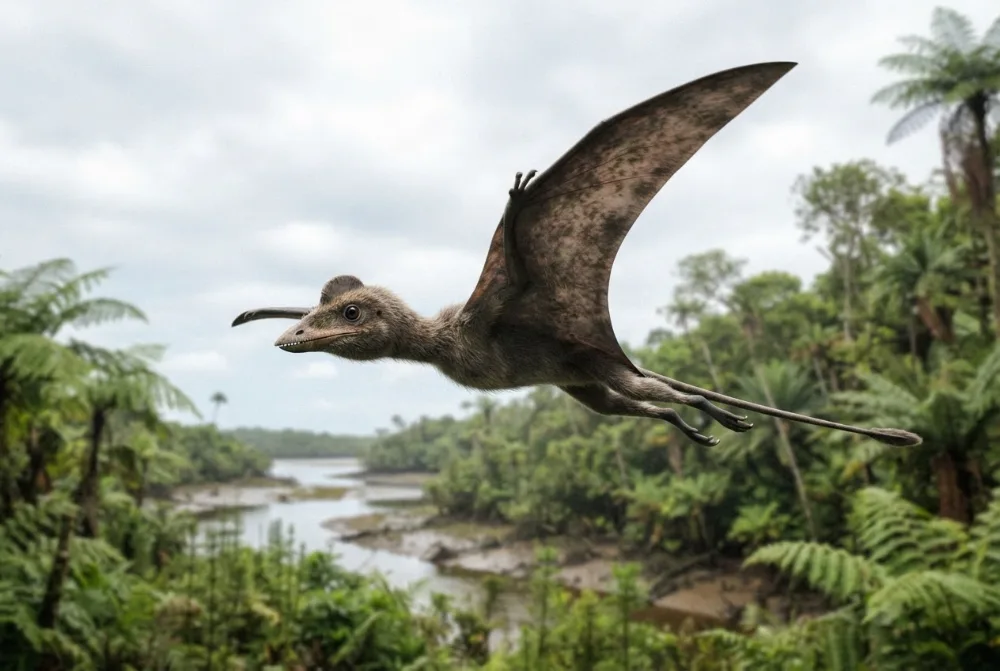
Aymberedactylus was a toothless flying reptile from the Early Cretaceous of Brazil. It had a short, downturned beak and probably ate fruits. Scientists think it was a small to medium-sized pterosaur with a wingspan of about 2 metres.1
Yaphila nini?
Yayinkulu kangakanani?
Amaphiko ayo ayebanzi kangakanani?
 inde njengeekati zasekhaya ezingama-4, impumlo ukuya emsileni⚽ibinokubhabha inqumle ibala lebhola ekhatywayo lonke ngemizuzwana engama-7.9
Aymberedactylus wayemkhulu kangakanani xa ethelekiswa NAWE?
Yimathematika nje kwibhrawuza yakho. Akukho nto igcinwayo okanye ithunyelwe naphi na.
Yayikhawuleza kangakanani?


Iinyani ezimnandi
Aymberedactylus is only known from one almost complete lower jaw (mandible). No other bones have been found.1
Its lower jaw is 27 centimetres long and is completely toothless.1
It had a very long retroarticular process (a part of the jaw joint) that was about 7% of the whole jaw length.1
The jaw had a shallow, rough-textured pit on the splenial bone that is unique to this species.1
Aymberedactylus belongs to the Tapejarinae group, which are toothless pterosaurs that often had big crests on their heads.1
It lived about 119 to 113 million years ago in a coastal lagoon environment.4
Eyona mibuzo ibuzwa kakhulu: Aymberedactylus
?What did Aymberedactylus eat?
It probably ate fruits. Scientists think it was a frugivore, like other tapejarine pterosaurs with downturned beaks.2
?How big was Aymberedactylus?
It had a wingspan of about 2 metres (6.5 feet), which is typical for tapejarid pterosaurs. The only known fossil is a 27 centimetre long lower jaw.32
?Was Aymberedactylus a dinosaur?
No, it was a pterosaur, a flying reptile that lived at the same time as dinosaurs but is not a dinosaur itself.3
Kwiingcali zeedayinaso
- Igama lenzululwazi
- Aymberedactylus
- Inikwe igama ngu:
- Pegas et al. 20164
- Iqela
- Izirhubuluzi ezibhabhayo
- Usapho / iclade
- Tapejaridae4
- Ukuhlelwa
- Pterosauria > Pterodactyloidea4
- Ubudala bamatye
- 120 ukuya ku-113 izigidi zeminyaka (Aptian)4
- Izakhiwo zamatye
- Crato4
- Amazwe
- iBrazil4
- Iirekhodi zeefosili
- 1 kwi-Paleobiology Database4
- Ukufunyanwa
- Aymberedactylus cearensis was named in 2016 by R.V. Pêgas, M.E.C. Leal and A.W.A. Kellner based on a lower jaw found near Nova Olinda, Brazil. Its name means 'small lizard finger' from the Tupi language, referring to its small size and pterosaur features.1
- Kusaxoxwa ngayo
- Since only a lower jaw has been found, scientists are not sure about the exact shape of its head crest or its full body size.1
Apho iinyani zivela khona
- A Basal Tapejarine (Pterosauria; Pterodactyloidea; Tapejaridae) from the Crato Formation, Early Cretaceous of Brazil (web.archive.org)
- A Basal Tapejarine (Pterosauria; Pterodactyloidea; Tapejaridae) from the Crato Formation, Early Cretaceous of Brazil | PLOS One (journals.plos.org)
- Aymberedactylus (en.wikipedia.org)
- Aymberedactylus in The Paleobiology Database (CC BY 4.0): ubudala, iindawo, izakhiwo zamatye, ukuhlelwa.
Yonke inyani ekweli phepha inenombolo ebonisa umthombo wayo. Ukuba siphosisile, uxolo, sithanda iidayinaso, asiyojenali yenzululwazi. Sixelele apha: [email protected], siya kuyilungisa.
 URex ulambile! I-Dino Wiki yiprojekthi katata ukwenzela unyana wakhe othanda iidayinaso, isimahla, ayinazintengiso, ayinazilandeli. Abantu abadala banokuphakela uRex isidlwana ukuze incede ihlale kwi-intanethi.Phakela uRex
 Pteranodon
 Quetzalcoatlus
 Dorygnathus
 Rhamphorhynchus
 Anhanguera
 Pterodactylus
 Stegosaurus
 Iguanodon
 Archaeopteryx
 Giganotosaurus
 Microraptor
 Deinonychus