 Uyiyiphi idayinaso? Ikwizi
 Idabi leedayinaso
 Ugqatso lweedayinaso
 Imidlalo emincinci yeedayinaso
 I-albhamu yezitikha
 Iilisti ze-TOP zeedayinaso
 Ndothuse!
Banguela
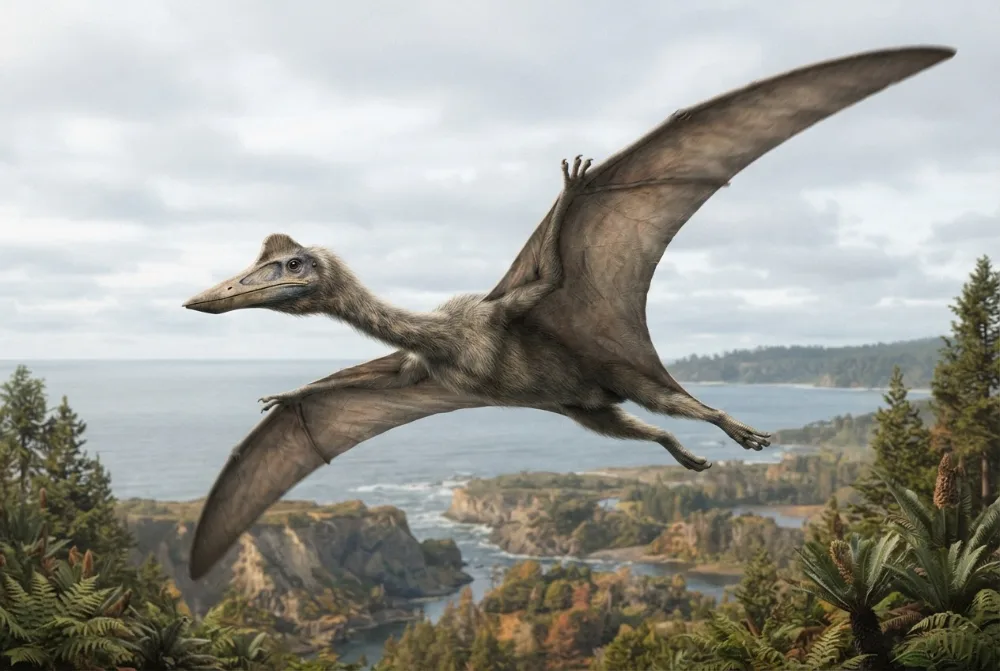
Banguela was a flying reptile that lived about 115 million years ago. It had no teeth, so it probably scooped up fish with its beak. It was not a dinosaur, but a pterosaur, a cousin of dinosaurs.14
Yaphila nini?
Yayinkulu kangakanani?
Amaphiko ayo ayebanzi kangakanani?
 amaphiko abanzi njengeebhayisikile ezingama-2 zilandelelana⚽ibinokubhabha inqumle ibala lebhola ekhatywayo lonke ngemizuzwana engama-6.2
Banguela wayemkhulu kangakanani xa ethelekiswa NAWE?
Yimathematika nje kwibhrawuza yakho. Akukho nto igcinwayo okanye ithunyelwe naphi na.
Yayikhawuleza kangakanani?


Iinyani ezimnandi
Banguela's lower jaw, called a symphysis, was about 27 centimeters (10.7 inches) long and curved upward. The front edges were sharp, but it had no teeth or tooth sockets.1
Its skull was about 61 centimeters (2 feet) long, and its wingspan was over 3.7 meters (12 feet).1
Banguela is one of the few pterosaurs that completely lost its teeth. Scientists think tooth loss happened at least four separate times among pterosaurs.1
The fossil was first thought to belong to another pterosaur called Thalassodromeus, but in 2015 scientists gave it its own name, Banguela.1
Banguela's toothless beak might have had a horny covering, like a bird's beak, which helped it catch slippery fish.1
Eyona mibuzo ibuzwa kakhulu: Banguela
?How big was Banguela?
Its skull was about 61 centimeters (24 inches) long and its wingspan was over 3.7 meters (12 feet). It weighed about as much as a small dog or a large goose.13
?Did Banguela have teeth?
No, Banguela had no teeth or tooth sockets. Its name means 'toothless one' in Portuguese.13
?What did Banguela eat?
It probably ate fish, scooping them up with its toothless beak. Its sharp jaw tips were not good for holding food, so it likely swallowed fish whole.3
?Is Banguela a dinosaur?
No, Banguela is a pterosaur, a flying reptile that lived alongside dinosaurs but is not a dinosaur itself.1
Inyaniso ngeentsomi
Intsomi: Some people think Banguela was a dinosaur because it lived with dinosaurs.
Inyaniso: Banguela was a pterosaur, a flying reptile, not a dinosaur. Pterosaurs are a separate group of reptiles.1
Kwiingcali zeedayinaso
- Igama lenzululwazi
- Banguela
- Inikwe igama ngu:
- Headden and Campos 20144
- Iqela
- Izirhubuluzi ezibhabhayo
- Usapho / iclade
- Dsungaripteridae4
- Ukuhlelwa
- Pterosauria > Pterodactyloidea4
- Ubudala bamatye
- 120 ukuya ku-113 izigidi zeminyaka (Aptian)4
- Izakhiwo zamatye
- Romualdo4
- Amazwe
- iBrazil4
- Iirekhodi zeefosili
- 1 kwi-Paleobiology Database4
- Ukufunyanwa
- A Swiss collector named Urs Oberli bought a jaw fragment from Brazil. In 2005, scientists first described it as Thalassodromeus, but in 2015, Jaime Headden and Hebert Campos named it Banguela oberlii, honoring Oberli.1
- Kusaxoxwa ngayo
- Scientists disagree about Banguela's family. Some say it belongs to Dsungaripteridae, others think it is a species of Thalassodromeus, and some place it in Chaoyangopteridae.1
Apho iinyani zivela khona
- Banguela (en.wikipedia.org)
- PBDB Taxon (paleobiodb.org)
- Meet Banguela | The Bite Stuff (qilong.wordpress.com)
- Banguela in The Paleobiology Database (CC BY 4.0): ubudala, iindawo, izakhiwo zamatye, ukuhlelwa.
Yonke inyani ekweli phepha inenombolo ebonisa umthombo wayo. Ukuba siphosisile, uxolo, sithanda iidayinaso, asiyojenali yenzululwazi. Sixelele apha: [email protected], siya kuyilungisa.
 URex ulambile! I-Dino Wiki yiprojekthi katata ukwenzela unyana wakhe othanda iidayinaso, isimahla, ayinazintengiso, ayinazilandeli. Abantu abadala banokuphakela uRex isidlwana ukuze incede ihlale kwi-intanethi.Phakela uRex
 Pteranodon
 Quetzalcoatlus
 Dorygnathus
 Rhamphorhynchus
 Anhanguera
 Pterodactylus
 Stegosaurus
 Iguanodon
 Archaeopteryx
 Giganotosaurus
 Microraptor
 Deinonychus