 Uyiyiphi idayinaso? Ikwizi
 Idabi leedayinaso
 Ugqatso lweedayinaso
 Imidlalo emincinci yeedayinaso
 I-albhamu yezitikha
 Iilisti ze-TOP zeedayinaso
 Ndothuse!
Yaphila nini?

Yayinkulu kangakanani?
Yayinde kangakanani?
Yayiphakame kangakanani?
uqikelelo
Yayinzima kangakanani?
 inde njengeekati zasekhaya ezingama-3, impumlo ukuya emsileni🍌inde njengeebhanana ezingama-8 zilandelelanamalunga nobunzima bekati yasekhaya🍌inzima njengeebhanana ezingama-17🏃ibinokubaleka iimitha ezili-100 ngemizuzwana engama-16 (oyena mntu ukhawulezayo udinga i-9,6)
Daurosaurus wayemkhulu kangakanani xa ethelekiswa NAWE?
Yimathematika nje kwibhrawuza yakho. Akukho nto igcinwayo okanye ithunyelwe naphi na.
Yayikhawuleza kangakanani?


Iinyani ezimnandi
Daurosaurus is known from a partial skeleton that includes preserved soft parts, which is very rare for dinosaurs.1
It had skin scales that split into bristles, a feature that scientists think may be an early step toward feathers.2
The fossil site was once a lake, and the dinosaur lived in a landscape with lakes and changing plant life.2
Scientists think Daurosaurus may have lived in groups, because the fossil record suggests it was gregarious.1
The age of the rocks where Daurosaurus was found was first thought to be Late Jurassic, but later studies showed it is actually Middle Jurassic, about 168 to 165 million years old.2
Daurosaurus is one of several small plant-eating dinosaurs found at the same site, along with Kulindapteryx and Kulindadromeus.2
Eyona mibuzo ibuzwa kakhulu: Daurosaurus
?How big was Daurosaurus?
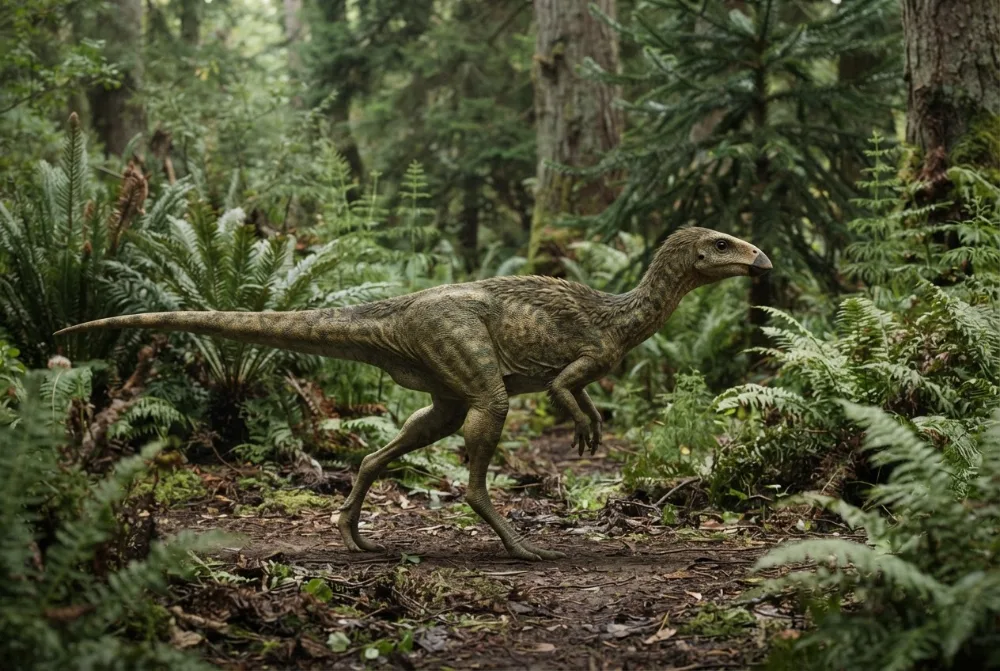
Daurosaurus was a small dinosaur. Its adult length is estimated at 1 metre, so it was quite small.4
?What did Daurosaurus eat?
Daurosaurus was a herbivore, meaning it ate plants. It had a beak for cropping plant material.4
?Did Daurosaurus have feathers?
Daurosaurus had skin scales that split into bristles, which scientists think may be an early step toward feathers. This is similar to the feather-like structures found on its relative Kulindadromeus.34
?When did Daurosaurus live?
Daurosaurus lived during the Late Bathonian stage of the Middle Jurassic, about 168 to 165 million years ago.4
?Where was Daurosaurus found?
Daurosaurus was found in the Ukureyskaya Formation in Zabaykal'ye, Russia. Its fossil was discovered at a site called Kulinda.4
?Did Daurosaurus live in groups?
Yes, the fossil record suggests Daurosaurus was gregarious, meaning it likely lived in groups.4
Inyaniso ngeentsomi
Intsomi: Some people think all dinosaurs with bristles or filaments were birds or ancestors of birds.
Inyaniso: Daurosaurus was a plant-eating dinosaur, not a bird, but its bristle-like scales show that such features appeared in many dinosaur groups, not just bird relatives.2
Kwiingcali zeedayinaso
- Igama lenzululwazi
- Daurosaurus
- Inikwe igama ngu:
- Alifanov and Saveliev 20144
- Iqela
- Izitya-zityalo ezinemilomo
- Usapho / iclade
- Hypsilophodontidae4
- Ukuhlelwa
- Ornithischia > Ornithopoda4
- Ubudala bamatye
- 168 ukuya ku-165 izigidi zeminyaka (Bathonian)4
- Izakhiwo zamatye
- Ukureyskaya4
- Amazwe
- iRashiya4
- Iirekhodi zeefosili
- 1 kwi-Paleobiology Database4
- Ukufunyanwa
- Daurosaurus was named by Russian scientists Vladimir Alifanov and Sergei Saveliev in 2014, based on a partial skeleton found at the Kulinda site in Transbaikalia, Russia.12
- Kusaxoxwa ngayo
- Scientists debate whether Daurosaurus is a valid species, because some researchers think the name is doubtful (a nomen dubium) due to incomplete remains.1
Apho iinyani zivela khona
- PBDB Taxon (paleobiodb.org)
- Two new ornithischian dinosaurs (Hypsilophodontia, Ornithopoda) from the Late Jurassic of Russia (researchgate.net)
- Kulindadromeus (Wikipedia) (Wikipedia)
- Daurosaurus in The Paleobiology Database (CC BY 4.0): ubudala, iindawo, izakhiwo zamatye, ukuhlelwa.
Yonke inyani ekweli phepha inenombolo ebonisa umthombo wayo. Ukuba siphosisile, uxolo, sithanda iidayinaso, asiyojenali yenzululwazi. Sixelele apha: [email protected], siya kuyilungisa.
 URex ulambile! I-Dino Wiki yiprojekthi katata ukwenzela unyana wakhe othanda iidayinaso, isimahla, ayinazintengiso, ayinazilandeli. Abantu abadala banokuphakela uRex isidlwana ukuze incede ihlale kwi-intanethi.Phakela uRex
 Iguanodon
 Tenontosaurus
 Thescelosaurus
 Zalmoxes
 Camptosaurus
 Rhabdodon
 Ichthyosaurus
 Khudiakovia
 Ophthalmosaurus
 Pterodactylus
 Peloneustes
 Rhamphocephalus