 Uyiyiphi idayinaso? Ikwizi
 Idabi leedayinaso
 Ugqatso lweedayinaso
 Imidlalo emincinci yeedayinaso
 I-albhamu yezitikha
 Iilisti ze-TOP zeedayinaso
 Ndothuse!
Djupedalia
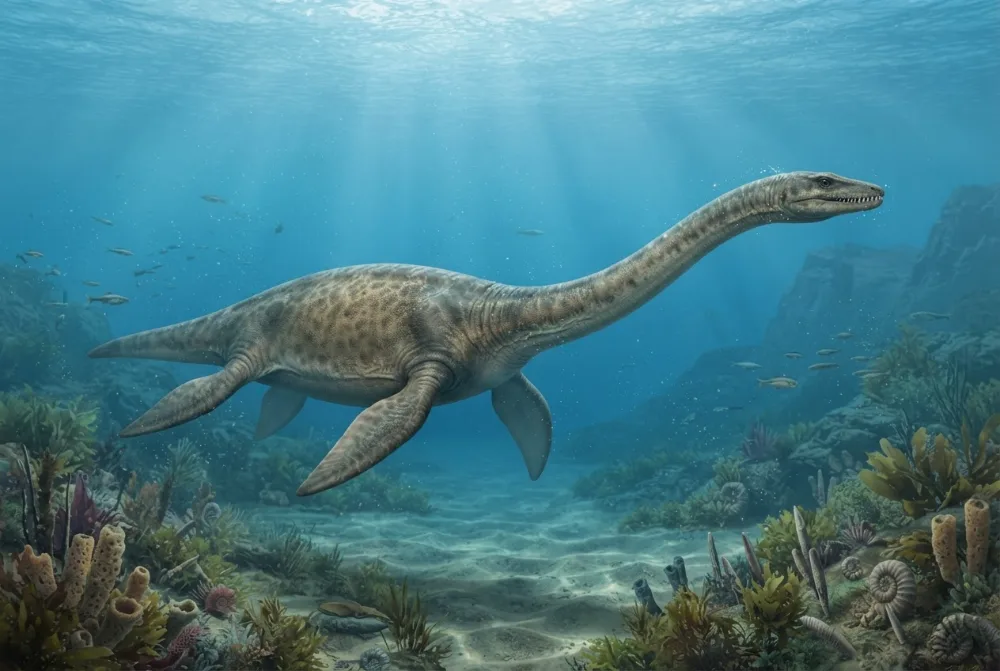
Djupedalia was a long-necked marine reptile that swam in the warm, shallow seas near Svalbard, Norway, about 150 million years ago. It was not a dinosaur, but a plesiosaur, a type of ocean predator. With its small head and long neck, it likely snapped up fish and squid while paddling through the water.42
Yaphila nini?
Yayinkulu kangakanani?
Yayinde kangakanani?
 inde njengezinja ezingama-6, impumlo ukuya emsileni🍌inde njengeebhanana ezingama-33 zilandelelana🏊ibinokuqubha ubude bechibi elikhulu lokuqubha (50 m) ngemizuzwana engama-6.7
Djupedalia wayemkhulu kangakanani xa ethelekiswa NAWE?
Yimathematika nje kwibhrawuza yakho. Akukho nto igcinwayo okanye ithunyelwe naphi na.
Yayikhawuleza kangakanani?


Iinyani ezimnandi
Djupedalia is known from a single juvenile skeleton that is one of the most complete marine reptile fossils ever found in Spitsbergen.2
Its neck bones were special: the neural spines (the parts that stick up from the vertebrae) were shifted far back, and the postzygapophyses (the joints that connect vertebrae) were very long.2
Djupedalia had femora (thigh bones) that were longer than its humeri (upper arm bones), which is unusual for plesiosaurs.2
The fossil was found about 20 metres below a rock layer called the Dorsoplanites bed, which is full of ammonite shells.2
Djupedalia lived during the Tithonian age, about 150 to 145 million years ago, in the Late Jurassic period.1
Inyaniso ngeentsomi
Intsomi: Some people might think Djupedalia was a dinosaur because it lived in the sea and had a long neck.
Inyaniso: Djupedalia was a plesiosaur, a marine reptile, not a dinosaur. Dinosaurs lived on land, while plesiosaurs swam in the ocean.4
Kwiingcali zeedayinaso
- Igama lenzululwazi
- Djupedalia
- Inikwe igama ngu:
- Knutsen et al. 20124
- Iqela
- Iiplesiosauri
- Usapho / iclade
- Cryptoclididae4
- Ukuhlelwa
- Plesiosauria > Sauropterygia4
- Ubudala bamatye
- 149 ukuya ku-143 izigidi zeminyaka (Tithonian)4
- Izakhiwo zamatye
- Agardhfjellet4
- Amazwe
- iNorway4
- Iirekhodi zeefosili
- 1 kwi-Paleobiology Database4
- Ukufunyanwa
- Djupedalia was named in 2012 by Espen M. Knutsen, Patrick S. Druckenmiller, and Jørn H. Hurum. The fossil was excavated in the summer of 2009 by the University of Oslo Natural History Museum from the Slottsmøya Member near Janusfjellet mountain.2
- Kusaxoxwa ngayo
- Scientists are still debating exactly how Djupedalia is related to other plesiosaurs, since it shares features with several different groups from England and other places.2
Apho iinyani zivela khona
- Djupedalia (en.wikipedia.org)
- A new plesiosauroid (Reptilia: Sauropterygia) from the Agardhfjellet Formation (Middle Volgian) of central Spitsbergen, Norway (foreninger.uio.no)
- PaleoCodex :: Djupedalia (paleocodex.com)
- Djupedalia in The Paleobiology Database (CC BY 4.0): ubudala, iindawo, izakhiwo zamatye, ukuhlelwa.
Yonke inyani ekweli phepha inenombolo ebonisa umthombo wayo. Ukuba siphosisile, uxolo, sithanda iidayinaso, asiyojenali yenzululwazi. Sixelele apha: [email protected], siya kuyilungisa.
 URex ulambile! I-Dino Wiki yiprojekthi katata ukwenzela unyana wakhe othanda iidayinaso, isimahla, ayinazintengiso, ayinazilandeli. Abantu abadala banokuphakela uRex isidlwana ukuze incede ihlale kwi-intanethi.Phakela uRex
 Elasmosaurus
 Pliosaurus
 Plesiosaurus
 Cimoliasaurus
 Colymbosaurus
 Trinacromerum
 Brachiosaurus
 Diplodocus
 Allosaurus
 Brontosaurus
 Compsognathus
 Camarasaurus