 Uyiyiphi idayinaso? Ikwizi
 Idabi leedayinaso
 Ugqatso lweedayinaso
 Imidlalo emincinci yeedayinaso
 I-albhamu yezitikha
 Iilisti ze-TOP zeedayinaso
 Ndothuse!
Dunkleosteus
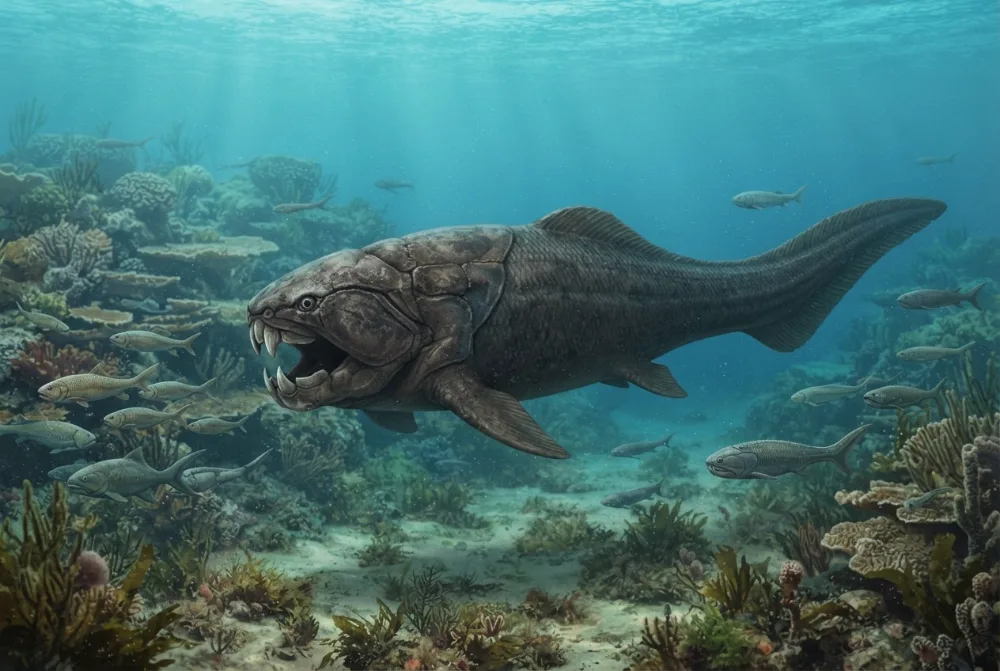
Dunkleosteus was a giant armoured fish that swam in the oceans about 382 to 358 million years ago. It had thick bone plates on its head and front body, and it was one of the first big predators in the sea. It wasn't a dinosaur, but it was super scary!1
Yaphila nini?
Yayinkulu kangakanani?
Yayinde kangakanani?
Yayinzima kangakanani?
 inde njengeemoto ezingama-2 zipakwe zilandelelana🍌inde njengeebhanana ezingama-56 zilandelelana
 inzima njengezinja ezingama-200🍉inzima njengamavatala angama-800🎒inzima njengamagumbi okufundela apheleleyo abantwana angama-5🐻❄️inzima njengeebhere ezimhlophe ezingama-9🏊ibinokuqubha ubude bechibi elikhulu lokuqubha (50 m) ngemizuzwana engama-7.2
Dunkleosteus wayemkhulu kangakanani xa ethelekiswa NAWE?
Yimathematika nje kwibhrawuza yakho. Akukho nto igcinwayo okanye ithunyelwe naphi na.
Yayikhawuleza kangakanani?


Iinyani ezimnandi
Dunkleosteus had a four-bar linkage in its skull that let it open its jaws in just 20 milliseconds, as fast as a blink!1
Its bite force was estimated at up to 7,495 newtons (about 1,685 pounds), which is among the highest of any fish ever.1
Instead of teeth, Dunkleosteus had sharp, blade-like bony plates in its jaws that could cut through armoured prey.1
Fossils of Dunkleosteus are often found with boluses of fish bones, which are the undigested remains of its last meals.1
The armour plates on its head and front body were up to 7.6 cm (3 inches) thick in some places, but thinner elsewhere.1
Dunkleosteus might have been a fast swimmer, not slow as once thought, because it could catch fast fish like Orodus.1
Eyona mibuzo ibuzwa kakhulu: Dunkleosteus
?How big was Dunkleosteus?
The largest known species, Dunkleosteus terrelli, was probably about 3.4 metres (11 feet) long for typical adults, and up to 4.1 metres (13 feet) for exceptionally large individuals. Some older estimates were much bigger, but recent studies suggest these smaller sizes.1
?Did Dunkleosteus have teeth?
No, instead of teeth it had sharp, blade-like bony plates in its jaws that could cut through armoured prey. These blades even sharpened themselves as the fish opened and closed its mouth.13
?What did Dunkleosteus eat?
It ate armoured prey like ammonites and other placoderms, and could even catch fast-swimming fish like Orodus. Fossils show it sometimes regurgitated bones from its last meal.1
?How fast could Dunkleosteus open its mouth?
It could open its jaws in just 20 milliseconds and complete a feeding snap in 50 to 60 milliseconds, which is as fast as a blink. This helped it catch fast prey.4
?Was Dunkleosteus a dinosaur?
No, it was a giant armoured fish that lived in the oceans during the Devonian Period, long before dinosaurs existed. It belonged to a group called placoderms.1
?How strong was Dunkleosteus' bite?
Its bite force was estimated at up to 7,495 newtons, which is among the highest of any fish ever. That is strong enough to puncture armour.14
?Where have Dunkleosteus fossils been found?
Fossils have been found in the United States, Canada, Poland, Belgium, Morocco, and Russia. The largest collection is at the Cleveland Museum of Natural History in Ohio.1
?When did Dunkleosteus live?
It lived during the Late Devonian Period, about 382 to 358 million years ago. That is before the first dinosaurs appeared.1
?Could Dunkleosteus swim fast?
Yes, it might have been a fast swimmer, not slow as once thought. It could catch fast-swimming fish like Orodus, which suggests it was quick.1
?Why did Dunkleosteus have armour?
Its thick bone plates on the head and front body protected it from other predators and helped it hunt armoured prey. The plates were up to 7.6 cm (3 inches) thick in some places.1
Inyaniso ngeentsomi
Intsomi: Dunkleosteus was a dinosaur.
Inyaniso: Dunkleosteus was not a dinosaur. It was a fish, specifically an arthrodire placoderm, and it lived long before the first dinosaurs.1
Kwiingcali zeedayinaso
- Igama lenzululwazi
- Dunkleosteus
- Inikwe igama ngu:
- Newberry 18745
- Iqela
- Amagorha amandulo
- Usapho / iclade
- Dunkleosteidae5
- Ukuhlelwa
- Placodermi > Phlyctaeniiformes > Dunkleosteidae5
- Ubudala bamatye
- 388 ukuya ku-359 izigidi zeminyaka (Givetian / Famennian)5
- Izakhiwo zamatye
- Ohio Shale, Lost Burro, Tērvete5
- Amazwe
- iUSA, iLatvia, iKhanada5
- Iirekhodi zeefosili
- 7 kwi-Paleobiology Database5
- Ukufunyanwa
- The first fossils were found in 1867 by Jay Terrell, an amateur paleontologist, near Lake Erie in Ohio, USA. The species was named Dunkleosteus terrelli in 1956, honouring both David Dunkle and Jay Terrell.1
- Kusaxoxwa ngayo
- Scientists still debate how Dunkleosteus fed. Some think it used suction to gulp prey, but a 2025 study suggests it actively bit and tore prey, and its bite force estimates might need to be revised.1
Apho iinyani zivela khona
- Dunkleosteus (en.wikipedia.org)
- PBDB Taxon (paleobiodb.org)
- Meet Dunk: Ohio’s Ancient Apex Predator (cmnh.org)
- Feeding mechanics and bite force modelling of the skull of Dunkleosteus terrelli , an ancient apex predator (pmc.ncbi.nlm.nih.gov)
- Dunkleosteus in The Paleobiology Database (CC BY 4.0): ubudala, iindawo, izakhiwo zamatye, ukuhlelwa.
Yonke inyani ekweli phepha inenombolo ebonisa umthombo wayo. Ukuba siphosisile, uxolo, sithanda iidayinaso, asiyojenali yenzululwazi. Sixelele apha: [email protected], siya kuyilungisa.
 URex ulambile! I-Dino Wiki yiprojekthi katata ukwenzela unyana wakhe othanda iidayinaso, isimahla, ayinazintengiso, ayinazilandeli. Abantu abadala banokuphakela uRex isidlwana ukuze incede ihlale kwi-intanethi.Phakela uRex
 Megalodon
 Sabre-toothed cat
 Dimetrodon
 Woolly mammoth
 Arthropleura
 Helicoprion