 Uyiyiphi idayinaso? Ikwizi
 Idabi leedayinaso
 Ugqatso lweedayinaso
 Imidlalo emincinci yeedayinaso
 I-albhamu yezitikha
 Iilisti ze-TOP zeedayinaso
 Ndothuse!
Haliskia
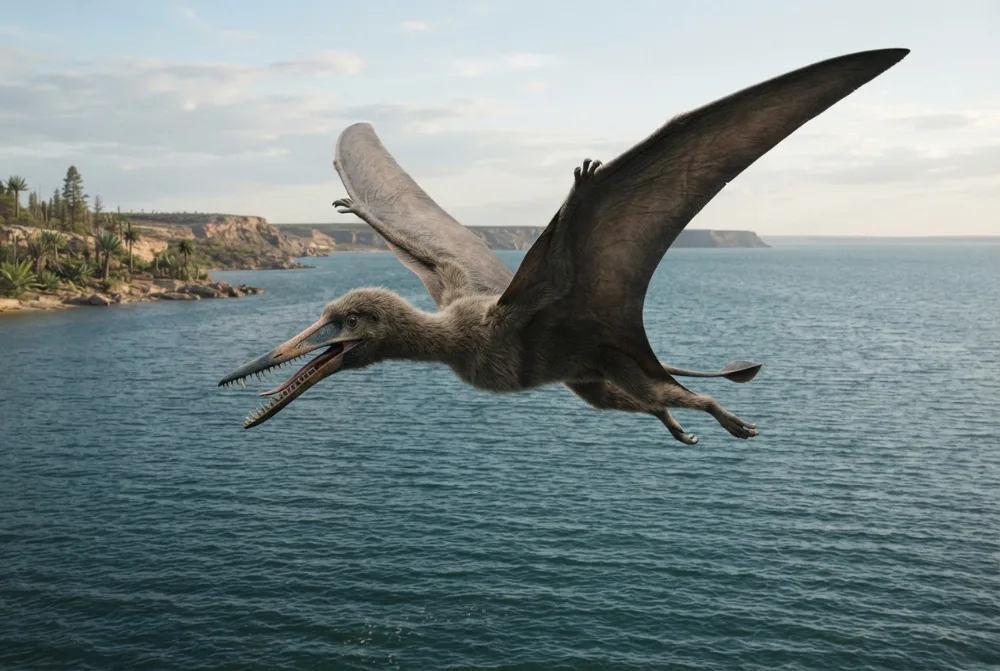
Haliskia was a flying reptile that soared over an ancient inland sea in Australia 100 million years ago. With a wingspan as wide as a car, it used its long, muscular tongue and curved teeth to catch slippery fish and squid. It is the most complete pterosaur skeleton ever found in Australia.12
Yaphila nini?
Yayinkulu kangakanani?
Amaphiko ayo ayebanzi kangakanani?
 amaphiko abanzi njengeebhayisikile ezingama-2.5 zilandelelana⚽ibinokubhabha inqumle ibala lebhola ekhatywayo lonke ngemizuzwana engama-5.7
Haliskia wayemkhulu kangakanani xa ethelekiswa NAWE?
Yimathematika nje kwibhrawuza yakho. Akukho nto igcinwayo okanye ithunyelwe naphi na.
Yayikhawuleza kangakanani?


Iinyani ezimnandi
Haliskia is 22% complete, more than twice as complete as any other partial pterosaur skeleton from Australia.2
Its hyoid bone (the tongue bone) is 70% as long as its lower jaw, the highest ratio of any pterosaur known. This means Haliskia had a very strong, muscular tongue.1
The fossil was found in 2021 by Kevin Petersen, a museum curator, at a site called Dig Site 3 near Richmond, Queensland.12
Haliskia lived during the Albian age, about 106 to 100 million years ago, when much of Queensland was covered by a shallow inland sea.31
Its teeth are curved and interlock when the mouth closes, forming a trap that stopped fish from wriggling out.1
Haliskia belongs to a group called Anhangueria, which were pterosaurs with crests on their snouts and teeth that stuck out sideways.1
Eyona mibuzo ibuzwa kakhulu: Haliskia
?How big was Haliskia?
About 4.6 metres (15 feet) across the wings, which is about as wide as a small car.12
?What did Haliskia eat?
It ate fish and soft-bodied animals like squid (cephalopods). Its curved, interlocking teeth formed a trap to stop slippery prey from escaping.12
?Is Haliskia a dinosaur?
No, it is a pterosaur, which is a flying reptile that lived at the same time as dinosaurs but is not a dinosaur.2
Kwiingcali zeedayinaso
- Igama lenzululwazi
- Haliskia
- Inikwe igama ngu:
- Pentland et al. 20244
- Iqela
- Izirhubuluzi ezibhabhayo
- Usapho / iclade
- Anhangueridae4
- Ukuhlelwa
- Pterosauria > Pterodactyloidea4
- Ubudala bamatye
- 106 ukuya ku-100 izigidi zeminyaka (Albian)4
- Izakhiwo zamatye
- Toolebuc4
- Amazwe
- i-Ostreliya4
- Iirekhodi zeefosili
- 1 kwi-Paleobiology Database4
- Ukufunyanwa
- Haliskia was discovered by Kevin Petersen, curator of Kronosaurus Korner museum, in November 2021 at a site in Queensland, Australia. It was named and described by Adele Pentland and colleagues in 2024.12
- Kusaxoxwa ngayo
- Scientists are not sure whether Haliskia ate only fish or also soft-bodied animals like squid. Its teeth have few wear marks, which could mean it ate soft prey, but its 'fish grab' teeth suggest it caught fish too.1
Apho iinyani zivela khona
- Haliskia peterseni, a new anhanguerian pterosaur from the late Early Cretaceous of Australia | Scientific Reports (nature.com)
- No bones about it: 100-million-year-old bones reveal new species of pterosaur | Curtin University (curtin.edu.au)
- PBDB Taxon (paleobiodb.org)
- Haliskia in The Paleobiology Database (CC BY 4.0): ubudala, iindawo, izakhiwo zamatye, ukuhlelwa.
Yonke inyani ekweli phepha inenombolo ebonisa umthombo wayo. Ukuba siphosisile, uxolo, sithanda iidayinaso, asiyojenali yenzululwazi. Sixelele apha: [email protected], siya kuyilungisa.
 URex ulambile! I-Dino Wiki yiprojekthi katata ukwenzela unyana wakhe othanda iidayinaso, isimahla, ayinazintengiso, ayinazilandeli. Abantu abadala banokuphakela uRex isidlwana ukuze incede ihlale kwi-intanethi.Phakela uRex
 Pteranodon
 Quetzalcoatlus
 Dorygnathus
 Rhamphorhynchus
 Anhanguera
 Pterodactylus
 Stegosaurus
 Iguanodon
 Archaeopteryx
 Giganotosaurus
 Microraptor
 Deinonychus