 Uyiyiphi idayinaso? Ikwizi
 Idabi leedayinaso
 Ugqatso lweedayinaso
 Imidlalo emincinci yeedayinaso
 I-albhamu yezitikha
 Iilisti ze-TOP zeedayinaso
 Ndothuse!
Hamipterus
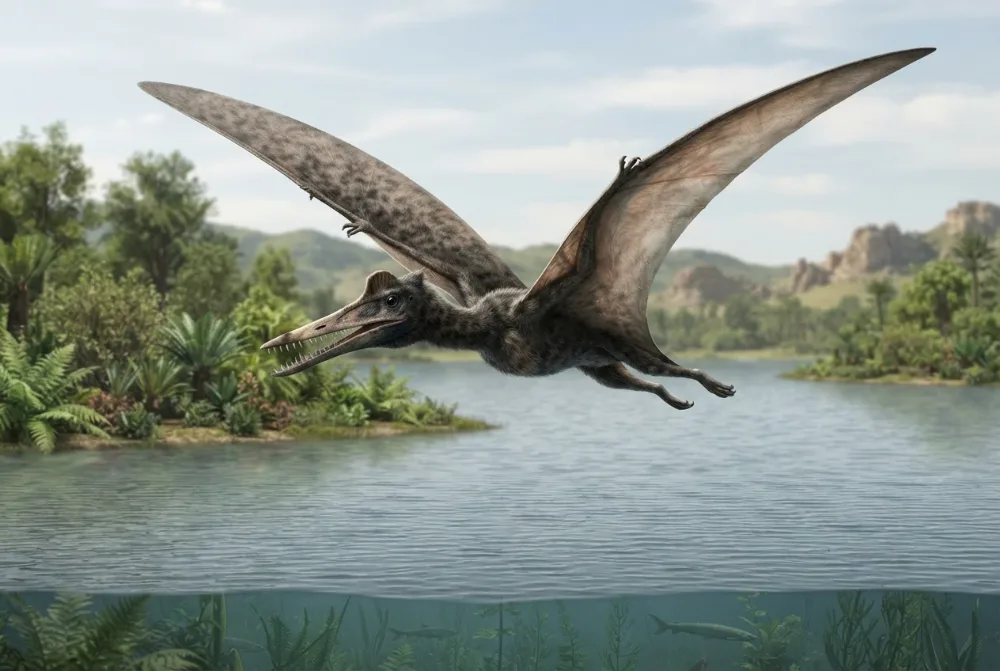
Hamipterus was a flying reptile with a wingspan as wide as a car! It lived in a big lake area in China and ate fish. Hundreds of Hamipterus fossils were found together, including eggs and soft parts like skin.12
Yaphila nini?
Yayinkulu kangakanani?
Amaphiko ayo ayebanzi kangakanani?
 amaphiko abanzi njengeebhayisikile ezingama-2 zilandelelana⚽ibinokubhabha inqumle ibala lebhola ekhatywayo lonke ngemizuzwana engama-6.4
Hamipterus wayemkhulu kangakanani xa ethelekiswa NAWE?
Yimathematika nje kwibhrawuza yakho. Akukho nto igcinwayo okanye ithunyelwe naphi na.
Yayikhawuleza kangakanani?


Iinyani ezimnandi
Hamipterus fossils were found in huge numbers, probably from a nesting colony that was buried by a storm. Over 40 individuals were collected, and there may have been hundreds.1
Unlike most pterosaurs, Hamipterus bones are three-dimensional and not squashed flat. Scientists even found the horny sheaths that covered its head crests.1
Five uncrushed eggs were found with the Hamipterus fossils. That is very rare for pterosaurs.1
Hamipterus had a hook-shaped bony process on the tip of its lower jaw, which scientists think helped it grab slippery fish.3
Male and female Hamipterus looked different. The paratype skull is thought to be from a male, while the holotype is probably a female.1
The tooth enamel of Hamipterus was very thin, only covering about half of each tooth crown.1
Eyona mibuzo ibuzwa kakhulu: Hamipterus
?How big was Hamipterus?
Hamipterus had a wingspan of 1.5 to 3.5 metres, which is about as wide as a small car.1
?Did Hamipterus have feathers?
No, Hamipterus was a pterosaur, a flying reptile, not a dinosaur. Pterosaurs did not have feathers; they had a fur-like covering called pycnofibers.1
?What did Hamipterus eat?
Hamipterus ate fish. It had a hook-shaped bony process on the tip of its lower jaw that helped it grab slippery fish.1
Kwiingcali zeedayinaso
- Igama lenzululwazi
- Hamipterus
- Inikwe igama ngu:
- Wang et al. 20144
- Iqela
- Izirhubuluzi ezibhabhayo
- Usapho / iclade
- Pteranodontoidea4
- Ukuhlelwa
- Pterosauria > Pterodactyloidea4
- Ubudala bamatye
- 137 ukuya ku-133 izigidi zeminyaka (Valanginian)4
- Izakhiwo zamatye
- Shengjinkou4
- Amazwe
- iTshayina4
- Iirekhodi zeefosili
- 4 kwi-Paleobiology Database4
- Ukufunyanwa
- Hamipterus was named in 2014 by Wang Xiaolin and a team of scientists. The fossils were found in the Hami region of Xinjiang, China, starting in 2006.1
- Kusaxoxwa ngayo
- Scientists are not sure exactly where Hamipterus fits in the pterosaur family tree. It may be close to Istiodactylus, Ludodactylus, or the Anhangueridae.1
Apho iinyani zivela khona
- Hamipterus (en.wikipedia.org)
- The first dinosaurs from the Early Cretaceous Hami Pterosaur Fauna, China (pmc.ncbi.nlm.nih.gov)
- PBDB Taxon (paleobiodb.org)
- Hamipterus in The Paleobiology Database (CC BY 4.0): ubudala, iindawo, izakhiwo zamatye, ukuhlelwa.
Yonke inyani ekweli phepha inenombolo ebonisa umthombo wayo. Ukuba siphosisile, uxolo, sithanda iidayinaso, asiyojenali yenzululwazi. Sixelele apha: [email protected], siya kuyilungisa.
 URex ulambile! I-Dino Wiki yiprojekthi katata ukwenzela unyana wakhe othanda iidayinaso, isimahla, ayinazintengiso, ayinazilandeli. Abantu abadala banokuphakela uRex isidlwana ukuze incede ihlale kwi-intanethi.Phakela uRex
 Pteranodon
 Quetzalcoatlus
 Dorygnathus
 Rhamphorhynchus
 Anhanguera
 Pterodactylus
 Stegosaurus
 Iguanodon
 Archaeopteryx
 Giganotosaurus
 Microraptor
 Deinonychus