 Uyiyiphi idayinaso? Ikwizi
 Idabi leedayinaso
 Ugqatso lweedayinaso
 Imidlalo emincinci yeedayinaso
 I-albhamu yezitikha
 Iilisti ze-TOP zeedayinaso
 Ndothuse!
Istiodactylus
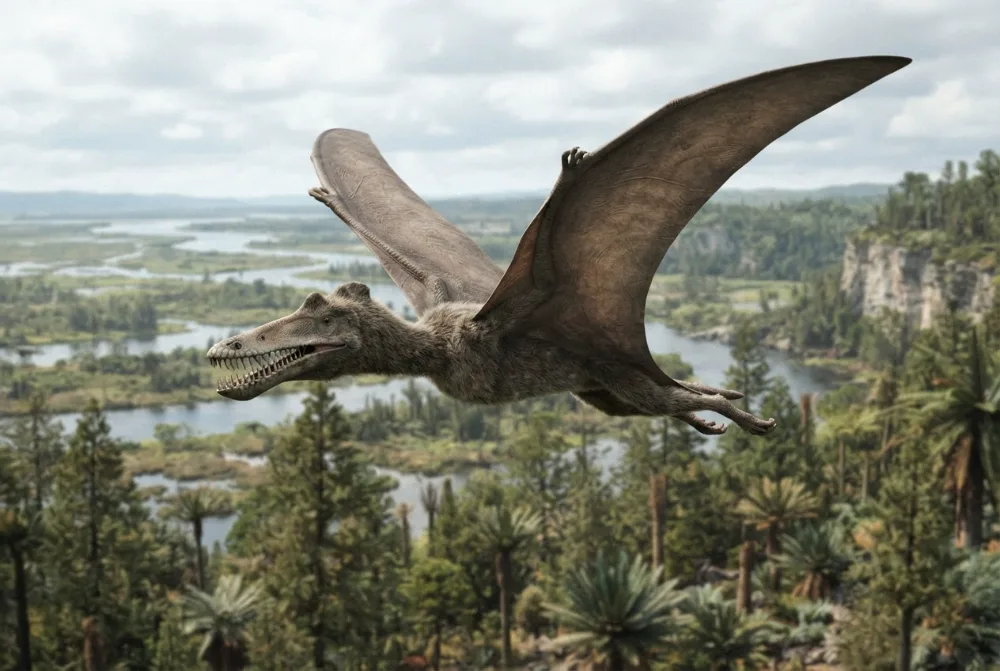
Istiodactylus was a flying reptile with a wide, blunt snout full of sharp, interlocking teeth. It lived about 120 million years ago and probably used its teeth like a cookie cutter to slice meat from big dead animals.12
Yaphila nini?
Yayinkulu kangakanani?
Amaphiko ayo ayebanzi kangakanani?
 amaphiko abanzi njengeebhayisikile ezingama-3 zilandelelana⚽ibinokubhabha inqumle ibala lebhola ekhatywayo lonke ngemizuzwana engama-5.5
Istiodactylus wayemkhulu kangakanani xa ethelekiswa NAWE?
Yimathematika nje kwibhrawuza yakho. Akukho nto igcinwayo okanye ithunyelwe naphi na.
Yayikhawuleza kangakanani?


Iinyani ezimnandi
Its skull was about 45 centimetres (18 inches) long and had a semicircle of 48 closely spaced, triangular teeth that interlocked to form a razor-edged outline.1
The lower jaw had a tooth-like projection that fit into the upper teeth, helping it bite cleanly.1
Some of its back vertebrae were fused into a structure called a notarium, which helped support its large wings.1
Its hindlimbs were very short, while its forelimbs and wing-finger were huge, making it a soaring specialist.1
For much of the 20th century, it was the only pterosaur known from three-dimensionally preserved fossils, giving scientists a rare look at pterosaur anatomy.12
Its teeth were unlike the long, curved fish-grabbing teeth of other pterosaurs, so scientists think it did not catch fish but instead scavenged.2
It lived in river and coastal environments in southern England, where the climate was warm, about 20 to 25 °C (68 to 77 °F).1
Eyona mibuzo ibuzwa kakhulu: Istiodactylus
?How big was Istiodactylus?
Its wingspan was about 4.3 to 5 metres. Its skull was about 45 centimetres long.12
?What did Istiodactylus eat?
It was a scavenger. It used its sharp, interlocking teeth like a cookie cutter to slice meat from dead animals.12
?Was Istiodactylus a dinosaur?
No, it was a pterosaur, a flying reptile that lived at the same time as dinosaurs but is not a dinosaur.1
?Could Istiodactylus fly?
Yes, it was a flying reptile with large wings. It may have been a soaring specialist, gliding long distances to find food.1
Inyaniso ngeentsomi
Intsomi: Some people think Istiodactylus was a dinosaur because it lived with dinosaurs and had sharp teeth.
Inyaniso: Istiodactylus was a pterosaur, a flying reptile, not a dinosaur. Pterosaurs are a separate group of reptiles.1
Kwiingcali zeedayinaso
- Igama lenzululwazi
- Istiodactylus
- Inikwe igama ngu:
- Howse et al. 20013
- Iqela
- Izirhubuluzi ezibhabhayo
- Usapho / iclade
- Ornithocheiroidea3
- Ukuhlelwa
- Pterosauria > Pterodactyloidea3
- Ubudala bamatye
- 126 ukuya ku-120 izigidi zeminyaka (Barremian / Aptian)3
- Izakhiwo zamatye
- Wessex, Vectis, Yixian3
- Amazwe
- iUnited Kingdom, iTshayina3
- Iirekhodi zeefosili
- 6 kwi-Paleobiology Database3
- Ukufunyanwa
- The first fossil was found on the Isle of Wight in 1887, and in 1901 it was named Ornithodesmus latidens. In 2001, scientists moved it to its own genus, Istiodactylus.1
- Kusaxoxwa ngayo
- Scientists debate whether the Chinese species Istiodactylus sinensis really belongs to this genus or to a different one, and whether it is the same as another pterosaur called Longchengpterus.1
Apho iinyani zivela khona
- Istiodactylus (en.wikipedia.org)
- New Insights into the Skull of Istiodactylus latidens (Ornithocheiroidea, Pterodactyloidea) | PLOS One (journals.plos.org)
- Istiodactylus in The Paleobiology Database (CC BY 4.0): ubudala, iindawo, izakhiwo zamatye, ukuhlelwa.
Yonke inyani ekweli phepha inenombolo ebonisa umthombo wayo. Ukuba siphosisile, uxolo, sithanda iidayinaso, asiyojenali yenzululwazi. Sixelele apha: [email protected], siya kuyilungisa.
 URex ulambile! I-Dino Wiki yiprojekthi katata ukwenzela unyana wakhe othanda iidayinaso, isimahla, ayinazintengiso, ayinazilandeli. Abantu abadala banokuphakela uRex isidlwana ukuze incede ihlale kwi-intanethi.Phakela uRex
 Pteranodon
 Quetzalcoatlus
 Dorygnathus
 Rhamphorhynchus
 Anhanguera
 Pterodactylus
 Stegosaurus
 Iguanodon
 Archaeopteryx
 Giganotosaurus
 Microraptor
 Deinonychus