 Uyiyiphi idayinaso? Ikwizi
 Idabi leedayinaso
 Ugqatso lweedayinaso
 Imidlalo emincinci yeedayinaso
 I-albhamu yezitikha
 Iilisti ze-TOP zeedayinaso
 Ndothuse!
Ornithodesmus
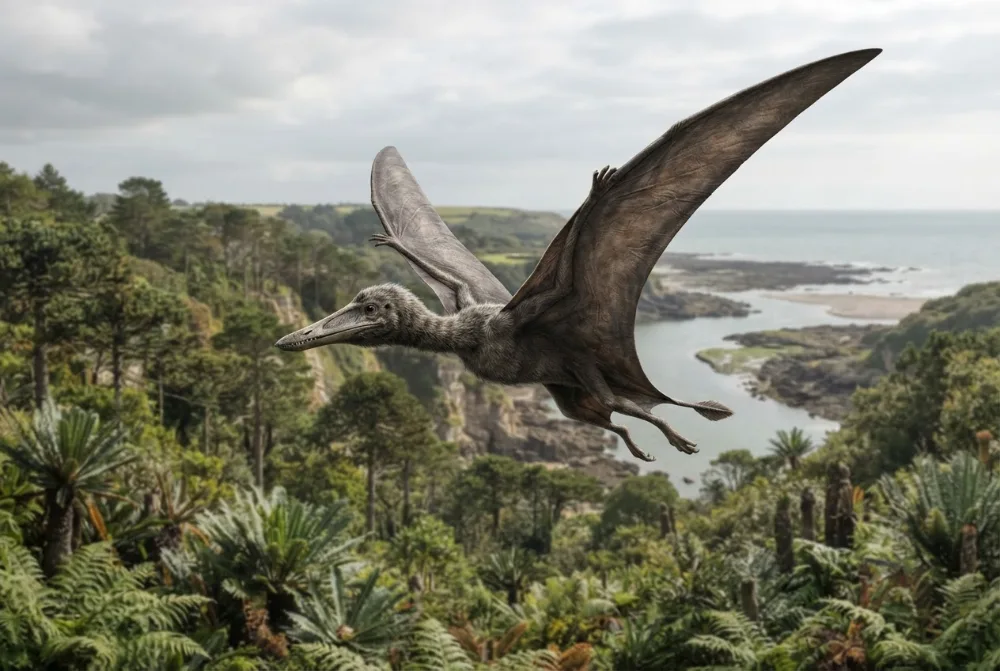
Ornithodesmus was a flying reptile that lived about 125 million years ago. It was once thought to be a bird, but scientists now know it was a pterosaur. It soared over the floodplains of what is now the Isle of Wight in England.1
Yaphila nini?
Yayinkulu kangakanani?
Yayinde kangakanani?
 inde njengeekati zasekhaya ezingama-4, impumlo ukuya emsileni🍌inde njengeebhanana ezingama-10 zilandelelana⚽ibinokubhabha inqumle ibala lebhola ekhatywayo lonke ngemizuzwana engama-5.3
Ornithodesmus wayemkhulu kangakanani xa ethelekiswa NAWE?
Yimathematika nje kwibhrawuza yakho. Akukho nto igcinwayo okanye ithunyelwe naphi na.
Yayikhawuleza kangakanani?


Iinyani ezimnandi
Ornithodesmus was first described in 1887 by Harry Govier Seeley, who thought it was a bird because of its bird-like hip bones.1
The only known fossil of Ornithodesmus is a set of six fused vertebrae from the hip, called a sacrum.1
For many years, scientists mistakenly thought Ornithodesmus was a pterosaur, and other pterosaur fossils were given the same name. Those fossils were later renamed Istiodactylus in 2001.1
The name Ornithodesmus comes from Greek words meaning 'bird link', because Seeley thought it was a link between birds and dinosaurs.1
The species name cluniculus means 'little buttock' in Latin, a reference to the small thigh muscles suggested by the fossil.1
Ornithodesmus lived during the Early Cretaceous period, about 125 million years ago, in a floodplain environment with rivers and lakes.1
Eyona mibuzo ibuzwa kakhulu: Ornithodesmus
?Is Ornithodesmus a dinosaur?
No, Ornithodesmus is a pterosaur, which is a flying reptile and not a dinosaur. While some fossils were once confused with dromaeosaurid dinosaurs, it is now classified as an azhdarchoid pterosaur.1
?How big was Ornithodesmus?
Ornithodesmus was small, with a total body length of about 1.5 to 1.8 metres. That is roughly the size of a large dog.1
?What did Ornithodesmus eat?
Nobody knows for sure what Ornithodesmus ate, but as an azhdarchoid pterosaur, it likely fed on small animals or insects. Previous associations with dromaeosaurid teeth were based on misidentifications.1
?When did Ornithodesmus live?
Ornithodesmus lived about 125 million years ago, during the Early Cretaceous period. It lived in a floodplain environment with rivers and lakes on what is now the Isle of Wight in England.1
Inyaniso ngeentsomi
Intsomi: Ornithodesmus was a bird.
Inyaniso: Ornithodesmus was actually a pterosaur, a flying reptile, not a bird. The confusion happened because its hip bones looked bird-like.1
Kwiingcali zeedayinaso
- Igama lenzululwazi
- Ornithodesmus
- Inikwe igama ngu:
- Seeley 18872
- Iqela
- Izirhubuluzi ezibhabhayo
- Usapho / iclade
- Ornithocheiroidea2
- Ukuhlelwa
- Pterosauria > Pterodactyloidea2
- Ubudala bamatye
- 137 ukuya ku-121 izigidi zeminyaka (Valanginian / Barremian)2
- Izakhiwo zamatye
- Wadhurst Clay, Wessex2
- Amazwe
- iUnited Kingdom2
- Iirekhodi zeefosili
- 2 kwi-Paleobiology Database2
- Ukufunyanwa
- Ornithodesmus was named by Harry Govier Seeley in 1887 based on a fossil sacrum found by Reverend William Fox in Brook Bay, Isle of Wight, England.1
- Kusaxoxwa ngayo
- Scientists are still unsure exactly what type of pterosaur Ornithodesmus was, because the only known fossil is a small piece of the hip.1
Apho iinyani zivela khona
- Ornithodesmus (en.wikipedia.org)
- Ornithodesmus in The Paleobiology Database (CC BY 4.0): ubudala, iindawo, izakhiwo zamatye, ukuhlelwa.
Yonke inyani ekweli phepha inenombolo ebonisa umthombo wayo. Ukuba siphosisile, uxolo, sithanda iidayinaso, asiyojenali yenzululwazi. Sixelele apha: [email protected], siya kuyilungisa.
 URex ulambile! I-Dino Wiki yiprojekthi katata ukwenzela unyana wakhe othanda iidayinaso, isimahla, ayinazintengiso, ayinazilandeli. Abantu abadala banokuphakela uRex isidlwana ukuze incede ihlale kwi-intanethi.Phakela uRex
 Pteranodon
 Quetzalcoatlus
 Dorygnathus
 Rhamphorhynchus
 Anhanguera
 Pterodactylus
 Stegosaurus
 Iguanodon
 Archaeopteryx
 Giganotosaurus
 Microraptor
 Deinonychus