 Uyiyiphi idayinaso? Ikwizi
 Idabi leedayinaso
 Ugqatso lweedayinaso
 Imidlalo emincinci yeedayinaso
 I-albhamu yezitikha
 Iilisti ze-TOP zeedayinaso
 Ndothuse!
Yaphila nini?

Yayinkulu kangakanani?
Yayinde kangakanani?
Yayiphakame kangakanani?
uqikelelo
Yayinzima kangakanani?
 inde njengeekati zasekhaya ezingama-3, impumlo ukuya emsileni🍌inde njengeebhanana ezingama-8 zilandelelanamalunga nobunzima bekati yasekhaya🍌inzima njengeebhanana ezingama-42🏃ibinokubaleka iimitha ezili-100 ngemizuzwana engama-12 (oyena mntu ukhawulezayo udinga i-9,6)
Shanag wayemkhulu kangakanani xa ethelekiswa NAWE?
Yimathematika nje kwibhrawuza yakho. Akukho nto igcinwayo okanye ithunyelwe naphi na.
Yayikhawuleza kangakanani?


Iinyani ezimnandi
Shanag is known from only a partial skull: a right maxilla (upper jaw bone), dentary (lower jaw bone), and part of the splenial (a jaw bone).2
It was a dromaeosaurid, meaning it was a close relative of famous raptors like Velociraptor and Deinonychus.2
Shanag had special air pockets inside its jawbone between the tooth sockets, called interalveolar pneumatic cavities.2
Unlike many other theropods, Shanag lacked a promaxillary fenestra, a small opening in the front of the snout.2
Shanag lived alongside Psittacosaurus, a small horned dinosaur, and large sauropods in the Öösh region.1
The fossils of Shanag were found in rocks that are about 130 million years old, from the Early Cretaceous period.1
Eyona mibuzo ibuzwa kakhulu: Shanag
?How big was Shanag?
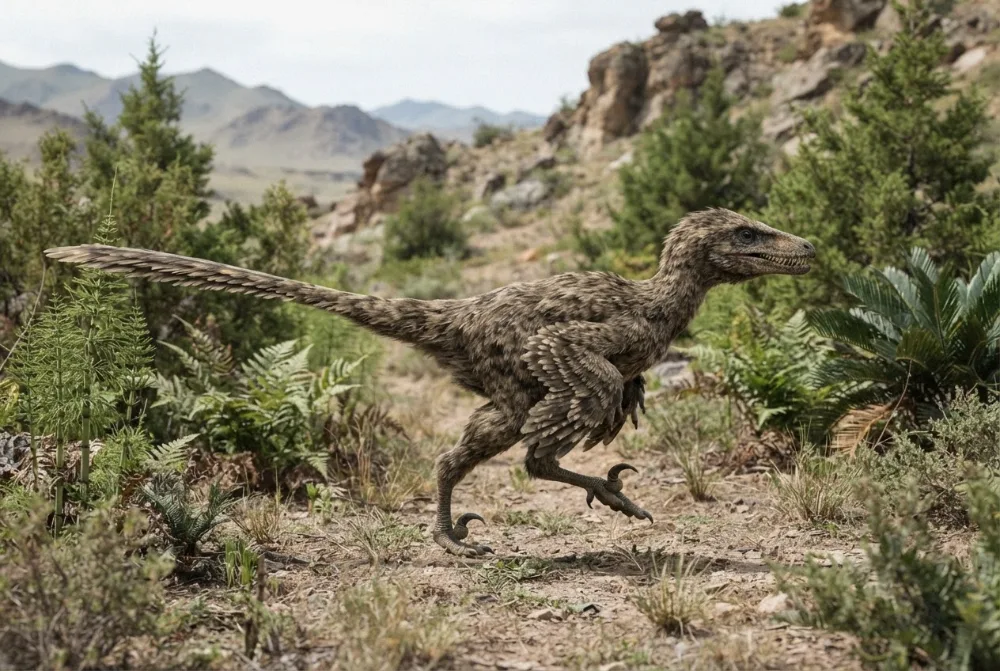
Shanag was a small predator, about 1.5 metres (4.9 feet) long and weighing around 5 kilograms (11 pounds).3
?Did Shanag have feathers?
Yes, as a theropod, Shanag had hollow bones and feathers. Its feathers helped with climbing, thermoregulation, and stabilizing while on prey.3
?What did Shanag eat?
Shanag was a meat-eating dinosaur with sharp teeth and claws. It likely used its claws to grip and pin down prey, similar to modern birds of prey.3
?Is Shanag a dromaeosaurid?
It may be a dromaeosaurid, but some researchers are skeptical. It shows a mix of dromaeosaurid, troodontid, and basal avialan traits, so its exact classification is debated.3
Kwiingcali zeedayinaso
- Igama lenzululwazi
- Shanag
- Inikwe igama ngu:
- Turner et al. 20074
- Iqela
- Iirapta
- Usapho / iclade
- Dromaeosauridae4
- Ukuhlelwa
- Theropoda > Dromaeosauridae4
- Ubudala bamatye
- 143 ukuya ku-100 izigidi zeminyaka (Berriasian / Albian)4
- Izakhiwo zamatye
- Öösh4
- Amazwe
- iMongolia4
- Iirekhodi zeefosili
- 1 kwi-Paleobiology Database4
- Ukufunyanwa
- Shanag was named in 2007 by Alan H. Turner, Sunny H. Hwang, and Mark A. Norell. The only known fossil was found by a Mongolian Academy of Sciences,American Museum of Natural History expedition in 1999 at the Öösh locality in Mongolia.21
- Kusaxoxwa ngayo
- Scientists are unsure about the exact size of Shanag because only a partial skull has been found.2
Apho iinyani zivela khona
- digitallibrary.amnh.org (digitallibrary.amnh.org)
- A small derived theropod from Öösh, early Cretaceous, Baykhangor Mongolia ; American Museum novitates, no. 3557 (digitallibrary.amnh.org)
- Shanag (en.wikipedia.org)
- Shanag in The Paleobiology Database (CC BY 4.0): ubudala, iindawo, izakhiwo zamatye, ukuhlelwa.
Yonke inyani ekweli phepha inenombolo ebonisa umthombo wayo. Ukuba siphosisile, uxolo, sithanda iidayinaso, asiyojenali yenzululwazi. Sixelele apha: [email protected], siya kuyilungisa.
 URex ulambile! I-Dino Wiki yiprojekthi katata ukwenzela unyana wakhe othanda iidayinaso, isimahla, ayinazintengiso, ayinazilandeli. Abantu abadala banokuphakela uRex isidlwana ukuze incede ihlale kwi-intanethi.Phakela uRex
 Velociraptor
 Microraptor
 Deinonychus
 Asiamericana
 Richardoestesia
 Saurornitholestes
 Stegosaurus
 Iguanodon
 Archaeopteryx
 Giganotosaurus
 Baryonyx
 Paronychodon