 Uyiyiphi idayinaso? Ikwizi
 Idabi leedayinaso
 Ugqatso lweedayinaso
 Imidlalo emincinci yeedayinaso
 I-albhamu yezitikha
 Iilisti ze-TOP zeedayinaso
 Ndothuse!
Tatenectes
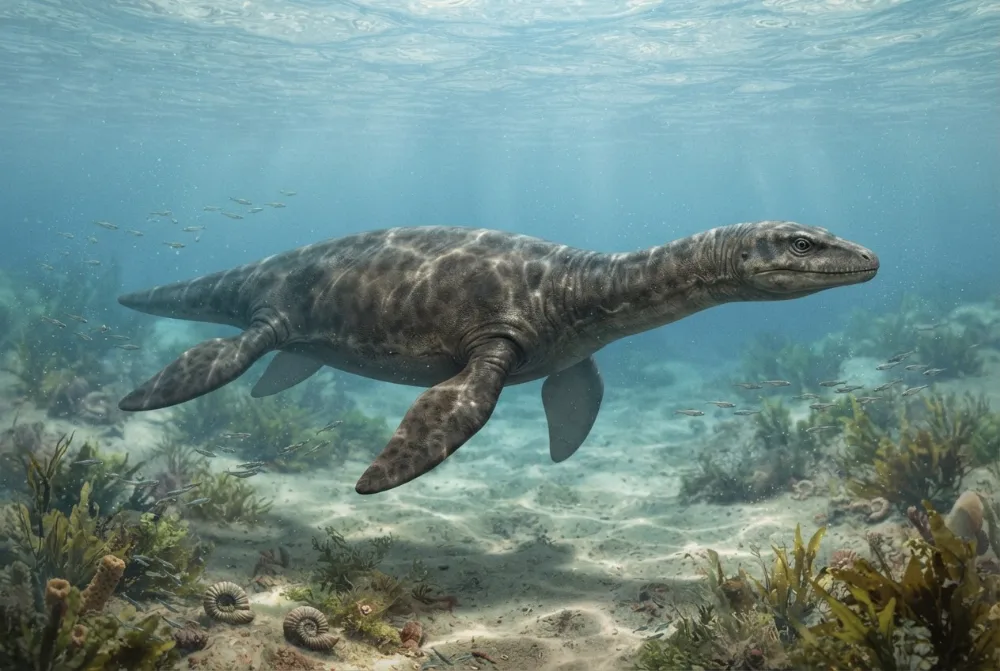
Tatenectes was a small plesiosaur that lived in a shallow sea that covered much of North America during the Jurassic Period. It had a flattened, boxy body and a long neck, and it swam using four flippers like paddles.1
Yaphila nini?
Yayinkulu kangakanani?
Yayinde kangakanani?
 inde njengezinja ezingama-3, impumlo ukuya emsileni🍌inde njengeebhanana ezingama-17 zilandelelana🏊ibinokuqubha ubude bechibi elikhulu lokuqubha (50 m) ngemizuzwana engama-6.4
Tatenectes wayemkhulu kangakanani xa ethelekiswa NAWE?
Yimathematika nje kwibhrawuza yakho. Akukho nto igcinwayo okanye ithunyelwe naphi na.
Yayikhawuleza kangakanani?


Iinyani ezimnandi
Tatenectes had a very unusual body shape for a plesiosaur: its torso was flattened and boxy, and its belly ribs were thickened, which helped it stay stable in turbulent water.1
The first fossil of Tatenectes was described in 1900 by Wilbur Clinton Knight, who thought it was a species of Cimoliosaurus. That original specimen has since been lost.1
Tatenectes lived in the Sundance Sea, a shallow inland sea that was less than 40 meters (130 feet) deep and covered parts of western North America during the Jurassic.1
Its teeth were small and thin, with long roots and low enamel ridges, perfect for catching slippery prey like fish and squid.1
Tatenectes shared its sea home with other marine reptiles, including the plesiosaur Pantosaurus and the large pliosaur Megalneusaurus.1
Scientists think Tatenectes could have used lung deflation to help it dive, just like some modern sea turtles do.1
Kwiingcali zeedayinaso
- Igama lenzululwazi
- Tatenectes
- Inikwe igama ngu:
- O'Keefe and Wahl 20033
- Iqela
- Iiplesiosauri
- Usapho / iclade
- Cryptoclididae3
- Ukuhlelwa
- Plesiosauria > Sauropterygia3
- Ubudala bamatye
- 162 ukuya ku-155 izigidi zeminyaka (Oxfordian)3
- Izakhiwo zamatye
- Sundance3
- Amazwe
- iUSA3
- Iirekhodi zeefosili
- 3 kwi-Paleobiology Database3
- Ukufunyanwa
- The first fossil was described by Wilbur Clinton Knight in 1900 as a new species of Cimoliosaurus. In 2003, F. Robin O'Keefe and William Wahl Jr. gave it its own genus, Tatenectes, based on a new specimen found in Wyoming.12
- Kusaxoxwa ngayo
- Scientists are still debating whether the gastroliths (stomach stones) found in plesiosaurs like Tatenectes were used for ballast, digestion, or something else.1
Apho iinyani zivela khona
- Tatenectes (en.wikipedia.org)
- "Preliminary Report on the Osteology and Relationships of a New Aberran" by F. Robin O’Keefe and William Wahl Jr. (mds.marshall.edu)
- Tatenectes in The Paleobiology Database (CC BY 4.0): ubudala, iindawo, izakhiwo zamatye, ukuhlelwa.
Yonke inyani ekweli phepha inenombolo ebonisa umthombo wayo. Ukuba siphosisile, uxolo, sithanda iidayinaso, asiyojenali yenzululwazi. Sixelele apha: [email protected], siya kuyilungisa.
 URex ulambile! I-Dino Wiki yiprojekthi katata ukwenzela unyana wakhe othanda iidayinaso, isimahla, ayinazintengiso, ayinazilandeli. Abantu abadala banokuphakela uRex isidlwana ukuze incede ihlale kwi-intanethi.Phakela uRex
 Elasmosaurus
 Pliosaurus
 Plesiosaurus
 Cimoliasaurus
 Colymbosaurus
 Trinacromerum
 Brachiosaurus
 Diplodocus
 Allosaurus
 Brontosaurus
 Compsognathus
 Camarasaurus