 Uyiyiphi idayinaso? Ikwizi
 Idabi leedayinaso
 Ugqatso lweedayinaso
 Imidlalo emincinci yeedayinaso
 I-albhamu yezitikha
 Iilisti ze-TOP zeedayinaso
 Ndothuse!
Utahraptor
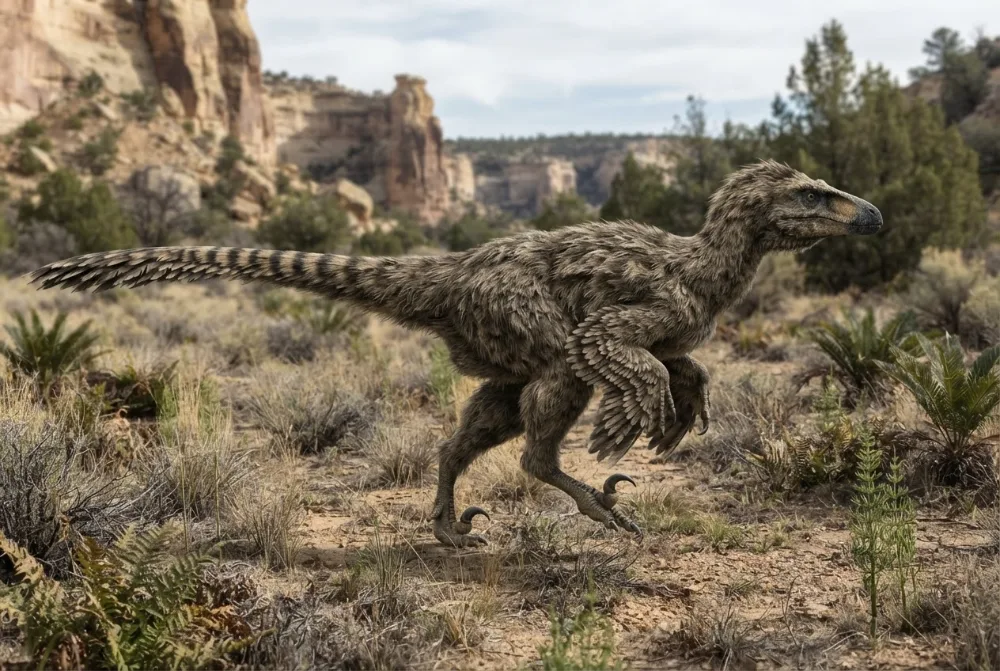
Utahraptor was a huge, feathered hunter that lived in what is now Utah, USA. It was the biggest member of the raptor family, much larger than the Velociraptor you see in movies. With a giant sickle claw on each foot, it was a fierce predator that could take down big plant-eaters.12
Yaphila nini?
Yayinkulu kangakanani?
Yayinde kangakanani?
Yayiphakame kangakanani?
Yayinzima kangakanani?
 inde njengezinja ezingama-6, impumlo ukuya emsileni🍌inde njengeebhanana ezingama-34 zilandelelana🍉inzima njengamavatala angama-70🧸inzima njengabantwana basenkulisa abangama-18🎒inzima njengabantwana besikolo abangama-11🏃ibinokubaleka iimitha ezili-100 ngemizuzwana engama-8 (oyena mntu ukhawulezayo udinga i-9,6)
Utahraptor wayemkhulu kangakanani xa ethelekiswa NAWE?
Yimathematika nje kwibhrawuza yakho. Akukho nto igcinwayo okanye ithunyelwe naphi na.
Yayikhawuleza kangakanani?


Iinyani ezimnandi
Utahraptor's sickle claw was 24 centimeters (9.5 inches) long, perfect for slashing at prey.2
It lived during the Early Cretaceous period, about 139 to 135 million years ago, making it one of the oldest known dromaeosaurs.12
Utahraptor was the inspiration for the Velociraptors in the movie Jurassic Park, even though real Velociraptor was much smaller.2
In 2018, Utahraptor became the official state dinosaur of Utah after a 10-year-old student asked the state senate.1
Scientists think Utahraptor was not very fast and may have ambushed its prey, using its bulk and claws.1
Although no direct fossils of feathers have been found, scientists believe Utahraptor almost certainly had feathers, like other dromaeosaurs.1
Eyona mibuzo ibuzwa kakhulu: Utahraptor
?How big was Utahraptor?
Utahraptor was about 6 to 7 metres (20 to 23 feet) long and weighed around 500 kilograms (1,100 pounds), about the size of a polar bear.31
?Did Utahraptor have feathers?
Yes, scientists believe Utahraptor almost certainly had feathers, because other dromaeosaurs had them, even though no direct feather fossils have been found yet.31
?What did Utahraptor eat?
Utahraptor was a carnivore that ate other animals, including large plant-eating dinosaurs like iguanodonts and ankylosaurs.31
?How fast could Utahraptor run?
Utahraptor was not very fast. It was an ambush hunter that used its bulk and claws to surprise prey, not speed.31
?Was Utahraptor bigger than Velociraptor?
Yes, Utahraptor was much bigger than Velociraptor. It was the largest known member of the raptor family, while Velociraptor was only about the size of a turkey.31
?When did Utahraptor live?
Utahraptor lived during the Early Cretaceous period, about 139 to 135 million years ago.31
?Where was Utahraptor found?
All known Utahraptor fossils come from Utah in the United States, especially from the Cedar Mountain Formation near Arches National Park.31
?How long was Utahraptor's claw?
Utahraptor's sickle claw on its second toe was about 24 centimetres (9.4 inches) long.31
Inyaniso ngeentsomi
Intsomi: Utahraptor was a fast runner like smaller raptors.
Inyaniso: Utahraptor was heavy and bulky, and scientists think it was not very fast. It probably used ambush hunting instead of chasing prey.1
Kwiingcali zeedayinaso
- Igama lenzululwazi
- Utahraptor
- Inikwe igama ngu:
- Kirkland et al. 19935
- Iqela
- Iirapta
- Usapho / iclade
- Dromaeosauridae5
- Ukuhlelwa
- Theropoda > Dromaeosauridae5
- Ubudala bamatye
- 137 ukuya ku-133 izigidi zeminyaka (Valanginian)5
- Izakhiwo zamatye
- Cedar Mountain5
- Amazwe
- iUSA5
- Iirekhodi zeefosili
- 4 kwi-Paleobiology Database5
- Ukufunyanwa
- The first Utahraptor fossils were found by Jim Jensen in 1975, but the dinosaur was not studied until 1991 when James Kirkland, Robert Gaston and Donald Burge found more remains. It was named in 1993.1
- Kusaxoxwa ngayo
- Scientists are not sure if Utahraptor had feathers, because no direct feather fossils have been found, but most think it did.1
Apho iinyani zivela khona
- Utahraptor | Natural History Museum (nhm.ac.uk)
- Utahraptor ostrommaysorum (nhmu.utah.edu)
- Utahraptor (en.wikipedia.org)
- Utahraptor Megablock Fossil Project - Utah Geological Survey (geology.utah.gov)
- Utahraptor in The Paleobiology Database (CC BY 4.0): ubudala, iindawo, izakhiwo zamatye, ukuhlelwa.
Yonke inyani ekweli phepha inenombolo ebonisa umthombo wayo. Ukuba siphosisile, uxolo, sithanda iidayinaso, asiyojenali yenzululwazi. Sixelele apha: [email protected], siya kuyilungisa.
 URex ulambile! I-Dino Wiki yiprojekthi katata ukwenzela unyana wakhe othanda iidayinaso, isimahla, ayinazintengiso, ayinazilandeli. Abantu abadala banokuphakela uRex isidlwana ukuze incede ihlale kwi-intanethi.Phakela uRex
 Velociraptor
 Microraptor
 Deinonychus
 Asiamericana
 Richardoestesia
 Saurornitholestes
 Stegosaurus
 Iguanodon
 Archaeopteryx
 Giganotosaurus
 Baryonyx
 Paronychodon