 Woyɛ dino bɛn? Nsɛmmisa agoro
 Dino ko
 Dino mmirikatuo
 Dino agodie nketewa
 Stika nwoma
 Dino TOP nhyehyɛeɛ
 Ma me nwanwa!
Avalonnectes
Avalonnectes was a small, early plesiosaur that swam in the seas near what is now England, about 200 million years ago. It had a short body and four flippers, and it was one of the very first plesiosaurs to appear after the Triassic,Jurassic extinction.1
Berɛ bɛn na ɛtenaa ase?
Na ɛyɛ ntɛm sɛn?


Nsɛm a ɛyɛ anigye
Avalonnectes had only 18 or 19 dorsal vertebrae, which is a very low number for a plesiosaur.1
Its skull was only about 180 mm long, making it one of the smallest plesiosaurs of its time.1
Avalonnectes lived in the earliest Jurassic, just after the Triassic,Jurassic extinction event, about 199.6 to 198 million years ago.3
The name Avalonnectes comes from Avalon, the legendary island of King Arthur, which is linked to Glastonbury near where the fossils were found.1
Avalonnectes is known from two partial skeletons, including the holotype NHMUK 14550, which has part of the skull and much of the body.3
It belonged to a group called Rhomaleosauridae, which were early plesiosaurs with short necks and large heads.2
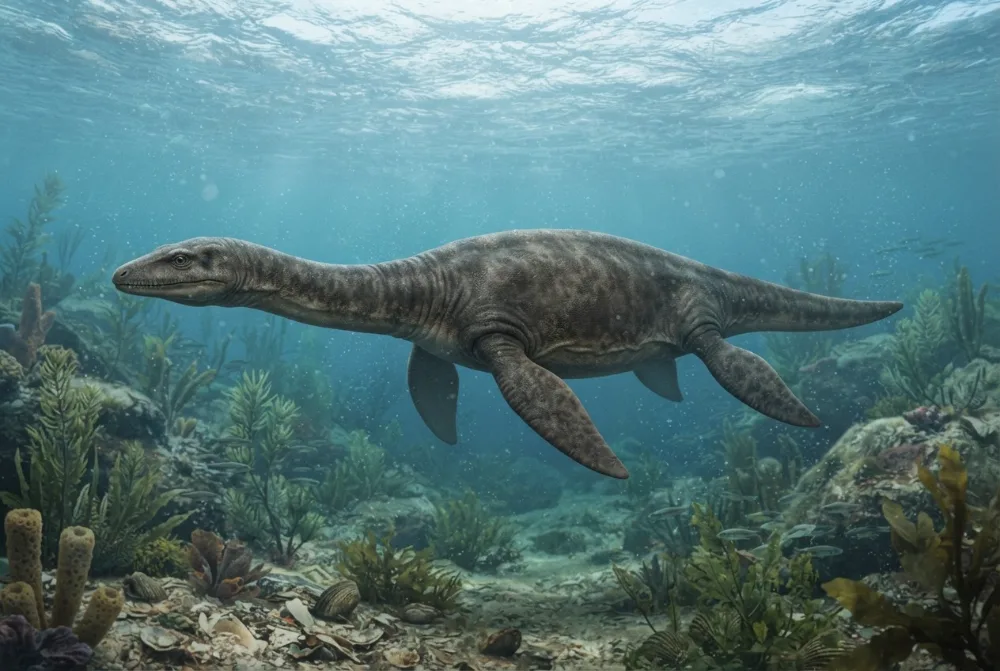
Ma dino ho animdefoɔ
- Nyansahu din
- Avalonnectes
- Obi a ɔtoo din
- Benson et al. 20124
- Kuo
- Plesiosɔɔ
- Abusua / kuo kɛseɛ
- Rhomaleosauridae4
- Nkyekyɛmu
- Plesiosauria > Sauropterygia4
- Abotan no mfeɛ
- mfeɛ ɔpepem 201 kɔsi 200 (Hettangian)4
- Abotan nhyehyɛeɛ
- Blue Lias4
- Aman
- Engiresi4
- Fɔsil nkyerɛwee
- 1 wɔ The Paleobiology Database mu4
- Nhunumu
- Avalonnectes was named in 2012 by Roger Benson and colleagues based on fossils collected in the 19th century from Street, Somerset, England. The species name arturi honors Arthur Cruickshank, a scientist who studied early plesiosaurs.1
Baabi a nsɛm no firi
- High Diversity, Low Disparity and Small Body Size in Plesiosaurs (Reptilia, Sauropterygia) from the Triassic, Jurassic Boundary | PLOS One (journals.plos.org)
- PBDB Taxon (paleobiodb.org)
- Avalonnectes (en.wikipedia.org)
- Avalonnectes in The Paleobiology Database (CC BY 4.0): mfeɛ, mmeaeɛ, abotan nhyehyɛeɛ, nkyekyɛmu.
Asɛm biara a ɛwɔ krataafa yi so wɔ nɔma a ɛkyerɛ baabi a ɛfiri. Sɛ yɛfom biribi a, kafra, yɛyɛ dino dɔfoɔ, yɛnyɛ nyansahu nsɛmma krataa. Ka kyerɛ yɛn wɔ [email protected] na yɛbɛsiesie.
 Ɔkɔm de Rex! Dino Wiki yɛ agya bi adwuma a ɔyɛɛ maa ne babarima a ɔdɔ dino. Ɛyɛ kwa, dawurubɔ biara nni mu, akyidifoɔ biara nni mu. Mpanimfoɔ bɛtumi ama Rex aduane kakra, na aboa ama Dino Wiki atena intanɛt so.Ma Rex aduane
 Elasmosaurus
 Pliosaurus
 Plesiosaurus
 Cimoliasaurus
 Colymbosaurus
 Trinacromerum
 Dilophosaurus
 Stenopterygius
 Dorygnathus
 Lufengosaurus
 Scutellosaurus
 Yunnanosaurus