 Woyɛ dino bɛn? Nsɛmmisa agoro
 Dino ko
 Dino mmirikatuo
 Dino agodie nketewa
 Stika nwoma
 Dino TOP nhyehyɛeɛ
 Ma me nwanwa!
Bohaiornis
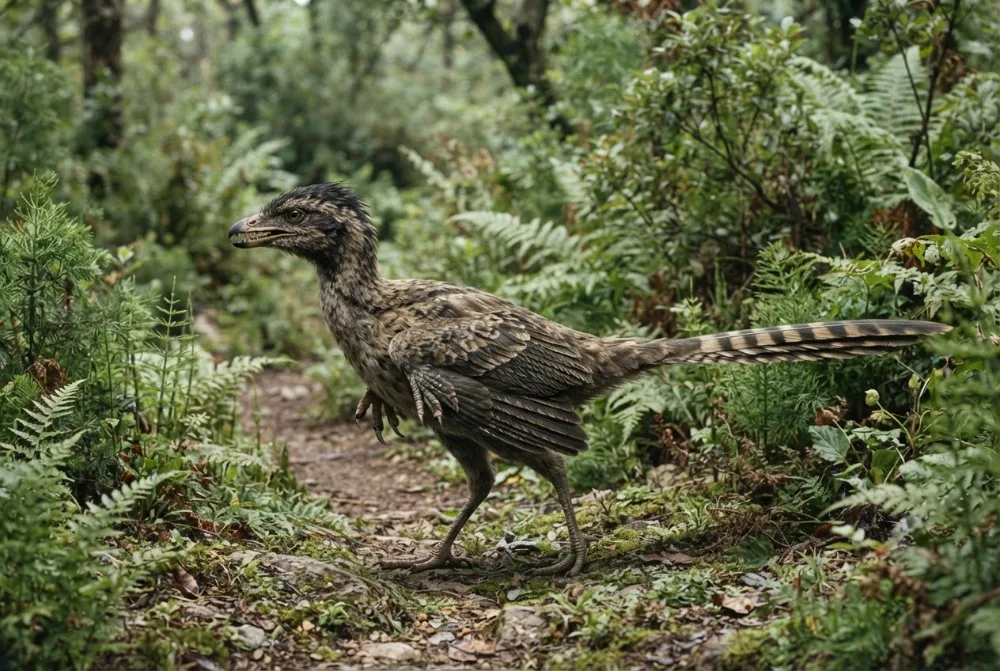
Bohaiornis was a feathered dinosaur that lived about 120 million years ago in what is now China. It was a bird-like predator with sharp teeth and long tail feathers. Scientists found a nearly complete skeleton that shows it was a fast, ground-dwelling hunter.15
Berɛ bɛn na ɛtenaa ase?
Na ne kɛseɛ yɛ sɛn?
Na ne mu yɛ duru sɛn?
Bohaiornis kɛseɛ yɛ sɛn sɛ wode toto WO ho a?
Akontaa nko ara wɔ wo browser mu. Yɛnkora biribiara so, na yɛmmfa biribiara nkɔ baabiara.
Na ɛyɛ ntɛm sɛn?


Nsɛm a ɛyɛ anigye
Bohaiornis had two long, ribbon-like feathers on its tail, not a fan of short feathers like many other birds.1
It was much larger than its close relative Eoenantiornis, which lived a bit earlier.1
The first skeleton found was almost complete, with all its bones still connected.2
Scientists once thought it had stones in its belly to help grind food, but those turned out to be mineral lumps that formed after death.1
Bohaiornis had a broad snout, which is unusual for early birds that ate meat.1
It lived during the Early Cretaceous, about 120 million years ago.1
Nsɛm a wɔbisa bebree fa Bohaiornis ho
?How big was Bohaiornis?
Scientists do not give an exact size, but it was much larger than its close relative Eoenantiornis, and a second, even larger specimen has been found.14
?What did Bohaiornis eat?
It was probably a meat-eater, maybe a raptorial predator. Scientists once thought it had stomach stones to help grind food, but those turned out to be mineral lumps that formed after death.14
?Did Bohaiornis have feathers?
Yes. The first skeleton found had two long, ribbon-like feathers attached to its tail.1
?When did Bohaiornis live?
It lived during the Early Cretaceous, about 120 million years ago, in what is now China.1
Atosɛm sɛefoɔ
Atosɛm: People might think Bohaiornis ate plants because it had stones in its stomach.
Nokorɛ: The stones were actually mineral concretions that formed after the animal died, and Bohaiornis was a meat-eater.1
Ma dino ho animdefoɔ
- Nyansahu din
- Bohaiornis
- Obi a ɔtoo din
- Hu et al. 20115
- Kuo
- Nnomaa a wɔdii kan
- Abusua / kuo kɛseɛ
- Bohaiornithidae5
- Nkyekyɛmu
- Theropoda > Avialae5
- Abotan no mfeɛ
- mfeɛ ɔpepem 121 kɔsi 113 (Aptian)5
- Abotan nhyehyɛeɛ
- Jiufotang5
- Aman
- Kyaena5
- Fɔsil nkyerɛwee
- 2 wɔ The Paleobiology Database mu5
- Nhunumu
- Bohaiornis was named by Dongyu Hu, Li Li, Lianhaim Hou, and Xing Xu in 2011. They described a nearly complete skeleton from the Yixian Formation in China.21
- Wɔda so gye ho akyinnye
- Scientists still debate what exactly Bohaiornis ate, because its stomach contents are not clear.1
Baabi a nsɛm no firi
- Bohaiornis (en.wikipedia.org)
- A new enantiornithine bird from the Lower Cretaceous of western L...: Ingenta Connect (ingentaconnect.com)
- Synthetic analysis of trophic diversity and evolution in Enantiornithes with new insights from Bohaiornithidae (pmc.ncbi.nlm.nih.gov)
- A new specimen of large-bodied basal Enantiornithine Bohaiornis from the Early Cretaceous of China and the inference of feeding ecology in Mesozoic birds | Journal of Paleontology | Cambridge Core (cambridge.org)
- Bohaiornis in The Paleobiology Database (CC BY 4.0): mfeɛ, mmeaeɛ, abotan nhyehyɛeɛ, nkyekyɛmu.
Asɛm biara a ɛwɔ krataafa yi so wɔ nɔma a ɛkyerɛ baabi a ɛfiri. Sɛ yɛfom biribi a, kafra, yɛyɛ dino dɔfoɔ, yɛnyɛ nyansahu nsɛmma krataa. Ka kyerɛ yɛn wɔ [email protected] na yɛbɛsiesie.
 Ɔkɔm de Rex! Dino Wiki yɛ agya bi adwuma a ɔyɛɛ maa ne babarima a ɔdɔ dino. Ɛyɛ kwa, dawurubɔ biara nni mu, akyidifoɔ biara nni mu. Mpanimfoɔ bɛtumi ama Rex aduane kakra, na aboa ama Dino Wiki atena intanɛt so.Ma Rex aduane
 Archaeopteryx
 Hesperornis
 Ichthyornis
 Baptornis
 Jurapteryx
 Gobipteryx
 Stegosaurus
 Iguanodon
 Giganotosaurus
 Microraptor
 Deinonychus
 Baryonyx