 Woyɛ dino bɛn? Nsɛmmisa agoro
 Dino ko
 Dino mmirikatuo
 Dino agodie nketewa
 Stika nwoma
 Dino TOP nhyehyɛeɛ
 Ma me nwanwa!
Berɛ bɛn na ɛtenaa ase?

Na ne kɛseɛ yɛ sɛn?
Na ne tenten yɛ sɛn?
Na ne korɔn yɛ sɛn?
nsusuiɛ
Na ne mu yɛ duru sɛn?
 ne tenten te sɛ fie agyinamoa 2 firi hwene kɔsi dua🍌ne tenten te sɛ kwadu 6 a wɔde abɔ toatoa sone mu duru bɛyɛ sɛ fie agyinamoa🍌ne mu duru te sɛ kwadu 42🪑ketewa ara ma ɔbɛtumi afa akonnwa ase🏃anka ɔbɛtumi atu mmirika mita 100 wɔ sikɛn 14 mu (onipa a ɔyɛ ntɛm sen biara hia 9.6)
Caudipteryx kɛseɛ yɛ sɛn sɛ wode toto WO ho a?
Akontaa nko ara wɔ wo browser mu. Yɛnkora biribiara so, na yɛmmfa biribiara nkɔ baabiara.
Na ɛyɛ ntɛm sɛn?


Nsɛm a ɛyɛ anigye
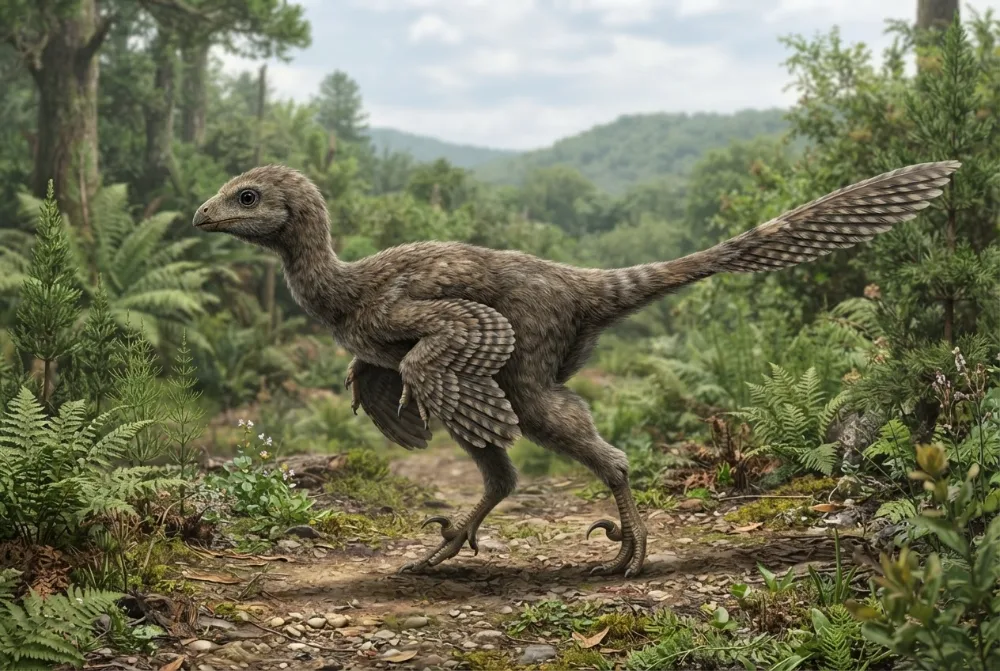
Caudipteryx had long, symmetrical feathers on its hands and tail, measuring 15 to 20 centimetres (5.9 to 7.9 inches) long. These feathers were black with a banded pattern on the tail.1
Its discovery in 1998 helped prove that birds evolved from dinosaurs, because it had clear feathers but was not a bird.1
Caudipteryx had a short, boxy skull with a beak-like snout and only a few teeth in the front of its upper jaw.1
Scientists think Caudipteryx was secondarily flightless, meaning its ancestors could fly but it lost that ability.1
Fossils of Caudipteryx have been found with gizzard stones in the place where its stomach would have been, just like in some plant-eating dinosaurs and modern birds.1
Nsɛm a wɔbisa bebree fa Caudipteryx ho
?How big was Caudipteryx?
About 72.5 to 89 centimetres (2 feet 4.5 inches to 2 feet 11 inches) long and weighed around 5 kilograms (11 pounds). It was about the size of a peacock.14
?What did Caudipteryx eat?
It was an omnivore. It probably ate insects and maybe plants, and it swallowed small stones called gastroliths to help digest its food.12
?Could Caudipteryx fly?
No, it could not fly. Its arms were too short to work as wings, and scientists think it was secondarily flightless, meaning its ancestors could fly but it lost that ability.14
?When did Caudipteryx live?
It lived during the Early Cretaceous period, about 124 to 122 million years ago.12
?Where was Caudipteryx found?
All Caudipteryx fossils have been found in the Yixian Formation in Liaoning, China.14
?Is Caudipteryx a bird?
Most scientists say it is a non-avian dinosaur, but a few think it might be a flightless bird. The debate helped prove that birds evolved from dinosaurs.1
Atosɛm sɛefoɔ
Atosɛm: Caudipteryx was a bird because it had feathers.
Nokorɛ: Caudipteryx was a non-avian dinosaur, not a bird. It belongs to a group called oviraptorosaurs, which are dinosaurs closely related to birds.1
Ma dino ho animdefoɔ
- Nyansahu din
- Caudipteryx
- Obi a ɔtoo din
- Ji et al. 19985
- Kuo
- Dino nwonwa a wɔwɔ ntakra
- Abusua / kuo kɛseɛ
- Oviraptorosauria5
- Nkyekyɛmu
- Theropoda > Oviraptorosauria5
- Abotan no mfeɛ
- mfeɛ ɔpepem 126 kɔsi 120 (Barremian / Aptian)5
- Abotan nhyehyɛeɛ
- Yixian5
- Aman
- Kyaena5
- Fɔsil nkyerɛwee
- 2 wɔ The Paleobiology Database mu5
- Nhunumu
- Caudipteryx was named in 1998 by Ji and colleagues based on two nearly complete skeletons found in Liaoning, China. The name honors Zou Jiahua, a Chinese vice premier.1
- Wɔda so gye ho akyinnye
- Scientists still debate whether Caudipteryx was a bird or a non-avian dinosaur, though most now agree it is a non-avian oviraptorosaur.1
Baabi a nsɛm no firi
- Caudipteryx (en.wikipedia.org)
- Caudipteryx | Natural History Museum (nhm.ac.uk)
- PBDB Taxon (paleobiodb.org)
- Caudipteryx | Size, Habitat, & Facts | Britannica (britannica.com)
- Caudipteryx in The Paleobiology Database (CC BY 4.0): mfeɛ, mmeaeɛ, abotan nhyehyɛeɛ, nkyekyɛmu.
Asɛm biara a ɛwɔ krataafa yi so wɔ nɔma a ɛkyerɛ baabi a ɛfiri. Sɛ yɛfom biribi a, kafra, yɛyɛ dino dɔfoɔ, yɛnyɛ nyansahu nsɛmma krataa. Ka kyerɛ yɛn wɔ [email protected] na yɛbɛsiesie.
 Ɔkɔm de Rex! Dino Wiki yɛ agya bi adwuma a ɔyɛɛ maa ne babarima a ɔdɔ dino. Ɛyɛ kwa, dawurubɔ biara nni mu, akyidifoɔ biara nni mu. Mpanimfoɔ bɛtumi ama Rex aduane kakra, na aboa ama Dino Wiki atena intanɛt so.Ma Rex aduane
 Therizinosaurus
 Oviraptor
 Chirostenotes
 Citipes
 Leptorhynchos
 Avimimus
 Stegosaurus
 Iguanodon
 Archaeopteryx
 Giganotosaurus
 Microraptor
 Deinonychus