 Woyɛ dino bɛn? Nsɛmmisa agoro
 Dino ko
 Dino mmirikatuo
 Dino agodie nketewa
 Stika nwoma
 Dino TOP nhyehyɛeɛ
 Ma me nwanwa!
Fortipesavis
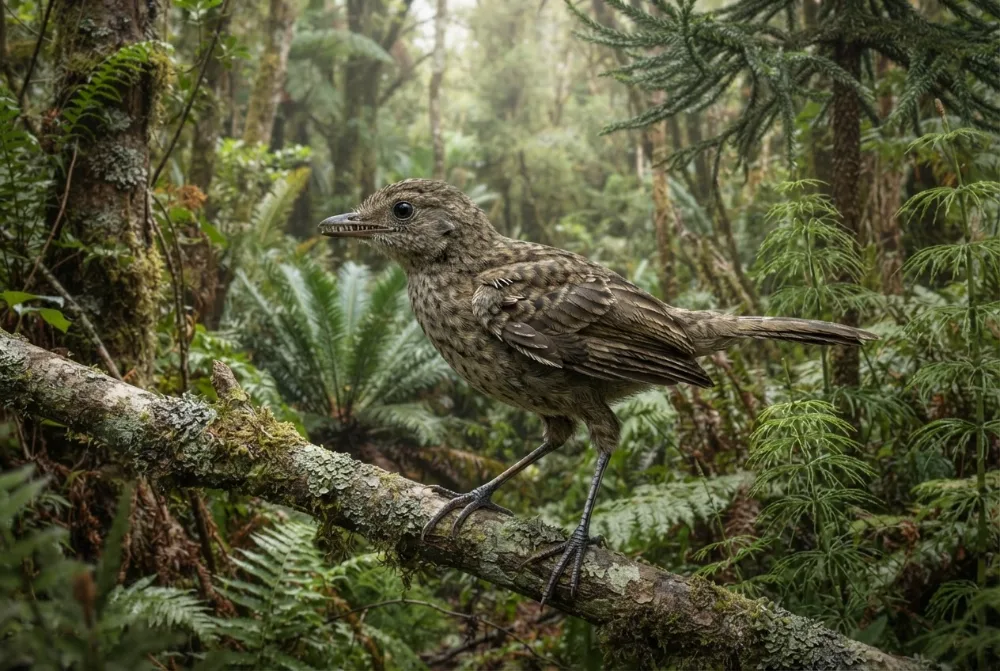
Fortipesavis was a tiny bird that lived about 98 million years ago. It had a very strong and wide fourth toe, which helped it grip onto thin, wobbly branches like a kingfisher. Its foot was so unusual that scientists named it the 'strong-footed bird'.12
Berɛ bɛn na ɛtenaa ase?
Na ɛyɛ ntɛm sɛn?


Nsɛm a ɛyɛ anigye
Fortipesavis is known only from a partial left foot preserved in amber, which is a piece of fossilized tree resin.1
Its fourth toe was almost twice as wide as its second toe, a feature not seen in any other bird, living or extinct.12
The foot of Fortipesavis had thick, padded toes with deep grooves between them, which helped it grip tightly onto branches.2
This bird lived in a mangrove forest environment, where it probably perched on thin, swaying branches while hunting for insects.12
The fossil of Fortipesavis was found in a piece of amber that weighs only 2.68 grams and is about the size of a large coin.1
Scientists used micro-CT scanning to study the foot inside the amber without damaging the fossil.1
Ma dino ho animdefoɔ
- Nyansahu din
- Fortipesavis
- Obi a ɔtoo din
- Clark and O’Connor 20214
- Kuo
- Nnomaa a wɔdii kan
- Abusua / kuo kɛseɛ
- Enantiornithes4
- Nkyekyɛmu
- Theropoda > Avialae4
- Abotan no mfeɛ
- mfeɛ ɔpepem 100 kɔsi 94 (Cenomanian)4
- Aman
- Myanmar4
- Fɔsil nkyerɛwee
- 1 wɔ The Paleobiology Database mu4
- Nhunumu
- Fortipesavis was named in 2021 by Alexander Clark and Jingmai O'Connor based on a foot preserved in amber from Myanmar. The fossil was first described in 2019 by Lida Xing and colleagues.13
- Wɔda so gye ho akyinnye
- Scientists are not sure whether Fortipesavis ate insects or fish, because its foot is similar to both modern kingfishers (which eat fish) and bee-eaters (which eat insects).2
Baabi a nsɛm no firi
- Fortipesavis (en.wikipedia.org)
- Frontiers | Exploring the Ecomorphology of Two Cretaceous Enantiornithines With Unique Pedal Morphology (frontiersin.org)
- PBDB Taxon (paleobiodb.org)
- Fortipesavis in The Paleobiology Database (CC BY 4.0): mfeɛ, mmeaeɛ, abotan nhyehyɛeɛ, nkyekyɛmu.
Asɛm biara a ɛwɔ krataafa yi so wɔ nɔma a ɛkyerɛ baabi a ɛfiri. Sɛ yɛfom biribi a, kafra, yɛyɛ dino dɔfoɔ, yɛnyɛ nyansahu nsɛmma krataa. Ka kyerɛ yɛn wɔ [email protected] na yɛbɛsiesie.
 Ɔkɔm de Rex! Dino Wiki yɛ agya bi adwuma a ɔyɛɛ maa ne babarima a ɔdɔ dino. Ɛyɛ kwa, dawurubɔ biara nni mu, akyidifoɔ biara nni mu. Mpanimfoɔ bɛtumi ama Rex aduane kakra, na aboa ama Dino Wiki atena intanɛt so.Ma Rex aduane
 Archaeopteryx
 Hesperornis
 Ichthyornis
 Baptornis
 Jurapteryx
 Gobipteryx
 Tyrannosaurus
 Triceratops
 Velociraptor
 Spinosaurus
 Ankylosaurus
 Parasaurolophus