 Woyɛ dino bɛn? Nsɛmmisa agoro
 Dino ko
 Dino mmirikatuo
 Dino agodie nketewa
 Stika nwoma
 Dino TOP nhyehyɛeɛ
 Ma me nwanwa!
Fukuipteryx
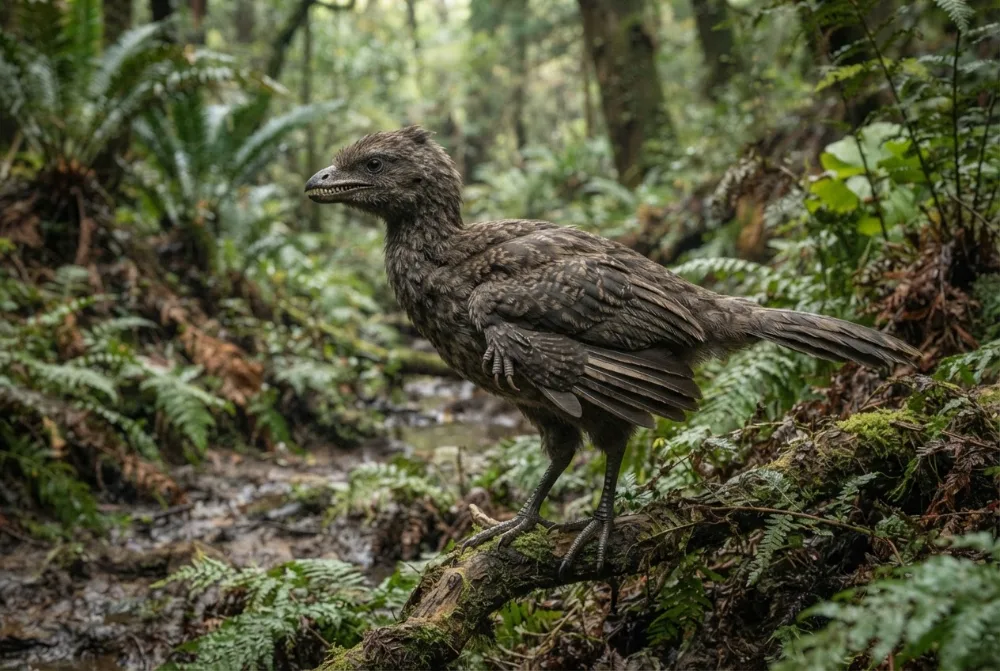
Fukuipteryx was a tiny, pigeon‑sized bird that lived in Japan about 120 million years ago. It had a short tail with a special bone called a pygostyle, and its wings were built for flying. This little bird is one of the oldest birds ever found outside of China.12
Berɛ bɛn na ɛtenaa ase?
Na ɛyɛ ntɛm sɛn?


Nsɛm a ɛyɛ anigye
Fukuipteryx is one of the most primitive birds known, even more primitive than Jeholornis from China.1
Its skeleton was found in three dimensions, not squashed flat like most other early bird fossils.12
The fossil was a young bird, not fully grown, which scientists could tell by looking at its bones under a microscope.12
Fukuipteryx had a strong, paddle‑shaped pygostyle at the end of its tail, which helped it steer in the air.1
It lived in a warm, lowland environment with rivers, very different from the volcanic lakes where most early birds are found.2
Nsɛm a wɔbisa bebree fa Fukuipteryx ho
?How big was Fukuipteryx?
It was about the size of a modern pigeon. The fossil was a subadult, so it was nearly full-grown when it died.31
?When did Fukuipteryx live?
It lived about 120 million years ago, during the Early Cretaceous period.31
Ma dino ho animdefoɔ
- Nyansahu din
- Fukuipteryx
- Obi a ɔtoo din
- Imai et al. 20194
- Kuo
- Nnomaa a wɔdii kan
- Abusua / kuo kɛseɛ
- Avialae4
- Nkyekyɛmu
- Theropoda > Avialae4
- Abotan no mfeɛ
- mfeɛ ɔpepem 121 kɔsi 113 (Aptian)4
- Abotan nhyehyɛeɛ
- Kitadani4
- Aman
- Gyapan4
- Fɔsil nkyerɛwee
- 1 wɔ The Paleobiology Database mu4
- Nhunumu
- The first skeleton of Fukuipteryx was collected in 2013 in Katsuyama, Japan. Scientists led by Takuya Imai named it in 2019.14
- Wɔda so gye ho akyinnye
- Scientists are not sure exactly where Fukuipteryx fits on the bird family tree. Some features make it look very primitive, but it also has a pygostyle, which is usually found in more advanced birds.12
Baabi a nsɛm no firi
- An unusual bird (Theropoda, Avialae) from the Early Cretaceous of Japan suggests complex evolutionary history of basal birds | Communications Biology (nature.com)
- An unusual bird (Theropoda, Avialae) from the Early Cretaceous of Japan suggests complex evolutionary history of basal birds (pmc.ncbi.nlm.nih.gov)
- Fukuipteryx (en.wikipedia.org)
- Fukuipteryx in The Paleobiology Database (CC BY 4.0): mfeɛ, mmeaeɛ, abotan nhyehyɛeɛ, nkyekyɛmu.
Asɛm biara a ɛwɔ krataafa yi so wɔ nɔma a ɛkyerɛ baabi a ɛfiri. Sɛ yɛfom biribi a, kafra, yɛyɛ dino dɔfoɔ, yɛnyɛ nyansahu nsɛmma krataa. Ka kyerɛ yɛn wɔ [email protected] na yɛbɛsiesie.
 Ɔkɔm de Rex! Dino Wiki yɛ agya bi adwuma a ɔyɛɛ maa ne babarima a ɔdɔ dino. Ɛyɛ kwa, dawurubɔ biara nni mu, akyidifoɔ biara nni mu. Mpanimfoɔ bɛtumi ama Rex aduane kakra, na aboa ama Dino Wiki atena intanɛt so.Ma Rex aduane
 Archaeopteryx
 Hesperornis
 Ichthyornis
 Baptornis
 Jurapteryx
 Gobipteryx
 Stegosaurus
 Iguanodon
 Giganotosaurus
 Microraptor
 Deinonychus
 Baryonyx