 Woyɛ dino bɛn? Nsɛmmisa agoro
 Dino ko
 Dino mmirikatuo
 Dino agodie nketewa
 Stika nwoma
 Dino TOP nhyehyɛeɛ
 Ma me nwanwa!
Gallardosaurus
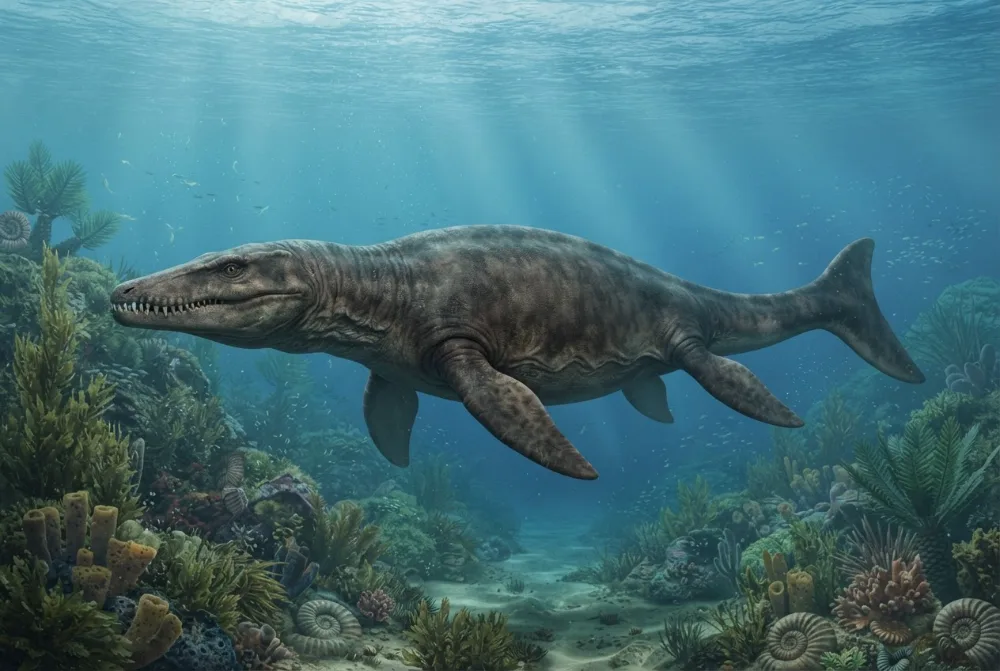
Gallardosaurus was a short-necked, big-headed marine reptile that swam in warm seas near Cuba 160 million years ago. It was a pliosaur, a type of plesiosaur with a huge skull and strong jaws for catching fish.12
Berɛ bɛn na ɛtenaa ase?
Na ɛyɛ ntɛm sɛn?


Nsɛm a ɛyɛ anigye
Gallardosaurus is known from only one partial skull and a few neck bones. The tip of the snout and the back of the lower jaw are missing.1
The bones were found inside a hard rock called a concretion, which helped preserve them in three dimensions.1
The individual was probably not fully grown when it died, because some of its vertebrae were not fused together.1
Gallardosaurus lived in a shallow sea only about 10 to 12 metres (33 to 39 feet) deep. Oysters and algae grew on the seafloor.1
It shared its home with ichthyosaurs, a marine turtle called Notoemys oxfordiensis, and another plesiosaur named Vinialesaurus caroli.1
Scientists think Gallardosaurus may have migrated across the Caribbean Seaway each season, following the fish it hunted.1
The first fossil was discovered in 1946 by a Cuban farmer named Juan Gallardo. It was not fully studied until many years later.1
Nsɛm a wɔbisa bebree fa Gallardosaurus ho
?How big was Gallardosaurus?
No complete skeleton has been found, so its exact size is unknown. Based on the partial skull and neck bones, it was probably a medium-sized pliosaur, but scientists do not have enough fossils to give a reliable length or weight.12
?What did Gallardosaurus eat?
It was a carnivore that likely ate fish. Scientists think it was an active predator that hunted nectonic (swimming) fish in the warm Caribbean Seaway.12
Ma dino ho animdefoɔ
- Nyansahu din
- Gallardosaurus
- Obi a ɔtoo din
- Gasparini 20093
- Kuo
- Plesiosɔɔ
- Abusua / kuo kɛseɛ
- Pliosauridae3
- Nkyekyɛmu
- Plesiosauria > Pliosauridae > Sauropterygia3
- Abotan no mfeɛ
- mfeɛ ɔpepem 159 kɔsi 155 (Oxfordian)3
- Abotan nhyehyɛeɛ
- Jagua3
- Aman
- Kuba3
- Fɔsil nkyerɛwee
- 1 wɔ The Paleobiology Database mu3
- Nhunumu
- The only known fossil was found in 1946 by Cuban farmer Juan Gallardo near Viñales, Cuba. It was first thought to be a species of Pliosaurus or Peloneustes, but in 2009 paleontologist Zulma Gasparini named it a new genus, Gallardosaurus.12
- Wɔda so gye ho akyinnye
- Scientists are not sure exactly how big Gallardosaurus grew, because only a partial skull and a few vertebrae have been found.1
Baabi a nsɛm no firi
- Gallardosaurus (en.wikipedia.org)
- A new Oxfordian pliosaurid (Plesiosauria, Pliosauridae) in the Caribbean Seaway | The Palaeontological Association (palass.org)
- Gallardosaurus in The Paleobiology Database (CC BY 4.0): mfeɛ, mmeaeɛ, abotan nhyehyɛeɛ, nkyekyɛmu.
Asɛm biara a ɛwɔ krataafa yi so wɔ nɔma a ɛkyerɛ baabi a ɛfiri. Sɛ yɛfom biribi a, kafra, yɛyɛ dino dɔfoɔ, yɛnyɛ nyansahu nsɛmma krataa. Ka kyerɛ yɛn wɔ [email protected] na yɛbɛsiesie.
 Ɔkɔm de Rex! Dino Wiki yɛ agya bi adwuma a ɔyɛɛ maa ne babarima a ɔdɔ dino. Ɛyɛ kwa, dawurubɔ biara nni mu, akyidifoɔ biara nni mu. Mpanimfoɔ bɛtumi ama Rex aduane kakra, na aboa ama Dino Wiki atena intanɛt so.Ma Rex aduane
 Elasmosaurus
 Pliosaurus
 Plesiosaurus
 Cimoliasaurus
 Colymbosaurus
 Trinacromerum
 Brachiosaurus
 Diplodocus
 Allosaurus
 Brontosaurus
 Compsognathus
 Camarasaurus