 Woyɛ dino bɛn? Nsɛmmisa agoro
 Dino ko
 Dino mmirikatuo
 Dino agodie nketewa
 Stika nwoma
 Dino TOP nhyehyɛeɛ
 Ma me nwanwa!
Rhamphinion
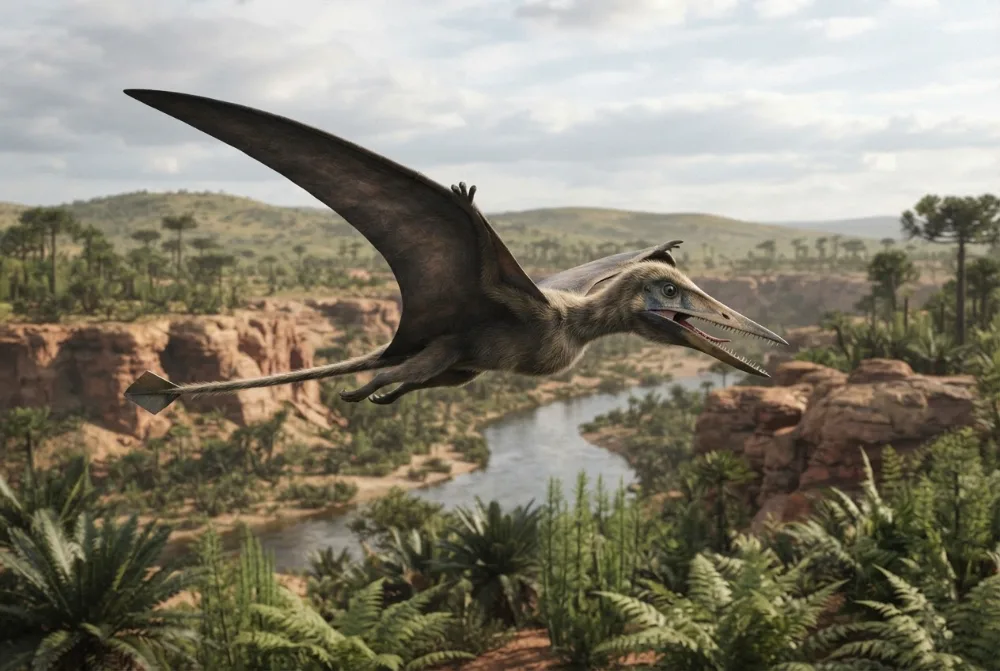
Rhamphinion was an early flying reptile that soared over what is now Arizona during the Early Jurassic. It was one of the first pterosaurs ever found in the Americas, but we only know it from a few pieces of its skull.12
Berɛ bɛn na ɛtenaa ase?
Na ɛyɛ ntɛm sɛn?


Nsɛm a ɛyɛ anigye
Rhamphinion lived about 196 to 183 million years ago, during the Early Jurassic.1
The only known fossils are three pieces of skull: an occipital bone, part of a left jugal (cheek bone), and two teeth with a possible jaw fragment.12
Its name comes from Greek words meaning 'beak nape', because the fossils come from the back of the skull.1
When it was discovered in 1978, Rhamphinion was the oldest pterosaur known from the Western Hemisphere.1
The fossils were found by an expedition led by Farish A. Jenkins Jr., and the species name jenkinsi honors him.1
A nearly complete wing bone (fourth metacarpal) found nearby might belong to Rhamphinion, but scientists are not sure.1
Nsɛm a wɔbisa bebree fa Rhamphinion ho
?Is Rhamphinion a dinosaur?
No, Rhamphinion is a pterosaur, a flying reptile that is not a dinosaur.1
?How big was Rhamphinion?
Nobody knows for sure because only a few skull pieces have been found, but it was a small pterosaur.1
?What did Rhamphinion eat?
Scientists are not certain, but as a basal pterosaur it likely ate small animals like insects or fish.1
?When did Rhamphinion live?
Rhamphinion lived during the Early Jurassic, about 196 to 183 million years ago.1
Ma dino ho animdefoɔ
- Nyansahu din
- Rhamphinion
- Obi a ɔtoo din
- Padian 19843
- Kuo
- Wim mmoa a wɔwea
- Abusua / kuo kɛseɛ
- Rhamphorhynchoidea3
- Nkyekyɛmu
- Pterosauria3
- Abotan no mfeɛ
- mfeɛ ɔpepem 200 kɔsi 184 (Sinemurian / Pliensbachian)3
- Abotan nhyehyɛeɛ
- Kayenta3
- Aman
- Amerika3
- Fɔsil nkyerɛwee
- 1 wɔ The Paleobiology Database mu3
- Nhunumu
- Rhamphinion was named in 1984 by Kevin Padian based on skull fragments collected in 1978 from the Kayenta Formation of Arizona. The fossils were found by an expedition from Harvard's Museum of Comparative Zoology and the Museum of Northern Arizona.12
- Wɔda so gye ho akyinnye
- Scientists are not sure exactly where Rhamphinion fits in the pterosaur family tree because the fossils are so fragmentary. It might be related to Dimorphodon, but its classification remains uncertain.1
Baabi a nsɛm no firi
- Rhamphinion (en.wikipedia.org)
- Pterosaur remains from the Kayenta Formation (?Early Jurassic) of Arizona | The Palaeontological Association (palass.org)
- Rhamphinion in The Paleobiology Database (CC BY 4.0): mfeɛ, mmeaeɛ, abotan nhyehyɛeɛ, nkyekyɛmu.
Asɛm biara a ɛwɔ krataafa yi so wɔ nɔma a ɛkyerɛ baabi a ɛfiri. Sɛ yɛfom biribi a, kafra, yɛyɛ dino dɔfoɔ, yɛnyɛ nyansahu nsɛmma krataa. Ka kyerɛ yɛn wɔ [email protected] na yɛbɛsiesie.
 Ɔkɔm de Rex! Dino Wiki yɛ agya bi adwuma a ɔyɛɛ maa ne babarima a ɔdɔ dino. Ɛyɛ kwa, dawurubɔ biara nni mu, akyidifoɔ biara nni mu. Mpanimfoɔ bɛtumi ama Rex aduane kakra, na aboa ama Dino Wiki atena intanɛt so.Ma Rex aduane
 Pteranodon
 Quetzalcoatlus
 Dorygnathus
 Rhamphorhynchus
 Anhanguera
 Pterodactylus
 Dilophosaurus
 Stenopterygius
 Lufengosaurus
 Scutellosaurus
 Yunnanosaurus
 Sinosaurus