 Woyɛ dino bɛn? Nsɛmmisa agoro
 Dino ko
 Dino mmirikatuo
 Dino agodie nketewa
 Stika nwoma
 Dino TOP nhyehyɛeɛ
 Ma me nwanwa!
Rhomaleopakhus
Rhomaleopakhus was a huge, long-necked plant-eater that lived in what is now China. Its front legs were extra strong and stocky, which is why its name means 'strong forearm'. It walked on four legs and used its long neck to reach leaves high up in trees.12
Berɛ bɛn na ɛtenaa ase?
Na ne kɛseɛ yɛ sɛn?
Na ne tenten yɛ sɛn?
Na ne korɔn yɛ sɛn?
nsusuiɛ
Na ne mu yɛ duru sɛn?

 ne tenten te sɛ kaa 4 a wɔde agyina toatoa so🍌ne tenten te sɛ kwadu 110 a wɔde abɔ toatoa sone mu duru te sɛ kaa 12🍉ne mu duru te sɛ watamɛlɔn 3600🎒ne mu duru te sɛ sukuu klaas mũ 22 mu mmofra🐻❄️ne mu duru te sɛ polar bea 40🏢ne korɔn bɛtumi ahwɛ mfɛnsere mu wɔ abansoro 2 so🏃anka ɔbɛtumi atu mmirika mita 100 wɔ sikɛn 30 mu (onipa a ɔyɛ ntɛm sen biara hia 9.6)
Rhomaleopakhus kɛseɛ yɛ sɛn sɛ wode toto WO ho a?
Akontaa nko ara wɔ wo browser mu. Yɛnkora biribiara so, na yɛmmfa biribiara nkɔ baabiara.
Na ɛyɛ ntɛm sɛn?


Nsɛm a ɛyɛ anigye
Rhomaleopakhus had one of the most robust (thick and strong) ulna bones of any known sauropod dinosaur.3
Its forearm bones were so strong that scientists think it evolved them separately from other sauropods, a process called convergent evolution.1
The only fossil found so far is a right forelimb, including the upper arm bone, two lower arm bones, a wrist bone, and a nearly complete hand.3
Rhomaleopakhus lived during the Late Jurassic period, about 152 to 143 million years ago.2
Its fossils were originally thought to belong to another dinosaur called Hudiesaurus, but scientists later realized they were from a different animal.1
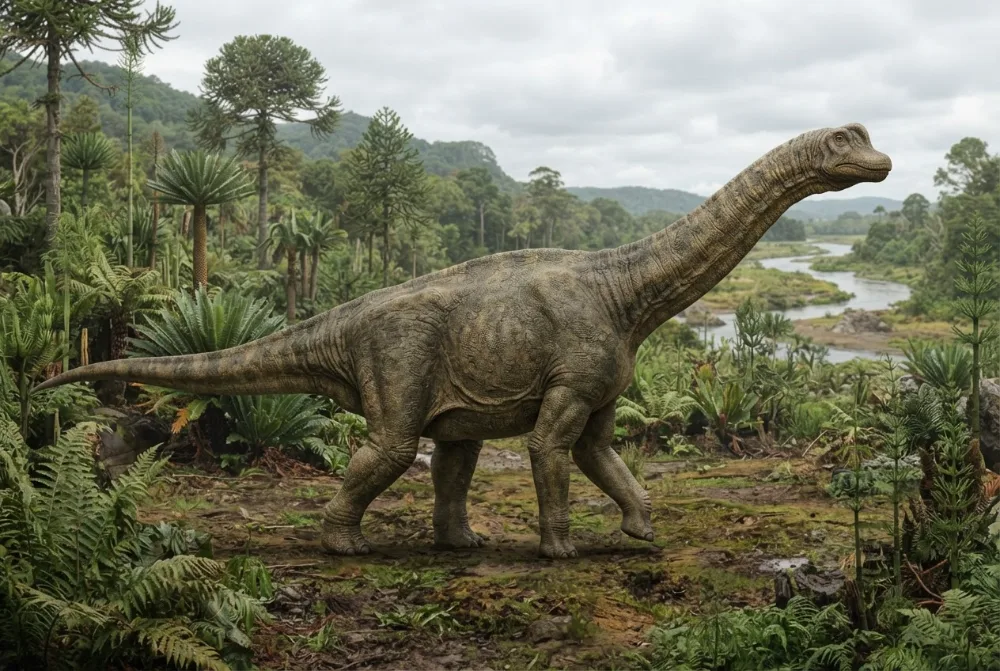
Ma dino ho animdefoɔ
- Nyansahu din
- Rhomaleopakhus
- Obi a ɔtoo din
- Upchurch et al. 20215
- Kuo
- Kɔn tenten
- Abusua / kuo kɛseɛ
- Mamenchisauridae5
- Nkyekyɛmu
- Sauropodomorpha > Sauropoda5
- Abotan no mfeɛ
- mfeɛ ɔpepem 152 kɔsi 143 (Kimmeridgian / Tithonian)5
- Abotan nhyehyɛeɛ
- Kalazha5
- Aman
- Kyaena5
- Fɔsil nkyerɛwee
- 1 wɔ The Paleobiology Database mu5
- Nhunumu
- The first fossil of Rhomaleopakhus was found in 1993 by a Chinese-Japanese expedition near Qiketai in Xinjiang, China. It was named Rhomaleopakhus turpanensis in 2021 by Paul Upchurch and colleagues.13
- Wɔda so gye ho akyinnye
- Scientists are not sure exactly how big Rhomaleopakhus was, because only its forelimb has been found. They also debate whether its strong forearms helped it walk or feed in a special way.1
Baabi a nsɛm no firi
- Rhomaleopakhus (en.wikipedia.org)
- PBDB Taxon (paleobiodb.org)
- Rhomaleopakhus turpanensis Upchurch, Mannion, Xu, and Barrett 2021 (gbif.org)
- Rhomaleopakhus turpanensis | Dinosaur Database by DinoAnimals.com (dinoanimals.com)
- Rhomaleopakhus in The Paleobiology Database (CC BY 4.0): mfeɛ, mmeaeɛ, abotan nhyehyɛeɛ, nkyekyɛmu.
Asɛm biara a ɛwɔ krataafa yi so wɔ nɔma a ɛkyerɛ baabi a ɛfiri. Sɛ yɛfom biribi a, kafra, yɛyɛ dino dɔfoɔ, yɛnyɛ nyansahu nsɛmma krataa. Ka kyerɛ yɛn wɔ [email protected] na yɛbɛsiesie.
 Ɔkɔm de Rex! Dino Wiki yɛ agya bi adwuma a ɔyɛɛ maa ne babarima a ɔdɔ dino. Ɛyɛ kwa, dawurubɔ biara nni mu, akyidifoɔ biara nni mu. Mpanimfoɔ bɛtumi ama Rex aduane kakra, na aboa ama Dino Wiki atena intanɛt so.Ma Rex aduane
 Brachiosaurus
 Diplodocus
 Brontosaurus
 Argentinosaurus
 Camarasaurus
 Morosaurus
 Allosaurus
 Compsognathus
 Camptosaurus
 Nanosaurus
 Rhamphorhynchus
 Ceratosaurus