 Woyɛ dino bɛn? Nsɛmmisa agoro
 Dino ko
 Dino mmirikatuo
 Dino agodie nketewa
 Stika nwoma
 Dino TOP nhyehyɛeɛ
 Ma me nwanwa!
Yelaphomte
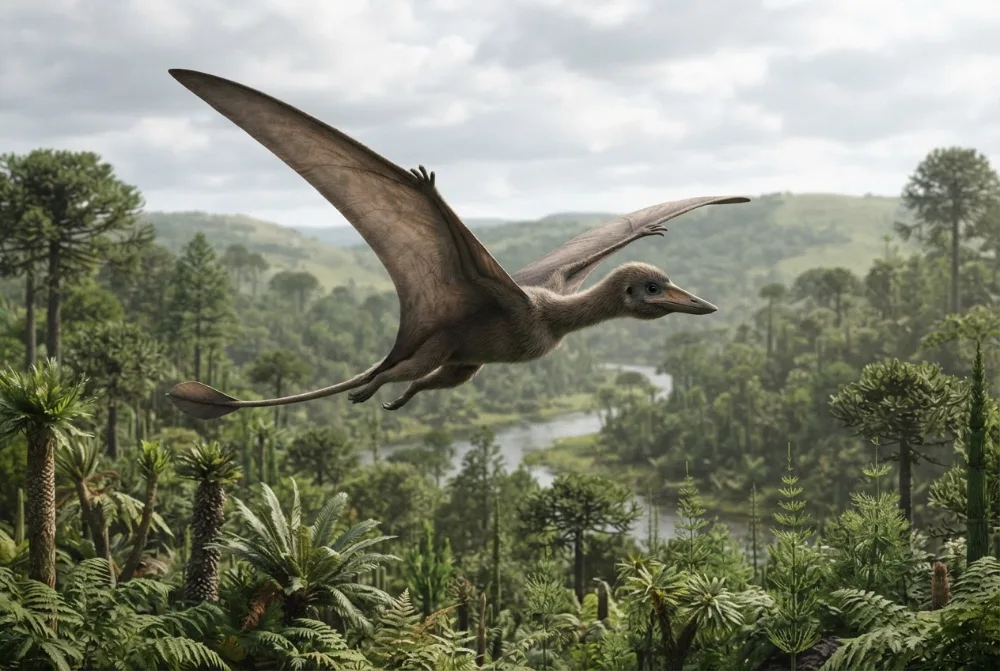
Yelaphomte was a small flying reptile that lived during the Late Triassic in what is now Argentina. It had a tall, thin crest on its snout and was one of the first pterosaurs found in the southern half of the world.12
Berɛ bɛn na ɛtenaa ase?
Na ɛyɛ ntɛm sɛn?


Nsɛm a ɛyɛ anigye
Yelaphomte is one of the only known Triassic pterosaurs from the southern hemisphere, along with its relative Pachagnathus.12
Its snout was full of air spaces, making it lightweight for flying. The name Yelaphomte means 'beast of the air' in the language of the Huarpe people.1
The only known fossil is a piece of the snout only 15.4 mm long, including parts of the upper jaw and palate.1
Yelaphomte lived far from the sea, in a dry inland environment, unlike many other early pterosaurs that lived near coasts.1
The crest on its snout had a unique pattern of grooves that is not seen in any other pterosaur.1
Scientists think Yelaphomte may have been a small adult, because the bones in its snout were tightly fused together, which often happens when an animal is fully grown.1
Ma dino ho animdefoɔ
- Nyansahu din
- Yelaphomte
- Obi a ɔtoo din
- Martínez et al. 20223
- Kuo
- Wim mmoa a wɔwea
- Abusua / kuo kɛseɛ
- Raeticodactylidae3
- Nkyekyɛmu
- Pterosauria3
- Abotan no mfeɛ
- mfeɛ ɔpepem 227 kɔsi 206 (Norian)3
- Abotan nhyehyɛeɛ
- Quebrada del Barro3
- Aman
- Argentina3
- Fɔsil nkyerɛwee
- 1 wɔ The Paleobiology Database mu3
- Nhunumu
- Yelaphomte was discovered by a team led by Ricardo Martínez between 2012 and 2014 in Argentina. It was named and described in 2022 by Martínez, Andres, Apaldetti, and Cerda.13
- Wɔda so gye ho akyinnye
- Scientists are not sure exactly how big Yelaphomte grew, because only a small piece of its snout has been found.1
Baabi a nsɛm no firi
- Yelaphomte (en.wikipedia.org)
- The dawn of the flying reptiles: first Triassic record in the southern hemisphere (onlinelibrary.wiley.com)
- Yelaphomte in The Paleobiology Database (CC BY 4.0): mfeɛ, mmeaeɛ, abotan nhyehyɛeɛ, nkyekyɛmu.
Asɛm biara a ɛwɔ krataafa yi so wɔ nɔma a ɛkyerɛ baabi a ɛfiri. Sɛ yɛfom biribi a, kafra, yɛyɛ dino dɔfoɔ, yɛnyɛ nyansahu nsɛmma krataa. Ka kyerɛ yɛn wɔ [email protected] na yɛbɛsiesie.
 Ɔkɔm de Rex! Dino Wiki yɛ agya bi adwuma a ɔyɛɛ maa ne babarima a ɔdɔ dino. Ɛyɛ kwa, dawurubɔ biara nni mu, akyidifoɔ biara nni mu. Mpanimfoɔ bɛtumi ama Rex aduane kakra, na aboa ama Dino Wiki atena intanɛt so.Ma Rex aduane
 Pteranodon
 Quetzalcoatlus
 Dorygnathus
 Rhamphorhynchus
 Anhanguera
 Pterodactylus
 Nothosaurus
 Massospondylus
 Plateosaurus
 Coelophysis
 Podokesaurus
 Simosaurus