When did it live?

How big was it?
How long was it?
How heavy was it?
How big was Amurosaurus compared to YOU?
Just maths in your browser. Nothing is saved or sent anywhere.
Fun facts
Amurosaurus is named after the Amur River, which forms the border between Russia and China.1
Most of the bones found in its bonebed belong to young Amurosaurus, not adults.1
Theropod teeth are common in the bonebed, and many bones have tooth marks, showing that predators or scavengers chewed on them.1
Amurosaurus had a unique S-shaped curve in its lower arm bone, the ulna.1
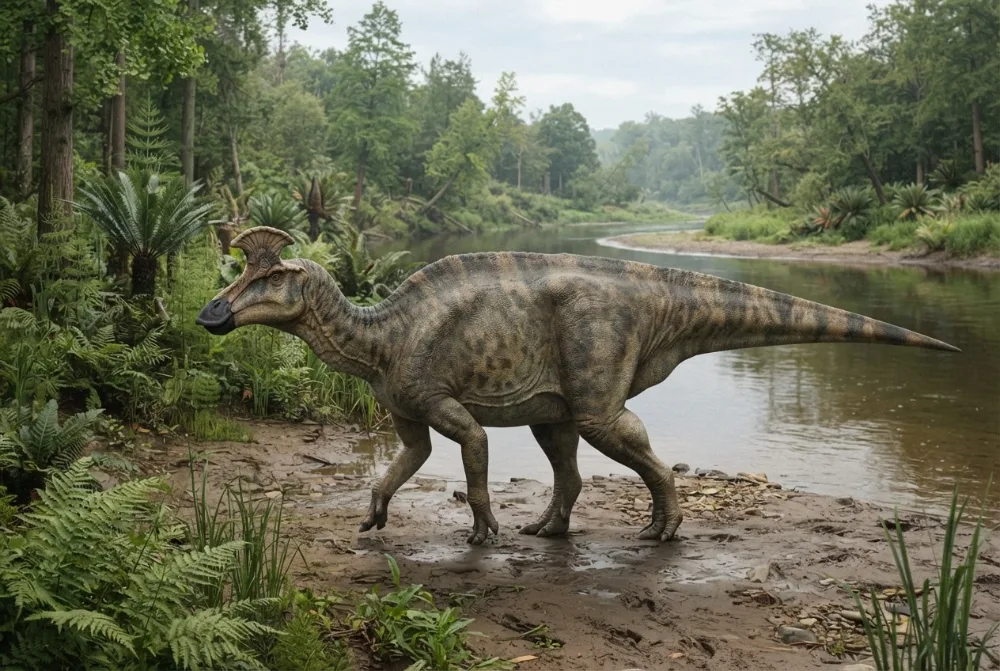
Although the crest bones are missing, the skull roof shows it likely had a hollow crest like other lambeosaurines.1
Amurosaurus had a relatively large brain compared to some other plant-eaters, which might mean it lived in groups.1
Most asked questions about Amurosaurus
?How big was Amurosaurus?
About 8 metres (26 feet) long and around 3 metric tons (3.3 short tons) in weight, though one source says it may have been up to 12 metres (39 feet) long.12
?What did Amurosaurus eat?
It was a plant-eater, or herbivore, like all hadrosaurid dinosaurs.1
?Did Amurosaurus have a crest?
Yes, it probably had a hollow crest on its head, even though the crest bones themselves have not been found yet.1
?When did Amurosaurus live?
It lived during the Late Cretaceous period, about 70 to 66 million years ago.1
?Where was Amurosaurus found?
All its fossils come from a single bonebed in Blagoveschensk, Russia, near the Amur River.1
?Was Amurosaurus a dinosaur?
Yes, it was a lambeosaurine hadrosaurid dinosaur.1
Ask Rex about Amurosaurus
Rex only answers questions about this page. 3 questions a day.
Rex is an AI and can make mistakes. He runs on servers in the EU and questions are never saved. Never type your name or other personal things.
Myth buster
Myth: Amurosaurus was a meat-eater because it had sharp teeth.
Truth: Amurosaurus was a plant-eater, as shown by its beak and teeth made for grinding plants.1
For dino experts
- Scientific name
- Amurosaurus
- Named by
- Bolotsky and Kurzanov 19913
- Group
- Duck-bills
- Family / clade
- Hadrosauridae3
- Classification
- Ornithischia > Ornithopoda > Iguanodontia > Hadrosauridae3
- Age of the rocks
- 72 to 66 million years (Maastrichtian)3
- Rock formations
- Udurchukan, Yuliangzi3
- Countries
- Russia, China3
- Fossil records
- 2 in the Paleobiology Database3
- Also known as
- Sahaliyania (older names now counted as the same animal)3
- Discovery
- Russian paleontologists Yuri Bolotsky and Sergei Kurzanov named Amurosaurus in 1991. The first fossils were found in 1984 in a bonebed inside the city of Blagoveschensk, Russia.1
- Still debated
- Scientists are still debating whether Amurosaurus had a crest and what it looked like, because the crest bones have not been found.1
Where the facts come from
- Amurosaurus (en.wikipedia.org)
- Amurosaurus State Darwin Museum (darwinmuseum.ru)
- Amurosaurus in The Paleobiology Database (CC BY 4.0): age, places, rock formations, classification.
Every fact on this page has a number that points to its source. If we got something wrong, sorry, we are dino fans, not a science journal. Tell us at [email protected] and we will fix it.
 Rex is hungry! Dino Wiki is a dad's project for his dino-loving son, free with no ads. Grown-ups can feed Rex a snack to help keep it online.Feed Rex
 Parasaurolophus
 Edmontosaurus
 Saurolophus
 Hypacrosaurus
 Corythosaurus
 Kritosaurus
 Tyrannosaurus
 Triceratops
 Velociraptor
 Spinosaurus
 Ankylosaurus
 Pteranodon