
Craspedodon
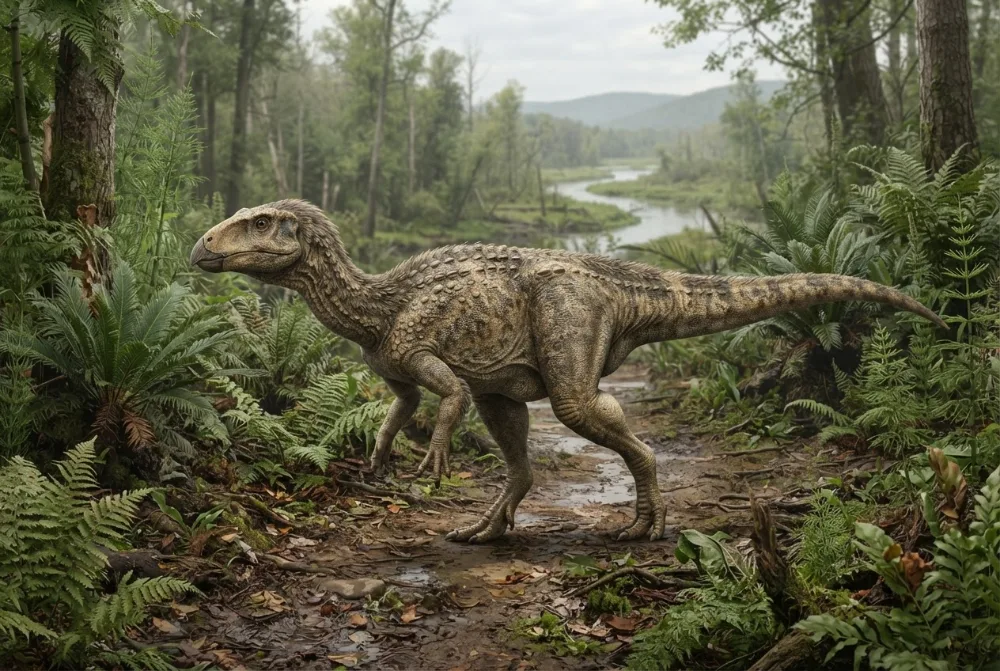
Craspedodon was a plant-eating dinosaur that lived in what is now Belgium. It had special teeth with strong ridges, which helped it chew tough plants. Scientists are still debating whether it was an ornithopod or a neoceratopsian, a relative of horned dinosaurs like Triceratops.13
When did it live?
Fun facts
Craspedodon is known only from three teeth found in Belgium.1
For over a century, scientists thought Craspedodon was an ornithopod like Iguanodon, but in 2007 researchers suggested it might be a neoceratopsian, a relative of horned dinosaurs.12
The teeth of Craspedodon have deep indentations and a prominent ridge at the base, which are features seen in neoceratopsians.2
Craspedodon lived during the Late Cretaceous period, about 89 to 83 million years ago.3
The name Craspedodon means 'edge tooth', referring to the strong ridges on its teeth.1

Ask Rex about Craspedodon
Rex only answers questions about this page. 3 questions a day.
Rex is an AI and can make mistakes. He runs on servers in the EU and questions are never saved. Never type your name or other personal things.
For dino experts
- Scientific name
- Craspedodon
- Named by
- Dollo 18833
- Group
- Beaked plant-eaters
- Family / clade
- Iguanodontoidea3
- Classification
- Ornithischia > Ornithopoda > Iguanodontia3
- Age of the rocks
- 90 to 84 million years (Coniacian / Santonian)3
- Rock formations
- Glauconie de Lonzée3
- Countries
- Belgium3
- Fossil records
- 1 in the Paleobiology Database3
- Discovery
- Craspedodon was named by Belgian paleontologist Louis Dollo in 1883, based on three teeth found near Lonzée, Belgium.13
- Still debated
- Scientists are not sure whether Craspedodon is a valid genus or a nomen dubium, because only teeth are known and tooth features are not enough to be certain.12
Where the facts come from
- Craspedodon (en.wikipedia.org)
- A re-appraisal of Craspedodon from the (biblio.naturalsciences.be)
- Craspedodon in The Paleobiology Database (CC BY 4.0): age, places, rock formations, classification.
Every fact on this page has a number that points to its source. If we got something wrong, sorry, we are dino fans, not a science journal. Tell us at [email protected] and we will fix it.
Rex is hungry! Dino Wiki is a dad's project for his dino-loving son, free with no ads. Grown-ups can feed Rex a snack to help keep it online.Feed Rex Iguanodon
 Tenontosaurus
 Thescelosaurus
 Zalmoxes
 Camptosaurus
 Rhabdodon
 Triceratops
 Velociraptor
 Spinosaurus
 Ankylosaurus
 Parasaurolophus