
Fostoria
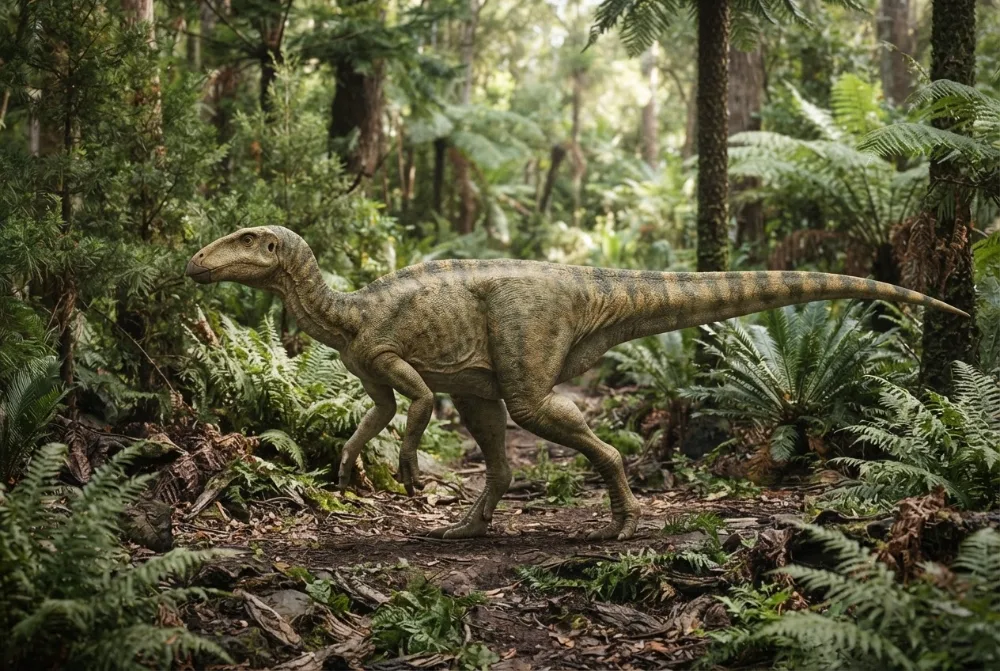
Fostoria was a plant-eating dinosaur that lived in Australia about 100 million years ago. It walked on two legs and had a beak for snipping leaves. Fossils of at least four Fostoria were found together in an opal mine.12
When did it live?
Fun facts
Fostoria is known from at least four individuals found together in a bone bed, the first ornithopod-dominated bone bed discovered in Australia.2
All of the Fostoria fossils are preserved in opal, a precious gemstone.2
The first Fostoria fossil was discovered in 1984 by opal miner Bob Foster, who thought it was a horse hoof.1
Fostoria belongs to a group of dinosaurs called iguanodontians, which are relatives of the famous Iguanodon.1
The partial skull of Fostoria is the first dinosaur skull ever found in New South Wales, Australia.2
Scientists think Fostoria lived during the Cenomanian age, about 100 to 94 million years ago.3

Ask Rex about Fostoria
Rex only answers questions about this page. 3 questions a day.
Rex is an AI and can make mistakes. He runs on servers in the EU and questions are never saved. Never type your name or other personal things.
For dino experts
- Scientific name
- Fostoria
- Named by
- Bell et al. 20193
- Group
- Beaked plant-eaters
- Family / clade
- Elasmaria3
- Classification
- Ornithischia > Ornithopoda > Iguanodontia3
- Age of the rocks
- 100 to 94 million years (Cenomanian)3
- Rock formations
- Griman Creek3
- Countries
- Australia3
- Fossil records
- 2 in the Paleobiology Database3
- Discovery
- In 1984, opal miner Bob Foster found a vertebra from an ornithopod in Lightning Ridge, Australia. He showed his many fossil finds to paleontologists, who later excavated more bones. The dinosaur was named Fostoria dhimbangunmal in 2019 by Bell and colleagues.12
- Still debated
- Scientists are not sure exactly where Fostoria fits in the dinosaur family tree. Some studies place it with rhabdodontomorphs, while others group it with other Gondwanan iguanodontians.13
Where the facts come from
- Fostoria dhimbangunmal (en.wikipedia.org)
- Fostoria dhimbangunmal, gen. et sp. nov., a new iguanodontian (Dinosauria, Ornithopoda) from the mid-Cretaceous of Lightning Ridge, New South Wales, Australia - University of New England (researchers.une.edu.au)
- Fostoria in The Paleobiology Database (CC BY 4.0): age, places, rock formations, classification.
Every fact on this page has a number that points to its source. If we got something wrong, sorry, we are dino fans, not a science journal. Tell us at [email protected] and we will fix it.
Rex is hungry! Dino Wiki is a dad's project for his dino-loving son, free with no ads. Grown-ups can feed Rex a snack to help keep it online.Feed Rex Iguanodon
 Tenontosaurus
 Thescelosaurus
 Zalmoxes
 Camptosaurus
 Rhabdodon
 Triceratops
 Velociraptor
 Spinosaurus
 Ankylosaurus
 Parasaurolophus