
Gongshuilong
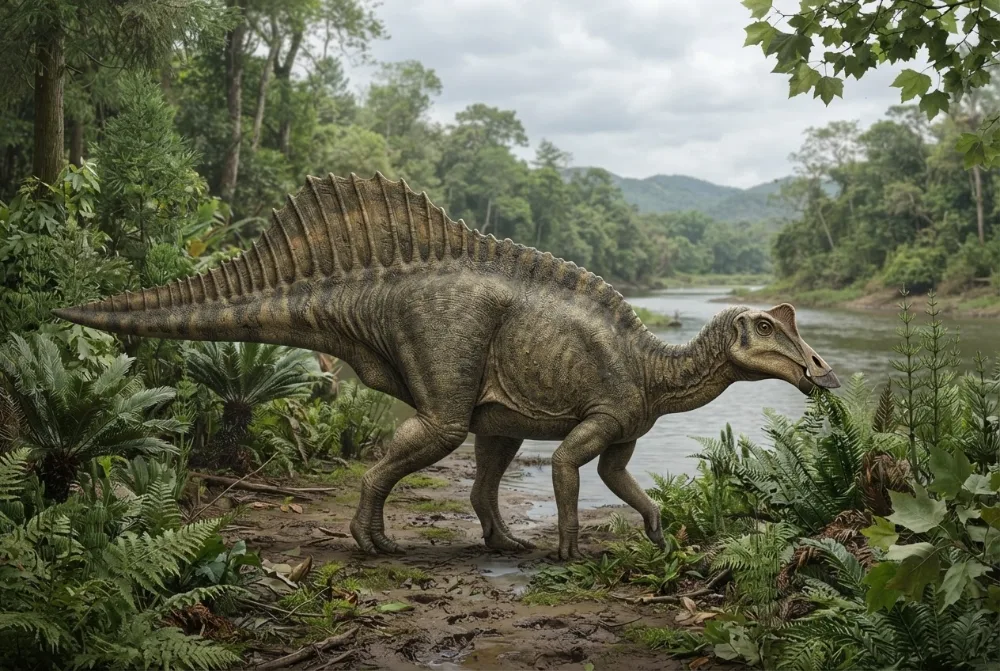
Gongshuilong was a duck-billed dinosaur that lived in China near the end of the Age of Dinosaurs. It had a tall, sail-like tail made of extra-long bones, which made it look really cool. This plant-eater is special because it is the first named hadrosaur from South China!1
When did it live?
How big was it?
How big was Gongshuilong compared to YOU?
Just maths in your browser. Nothing is saved or sent anywhere.
Fun facts
Gongshuilong's tail bones were super long, making the tail look like a sail. The neural spines were 8.5 times as tall as the bones they attached to, which is unique among all iguanodontian dinosaurs.1
It was a medium-sized hadrosaur, about 7 metres (23 feet) long, which is about as long as a small school bus.1
Gongshuilong is the second brachylophosaurin found in Asia, after Wulagasaurus. Most of its close relatives lived in North America, so it helps show that this group might have started in Asia.1
The fossils were found in a bonebed with at least two individuals, because scientists found two left lower jaws, two shoulder blades, and two shin bones of different sizes.1
Its name, Gongshuilong, comes from the Gong River near where it was found, and 'long' means dragon in Chinese.1
The species name 'fanwei' refers to the sail-like tail, because 'fan' means sail in Chinese.1
Most asked questions about Gongshuilong
?What did Gongshuilong eat?
Gongshuilong was a plant-eater, like other duck-billed dinosaurs. It used its beak and many teeth to chew plants.1
?How big was Gongshuilong?
Gongshuilong was a medium sized hadrosaur, about 7 metres (23 feet) long, roughly the length of a small school bus.1
?When did Gongshuilong live?
Gongshuilong lived during the Late Cretaceous period, specifically in the Maastrichtian age, near the end of the Age of Dinosaurs.1

Ask Rex about Gongshuilong
Rex only answers questions about this page. 3 questions a day.
Rex is an AI and can make mistakes. He runs on servers in the EU and questions are never saved. Never type your name or other personal things.
Myth buster
Myth: Some people think all duck-billed dinosaurs lived in North America.
Truth: Gongshuilong shows that duck-billed dinosaurs also lived in Asia, and it is the first named hadrosaur from South China.1
For dino experts
- Scientific name
- Gongshuilong
- Named by
- Yao et al. 20263
- Group
- Duck-bills
- Family / clade
- Hadrosauridae3
- Classification
- Ornithischia > Ornithopoda > Iguanodontia > Hadrosauridae3
- Age of the rocks
- 72 to 66 million years (Maastrichtian)3
- Rock formations
- Lianhe3
- Countries
- China3
- Fossil records
- 1 in the Paleobiology Database3
- Discovery
- In March 2021, construction workers found a bonebed in Ganzhou, China. Scientists from the Jiangxi Geological Survey and Exploration Institute dug out the fossils in two blocks, and in 2026 Han Yao and colleagues named the new species Gongshuilong fanwei.12
- Still debated
- Scientists are still debating exactly how Gongshuilong is related to other brachylophosaurins, because the family tree shows a polytomy, meaning the relationships are not fully resolved.1
Where the facts come from
- Gongshuilong (en.wikipedia.org)
- MorphoBank V4 (beta.morphobank.org)
- Gongshuilong in The Paleobiology Database (CC BY 4.0): age, places, rock formations, classification.
Every fact on this page has a number that points to its source. If we got something wrong, sorry, we are dino fans, not a science journal. Tell us at [email protected] and we will fix it.
Rex is hungry! Dino Wiki is a dad's project for his dino-loving son, free with no ads. Grown-ups can feed Rex a snack to help keep it online.Feed Rex Parasaurolophus
 Edmontosaurus
 Saurolophus
 Hypacrosaurus
 Corythosaurus
 Kritosaurus
 Triceratops
 Velociraptor
 Spinosaurus
 Ankylosaurus
 Pteranodon