
Jucha
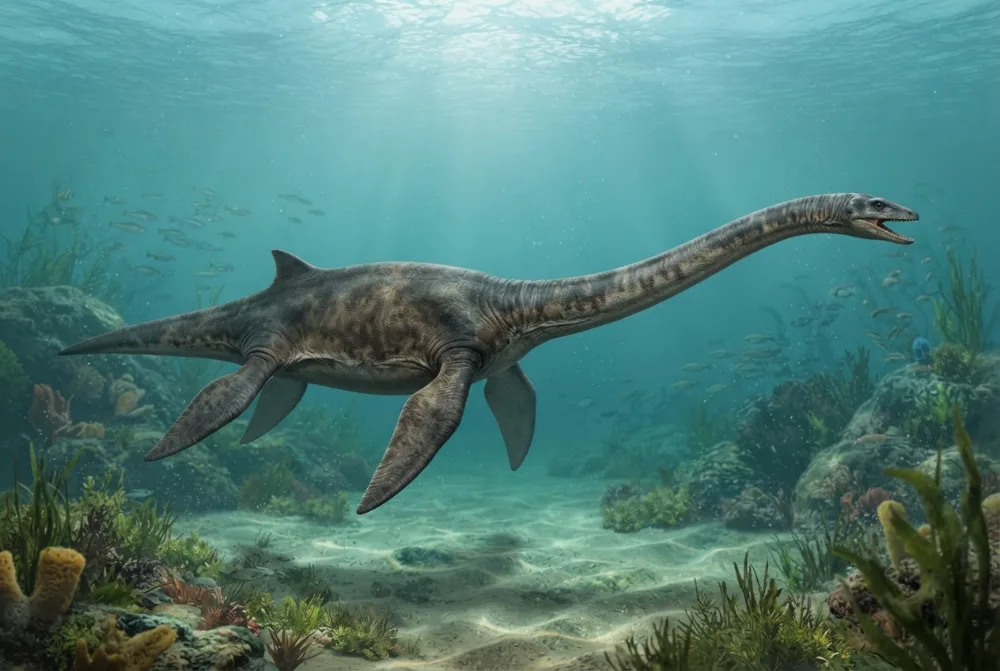
Jucha was a long-necked marine reptile that swam in the seas of Early Cretaceous Russia. It was an early elasmosaur, a type of plesiosaur with a very long neck. Jucha is one of the oldest elasmosaurs ever found.13
When did it live?
How big was it?
How big was Jucha compared to YOU?
Just maths in your browser. Nothing is saved or sent anywhere.
Fun facts
Jucha lived about 130 million years ago, during the Early Cretaceous period.1
The only known skeleton of Jucha was discovered in 2007 near the Slantsevy Rudnik village in Russia.12
Jucha's neck bones were already getting longer, showing an early step toward the super-long necks of later elasmosaurs.2
The fossil bones were covered in a crust of pyrite, also called fool's gold, which gave the species its name 'squalea' meaning coated.12
Jucha lacked some features that later elasmosaurs had, like a heart-shaped hole in the chest bone and a bar across the shoulder blades.2

Ask Rex about Jucha
Rex only answers questions about this page. 3 questions a day.
Rex is an AI and can make mistakes. He runs on servers in the EU and questions are never saved. Never type your name or other personal things.
For dino experts
- Scientific name
- Jucha
- Named by
- Fischer et al. 20203
- Group
- Plesiosaurs
- Family / clade
- Elasmosauridae3
- Classification
- Plesiosauria > Elasmosauridae > Sauropterygia3
- Age of the rocks
- 133 to 126 million years (Hauterivian)3
- Rock formations
- Klimovka3
- Countries
- Russia3
- Fossil records
- 1 in the Paleobiology Database3
- Discovery
- Jucha was named in 2020 by Fischer and colleagues. The holotype skeleton was found in 2007 by a field crew led by G. N. Uspensky in the Klimovka Formation of European Russia.12
- Still debated
- Scientists are not sure exactly how the necks of elasmosaurs evolved. Jucha shows an early attempt at neck lengthening, but the pattern of elongation and shortening in different species is still debated.2
Where the facts come from
- Jucha (en.wikipedia.org)
- Author postprint version (orbi.uliege.be)
- Jucha in The Paleobiology Database (CC BY 4.0): age, places, rock formations, classification.
Every fact on this page has a number that points to its source. If we got something wrong, sorry, we are dino fans, not a science journal. Tell us at [email protected] and we will fix it.
Rex is hungry! Dino Wiki is a dad's project for his dino-loving son, free with no ads. Grown-ups can feed Rex a snack to help keep it online.Feed Rex Elasmosaurus
 Pliosaurus
 Plesiosaurus
 Cimoliasaurus
 Colymbosaurus
 Trinacromerum
 Stegosaurus
 Iguanodon
 Archaeopteryx
 Giganotosaurus
 Microraptor
 Deinonychus