
Kamuysaurus
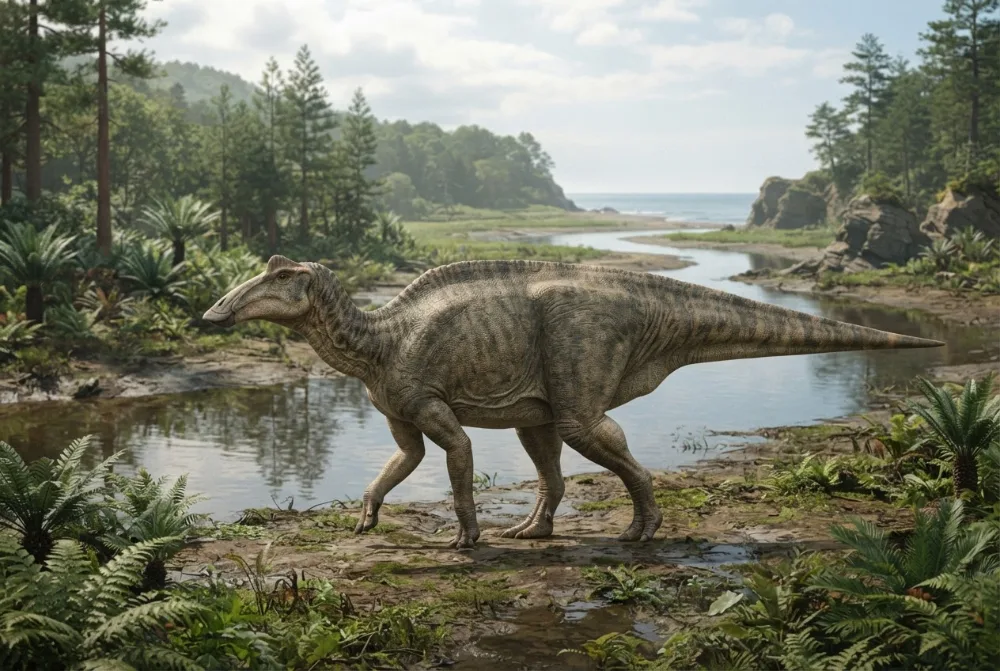
Kamuysaurus was a duck-billed dinosaur that lived in what is now Japan. It had a flat, toothless beak and hundreds of cheek teeth for chewing plants. This dinosaur is one of the most complete skeletons ever found in Japan.12
When did it live?
How big was it?
How long was it?
How heavy was it?
How big was Kamuysaurus compared to YOU?
Just maths in your browser. Nothing is saved or sent anywhere.
Fun facts
The skeleton is over 60% complete and includes the skull, making it one of the most complete dinosaur skeletons from Japan.1
It lived about 72 to 70 million years ago during the early Maastrichtian age.1
Kamuysaurus belongs to a group of duck-billed dinosaurs called Edmontosaurini, which also includes Edmontosaurus.2
The dinosaur was named after the Ainu word 'kamuy', meaning deity or god.1
It was an adult at least nine years old when it died.1
Most asked questions about Kamuysaurus
?How big was Kamuysaurus?
It was about 8 metres long and weighed 4 to 5.3 tonnes.1
?What did Kamuysaurus eat?
It was a plant-eater. It had a toothless beak and rows of cheek teeth for chewing tough plants.1
?When did Kamuysaurus live?
It lived about 72 to 70 million years ago, during the early Maastrichtian age of the Late Cretaceous.1
?Was Kamuysaurus a dinosaur?
Yes, it was a duck-billed dinosaur called a hadrosaur, but it was not a meat-eater.1
?Did Kamuysaurus have a crest?
It may have had a small, flat crest on its head, similar to the crest of Brachylophosaurus.24
?Where was Kamuysaurus found?
It was found in marine rocks in Hokkaido, Japan. Its body likely washed out to sea after it died.1

Ask Rex about Kamuysaurus
Rex only answers questions about this page. 3 questions a day.
Rex is an AI and can make mistakes. He runs on servers in the EU and questions are never saved. Never type your name or other personal things.
For dino experts
- Scientific name
- Kamuysaurus
- Named by
- Kobayashi et al. 20195
- Group
- Duck-bills
- Family / clade
- Hadrosauridae5
- Classification
- Ornithischia > Ornithopoda > Iguanodontia > Hadrosauridae5
- Age of the rocks
- 72 to 66 million years (Maastrichtian)5
- Rock formations
- Hakobuchi5
- Countries
- Japan5
- Fossil records
- 1 in the Paleobiology Database5
- Discovery
- Amateur paleontologist Yoshiyuki Horita found the tail in 2003. Teams from the Hobetsu Museum and Hokkaido University Museum dug up the rest of the skeleton in 2013 and 2014. It was named Kamuysaurus japonicus in 2019 by Yoshitsugu Kobayashi and colleagues.12
- Still debated
- Scientists are not sure if Kamuysaurus had a small crest on its head, because the bones at the front of the skull are missing.2
Where the facts come from
- Kamuysaurus (en.wikipedia.org)
- A New Hadrosaurine (Dinosauria: Hadrosauridae) from the Marine Deposits of the Late Cretaceous Hakobuchi Formation, Yezo Group, Japan | Scientific Reports (nature.com)
- PBDB Taxon (paleobiodb.org)
- A new duck-billed dinosaur, Kamuysaurus japonicus, identified | Hokkaido University (global.hokudai.ac.jp)
- Kamuysaurus in The Paleobiology Database (CC BY 4.0): age, places, rock formations, classification.
Every fact on this page has a number that points to its source. If we got something wrong, sorry, we are dino fans, not a science journal. Tell us at [email protected] and we will fix it.
 Rex is hungry! Dino Wiki is a dad's project for his dino-loving son, free with no ads. Grown-ups can feed Rex a snack to help keep it online.Feed Rex
 Parasaurolophus
 Edmontosaurus
 Saurolophus
 Hypacrosaurus
 Corythosaurus
 Kritosaurus
 Tyrannosaurus
 Triceratops
 Velociraptor
 Spinosaurus
 Ankylosaurus
 Pteranodon