
Kronosaurus
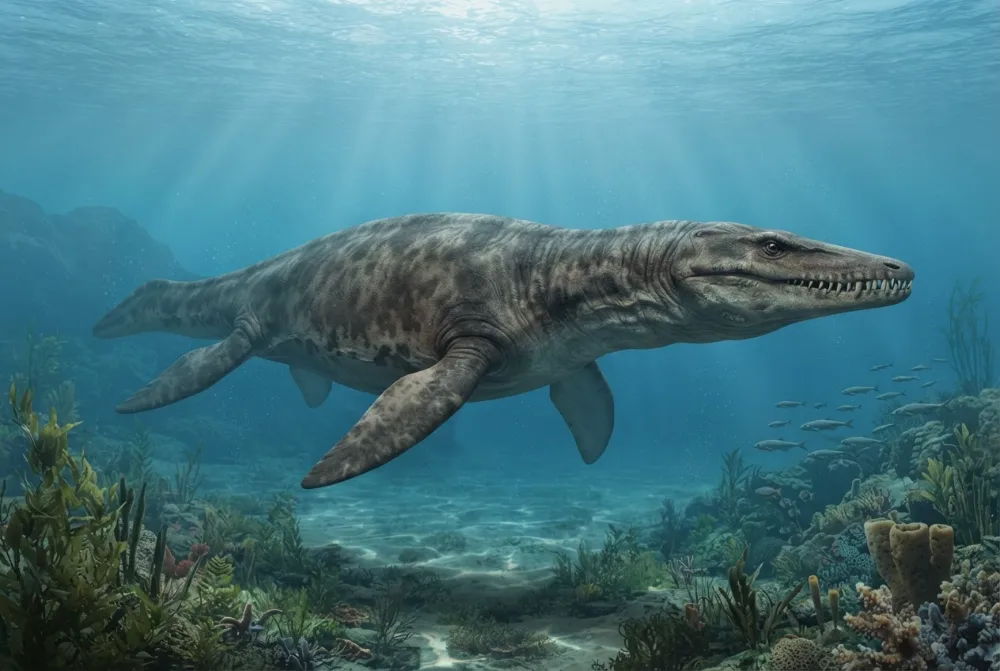
Kronosaurus was a giant marine reptile that swam in the oceans and inland seas of the Early Cretaceous. It was a pliosaur, a type of short-necked plesiosaur with a huge head and powerful jaws. With its four flippers, it could 'fly' underwater to chase down big prey.21
When did it live?
How big was it?
How big was Kronosaurus compared to YOU?
Just maths in your browser. Nothing is saved or sent anywhere.
Fun facts
Kronosaurus had a skull at least 2.4 metres long, which is huge compared to its body length of about 10 metres.2
Its teeth were conical and crushing, perfect for cracking the hard shells of ammonites.2
One Kronosaurus fossil (QM F10113) contains the remains of a sea turtle inside. The turtle was so big that it choked the pliosaur.1
Bite marks on the skull of an elasmosaurid called Eromangasaurus show that Kronosaurus attacked it, probably aiming for the long neck.1
Kronosaurus lived in the cool Eromanga Sea, an inland sea that covered parts of Australia. Glendonites and ice-rafted boulders show the water was near-freezing in winter.2
Unlike long-necked elasmosaurids, pliosaurids like Kronosaurus could cruise at high speed for a long time.2
The first Kronosaurus fossil was a piece of jawbone found in 1899. It was first thought to be from an ichthyosaur.1
Most asked questions about Kronosaurus
?How big was Kronosaurus?
Kronosaurus was about 9 to 10 metres long. Early guesses of 13 metres were too big because the skeleton had too many vertebrae.12
?Was Kronosaurus a dinosaur?
No, Kronosaurus was a marine reptile called a pliosaur, a type of plesiosaur. It was not a dinosaur.12
?What did Kronosaurus eat?
Kronosaurus ate large fish, squid, ammonites, sea turtles, and even other marine reptiles like elasmosaurids and ichthyosaurs.21
?How fast could Kronosaurus swim?
Pliosaurids like Kronosaurus could cruise at high speeds for long periods, using all four flippers to 'fly' underwater. Scientists do not know the exact speed.2
?How strong was Kronosaurus' bite?
Its bite force is estimated at 15,000 to 27,000 newtons. That is stronger than any living animal, but less than megalodon.1
?Where did Kronosaurus live?
Kronosaurus lived in the Eromanga Sea, an inland sea that covered parts of Australia during the Early Cretaceous. The water was cold, near freezing in winter.21
?When did Kronosaurus live?
Kronosaurus lived during the Early Cretaceous, about 125 to 100 million years ago.3
?Did Kronosaurus have feathers?
No, Kronosaurus was a marine reptile with smooth skin and flippers. It did not have feathers.1

Ask Rex about Kronosaurus
Rex only answers questions about this page. 3 questions a day.
Rex is an AI and can make mistakes. He runs on servers in the EU and questions are never saved. Never type your name or other personal things.
Myth buster
Myth: Kronosaurus was nearly 13 metres long.
Truth: Scientists now think it was no more than about 10 metres long. The old 13-metre estimate was based on exaggerated reconstructions.2
For dino experts
- Scientific name
- Kronosaurus
- Named by
- Longman 19244
- Group
- Plesiosaurs
- Family / clade
- Pliosauridae4
- Classification
- Plesiosauria > Pliosauridae > Sauropterygia4
- Age of the rocks
- 121 to 100 million years (Aptian / Albian)4
- Rock formations
- Wallumbilla, Toolebuc, Paja4
- Countries
- Australia, Colombia4
- Fossil records
- 4 in the Paleobiology Database4
- Discovery
- The first fossil was found in 1899 near Hughenden, Queensland. In 1924, Albert Heber Longman named it Kronosaurus queenslandicus. A famous skeleton was collected by the Harvard Museum of Comparative Zoology in the early 1930s.1
- Still debated
- Scientists are not sure if the Colombian pliosaur Monquirasaurus boyacensis was really a close relative of Kronosaurus or belongs to a different group.1
Where the facts come from
- Kronosaurus (en.wikipedia.org)
- Kronosaurus queenslandicus - The Australian Museum (australian.museum)
- Fossil Factfile: Kronosaurus (australiangeographic.com.au)
- Kronosaurus in The Paleobiology Database (CC BY 4.0): age, places, rock formations, classification.
Every fact on this page has a number that points to its source. If we got something wrong, sorry, we are dino fans, not a science journal. Tell us at [email protected] and we will fix it.
Rex is hungry! Dino Wiki is a dad's project for his dino-loving son, free with no ads. Grown-ups can feed Rex a snack to help keep it online.Feed Rex Elasmosaurus
 Pliosaurus
 Plesiosaurus
 Cimoliasaurus
 Colymbosaurus
 Trinacromerum
 Stegosaurus
 Iguanodon
 Archaeopteryx
 Giganotosaurus
 Microraptor
 Deinonychus