
Lagenanectes
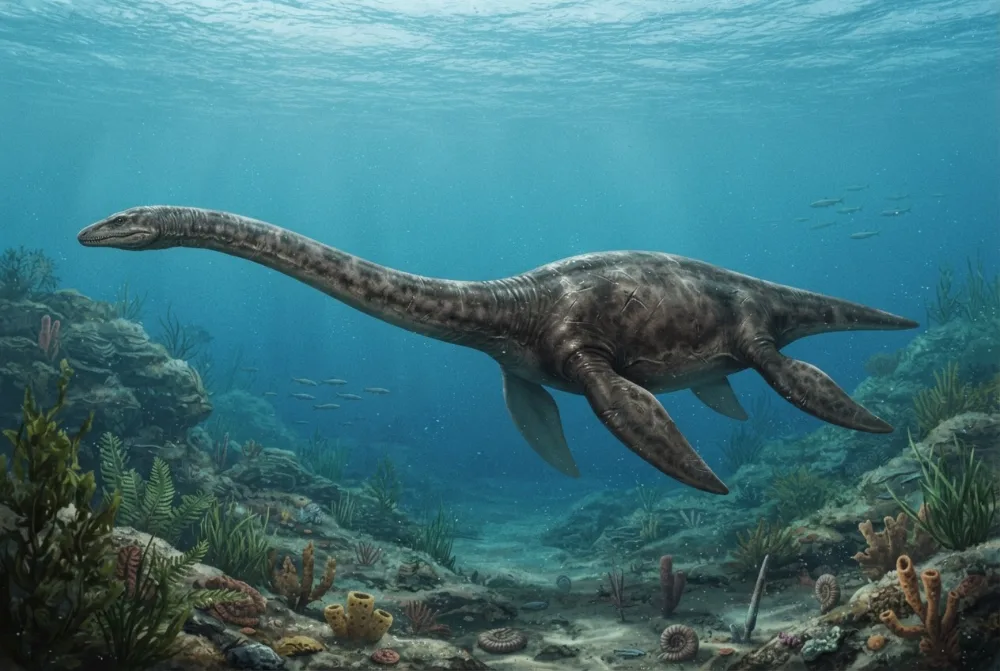
Lagenanectes was a long-necked marine reptile that swam in the seas of what is now Germany. It was not a dinosaur, but a plesiosaur, and it used its four flippers to paddle through the water. This ancient creature grew to about 8 meters long, as long as a school bus!21
When did it live?
How big was it?
How long was it?
How big was Lagenanectes compared to YOU?
Just maths in your browser. Nothing is saved or sent anywhere.
Fun facts
Lagenanectes is one of the earliest known elasmosaurids, a group of plesiosaurs with very long necks. It lived about 130 million years ago during the Early Cretaceous.21
The front part of its lower jaw had a unique platform with dents, and the tooth sockets pointed sideways. This is different from most other plesiosaurs.1
Grooves on the top of its skull may have held electroreceptors, which helped Lagenanectes detect prey hidden in the dark water.1
The only known fossil of Lagenanectes shows signs of bone disease. The back of the skull and first neck vertebra had bony outgrowths, possibly from a bacterial infection.21
The fossil was discovered in 1964 by a private collector named Kurt Wiedenroth in a clay pit near Sarstedt, Germany. The pit no longer exists.21
Lagenanectes was named in 2017, more than 50 years after its discovery. Scientists finally studied the bones and realized it was a new genus.1

Ask Rex about Lagenanectes
Rex only answers questions about this page. 3 questions a day.
Rex is an AI and can make mistakes. He runs on servers in the EU and questions are never saved. Never type your name or other personal things.
For dino experts
- Scientific name
- Lagenanectes
- Named by
- Sachs et al. 20174
- Group
- Plesiosaurs
- Family / clade
- Elasmosauridae4
- Classification
- Plesiosauria > Elasmosauridae > Sauropterygia4
- Age of the rocks
- 133 to 126 million years (Hauterivian)4
- Rock formations
- Stadthagen4
- Countries
- Germany4
- Fossil records
- 1 in the Paleobiology Database4
- Discovery
- Lagenanectes was discovered in 1964 by fossil collector Kurt Wiedenroth in a clay pit near Sarstedt, Germany. It was named and described as a new genus and species by Sven Sachs, Jahn J. Hornung and Benjamin P. Kear in 2017.21
- Still debated
- The exact age of the Lagenanectes fossil is uncertain. It could be from the lower Hauterivian to lower Barremian stages, but scientists think it is most likely upper Hauterivian.21
Where the facts come from
- Lagenanectes (en.wikipedia.org)
- Lagenanectes richterae, an early elasmosaurid from Germany (sachspal.de)
- PBDB Taxon (paleobiodb.org)
- Lagenanectes in The Paleobiology Database (CC BY 4.0): age, places, rock formations, classification.
Every fact on this page has a number that points to its source. If we got something wrong, sorry, we are dino fans, not a science journal. Tell us at [email protected] and we will fix it.
 Rex is hungry! Dino Wiki is a dad's project for his dino-loving son, free with no ads. Grown-ups can feed Rex a snack to help keep it online.Feed Rex
 Elasmosaurus
 Pliosaurus
 Plesiosaurus
 Cimoliasaurus
 Colymbosaurus
 Trinacromerum
 Stegosaurus
 Iguanodon
 Archaeopteryx
 Giganotosaurus
 Microraptor
 Deinonychus