
Leptocleidus
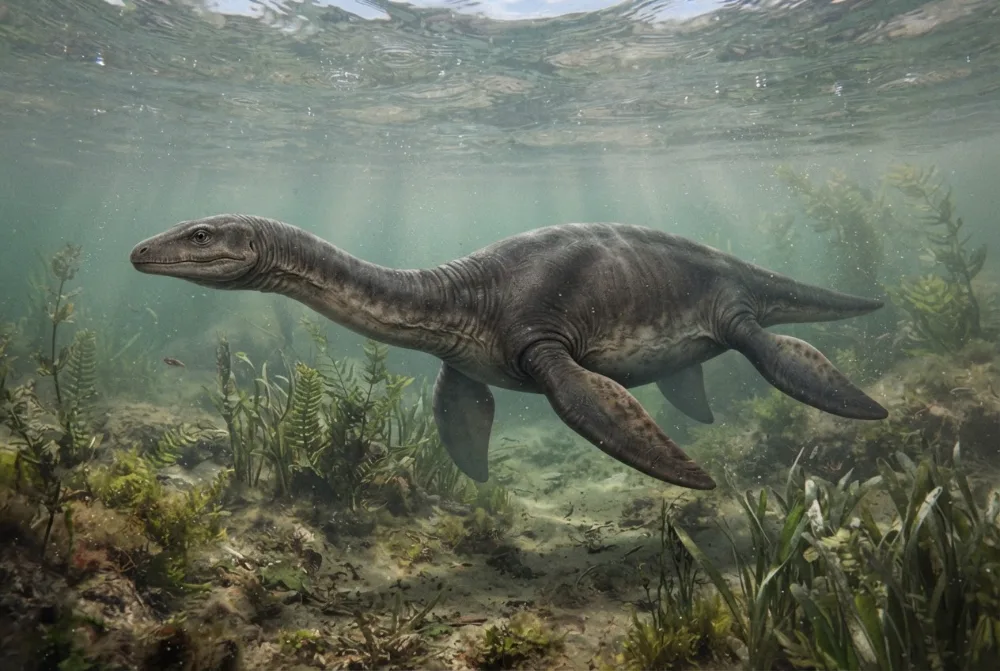
Leptocleidus was a small plesiosaur that swam in shallow seas and rivers during the Early Cretaceous. It had a long neck, a short body, and four flippers to paddle through the water. Unlike many other plesiosaurs, it lived in lagoons and even brackish or fresh water.1
When did it live?
How big was it?
How long was it?
How big was Leptocleidus compared to YOU?
Just maths in your browser. Nothing is saved or sent anywhere.
Fun facts
Leptocleidus had about 21 teeth on each side of its upper jaw and around 35 teeth on each side of its lower jaw.1
Its skull was triangle-shaped with a crest running from the tip of the nose to the nasal region.1
Unlike many plesiosaurs, Leptocleidus lived in shallow lagoons and may have entered brackish or fresh water, like river mouths.1
Scientists think Leptocleidus moved into fresh water to escape larger plesiosaurs and pliosaurs.1
The name Leptocleidus comes from Greek words meaning 'slender clavicle', referring to its thin collarbone.1
Leptocleidus had large clavicles and interclavicle bones but small shoulder blades, similar to the early Jurassic Rhomaleosaurus.1
A specimen from the Isle of Wight, once thought to be Leptocleidus, was later named a separate genus, Vectocleidus, in 2012.1
Most asked questions about Leptocleidus
?How big was Leptocleidus?
Leptocleidus was small for a plesiosaur, measuring up to 3 metres (9.8 feet) long. One species, Leptocleidus superstes, was even smaller at about 1.5 metres (5 feet).13
?Was Leptocleidus a dinosaur?
No, Leptocleidus was not a dinosaur. It was a plesiosaur, a type of extinct marine reptile that lived in the sea.13

Ask Rex about Leptocleidus
Rex only answers questions about this page. 10 questions a month.
Rex is an AI and can make mistakes. He runs on servers in the EU and questions are never saved. Never type your name or other personal things.
For dino experts
- Scientific name
- Leptocleidus
- Named by
- Andrews 19224
- Group
- Plesiosaurs
- Family / clade
- Leptocleididae4
- Classification
- Plesiosauria > Sauropterygia4
- Age of the rocks
- 143 to 100 million years (Berriasian / Albian)4
- Rock formations
- Murderong Shale, Bulldog Shale, Weald Clay4
- Countries
- Australia, United Kingdom, South Africa4
- Fossil records
- 7 in the Paleobiology Database4
- Also known as
- Peyerus (older names now counted as the same animal)4
- Discovery
- Leptocleidus was named by Charles William Andrews in 1922 based on a partial skeleton and skull from the Weald Clay of Berwick, Sussex, England.41
- Still debated
- Scientists debate whether Leptocleidus belongs within the group Rhomaleosauridae or in its own separate clade called Leptocleididae.2
Where the facts come from
- Leptocleidus (en.wikipedia.org)
- Reassessment of the Lower Cretaceous (Barremian) pliosauroid Leptocleidus superstes Andrews, 1922 and other plesiosaur remains from the nonmarine Wealden succession of southern England | Zoological Journal of the Linnean Society | Oxford Academic (academic.oup.com)
- Leptocleidus Facts for Kids (kids.kiddle.co)
- Leptocleidus in The Paleobiology Database (CC BY 4.0): age, places, rock formations, classification.
Every fact on this page has a number that points to its source. If we got something wrong, sorry, we are dino fans, not a science journal. Tell us at [email protected] and we will fix it.
 Rex is hungry! Dino Wiki is a dad's project for his dino-loving son, free with no ads. Grown-ups can feed Rex a snack to help keep it online.Feed Rex
 Elasmosaurus
 Pliosaurus
 Plesiosaurus
 Cimoliasaurus
 Colymbosaurus
 Trinacromerum
 Stegosaurus
 Iguanodon
 Archaeopteryx
 Giganotosaurus
 Microraptor
 Deinonychus