
Makhaira
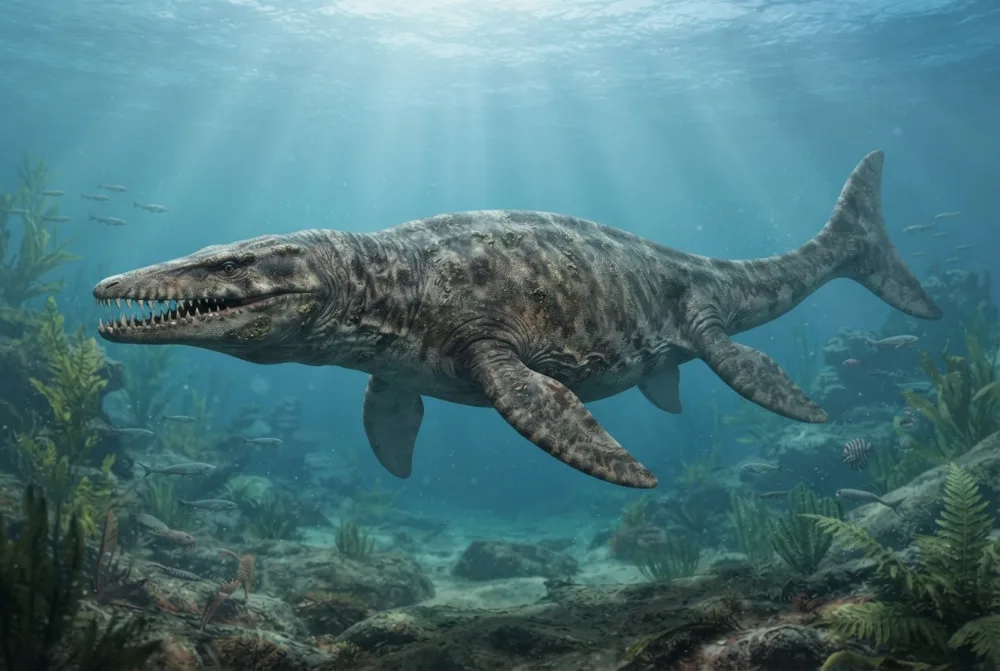
Makhaira was a fierce marine reptile that swam in the ancient seas of Russia about 130 million years ago. It had special teeth that were shaped like blades and had tiny saw-like edges, perfect for slicing through big prey.12
When did it live?
How big was it?
How long was it?
How big was Makhaira compared to YOU?
Just maths in your browser. Nothing is saved or sent anywhere.
Fun facts
Makhaira's teeth had serrated edges with tiny bumps that were taller than they were wide, making them look like a saw blade.1
Its tooth sockets were arranged in pairs, which is unusual for pliosaurids.1
Makhaira is the oldest known member of the brachauchenine group of pliosaurids from the Cretaceous period.1
The teeth of Makhaira look very similar to those of metriorhynchid crocodylomorphs, which were ancient crocodile-like reptiles.2
Only a partial skeleton of Makhaira has been found, including parts of the skull, teeth, vertebrae, and hip bones.1

Ask Rex about Makhaira
Rex only answers questions about this page. 3 questions a day.
Rex is an AI and can make mistakes. He runs on servers in the EU and questions are never saved. Never type your name or other personal things.
For dino experts
- Scientific name
- Makhaira
- Named by
- Fischer et al. 20153
- Group
- Plesiosaurs
- Family / clade
- Pliosauridae3
- Classification
- Plesiosauria > Pliosauridae > Sauropterygia3
- Age of the rocks
- 133 to 126 million years (Hauterivian)3
- Countries
- Russia3
- Fossil records
- 1 in the Paleobiology Database3
- Discovery
- Makhaira was named in 2015 by a team of scientists including V. Fischer, based on a partial skeleton found in pyrite nodules along the Volga River in Russia.31
- Still debated
- Scientists are still debating whether Makhaira's serrated teeth mean it was more like Jurassic pliosaurids or if it was a unique early brachauchenine.1
Where the facts come from
- Peculiar macrophagous adaptations in a new Cretaceous pliosaurid (pmc.ncbi.nlm.nih.gov)
- Makhaira rossica (en.wikipedia.org)
- Makhaira in The Paleobiology Database (CC BY 4.0): age, places, rock formations, classification.
Every fact on this page has a number that points to its source. If we got something wrong, sorry, we are dino fans, not a science journal. Tell us at [email protected] and we will fix it.
 Rex is hungry! Dino Wiki is a dad's project for his dino-loving son, free with no ads. Grown-ups can feed Rex a snack to help keep it online.Feed Rex
 Elasmosaurus
 Pliosaurus
 Plesiosaurus
 Cimoliasaurus
 Colymbosaurus
 Trinacromerum
 Stegosaurus
 Iguanodon
 Archaeopteryx
 Giganotosaurus
 Microraptor
 Deinonychus