
Montanoceratops
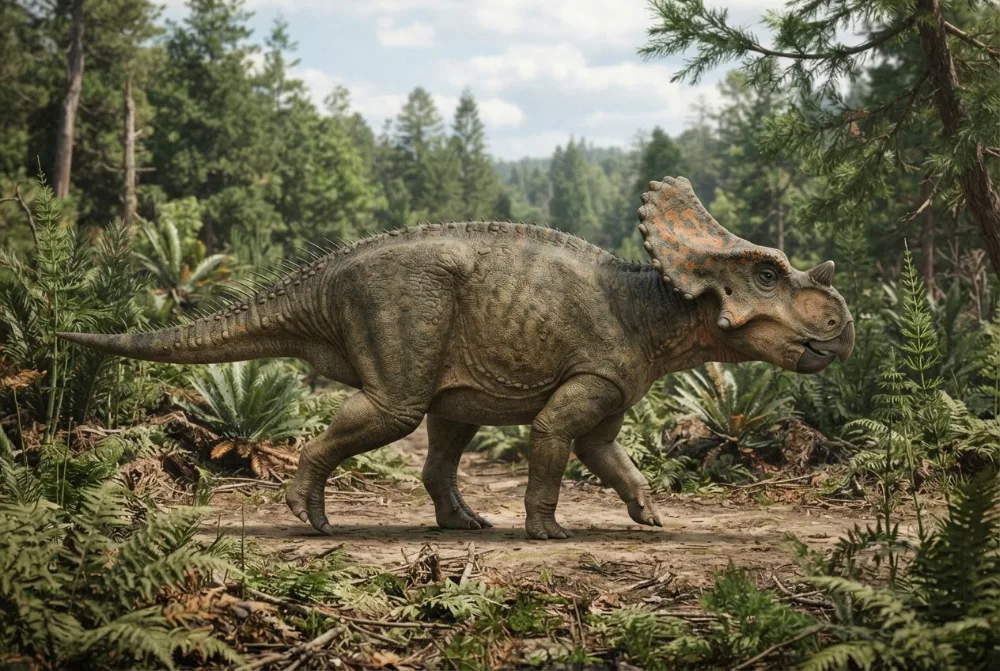
Montanoceratops was a small, plant-eating dinosaur with a beak and a bony frill on its head. It lived in North America during the Late Cretaceous, about 72 million years ago. This dinosaur is part of a group called leptoceratopsids, which were like smaller cousins of the famous Triceratops.1
When did it live?
How big was it?
How long was it?
How heavy was it?
How big was Montanoceratops compared to YOU?
Just maths in your browser. Nothing is saved or sent anywhere.
How fast was it?
Fun facts
Montanoceratops was first thought to be a species of Leptoceratops, but in 1951 it got its own genus name.1
The nose horn of Montanoceratops was actually a misidentified cheekbone, which fooled paleontologists for years.1
Montanoceratops lived alongside bigger horned dinosaurs, but it was smaller and had a deeper tail.1
Fossils of Montanoceratops have been found in rocks that are between 83.6 and 66 million years old.3
Montanoceratops is part of a group called leptoceratopsids, which were diverse and lived in the same habitats as the bigger ceratopsids.1
Most asked questions about Montanoceratops
?How big was Montanoceratops?
Montanoceratops was a small dinosaur, about 2.5 metres (8.2 feet) long and weighed around 170 kilograms (370 pounds).2
?What did Montanoceratops eat?
Montanoceratops was a herbivore, meaning it ate plants. It used its sharp beak to bite off leaves or needles.2
?Did Montanoceratops have a horn?
It was once thought to have a horn on its nose, but that bone was later identified as a misplaced cheek horn. So it did not have a nose horn.21
?Where did Montanoceratops live?
Montanoceratops lived in what is now Montana, USA, and Alberta, Canada, about 70 million years ago.2

Ask Rex about Montanoceratops
Rex only answers questions about this page. 10 questions a month.
Rex is an AI and can make mistakes. He runs on servers in the EU and questions are never saved. Never type your name or other personal things.
Myth buster
Myth: Montanoceratops had a prominent nose horn like some other horned dinosaurs.
Truth: The supposed nose horn was actually a misidentified cheekbone, so Montanoceratops likely did not have a nose horn.1
For dino experts
- Scientific name
- Montanoceratops
- Named by
- Sternberg 19513
- Group
- Horned dinos
- Family / clade
- Leptoceratopsidae3
- Classification
- Ornithischia > Ceratopsia3
- Age of the rocks
- 84 to 66 million years (Campanian / Maastrichtian)3
- Rock formations
- St. Mary River, Horseshoe Canyon3
- Countries
- USA, Canada3
- Fossil records
- 3 in the Paleobiology Database3
- Discovery
- Barnum Brown and Erich Schlaikjer described the first fossil in 1942, but they called it Leptoceratops cerorhynchos. In 1951, Charles M. Sternberg realized it was different and named it Montanoceratops.1
- Still debated
- Scientists still debate exactly how Montanoceratops is related to other horned dinosaurs, especially because some fossils were misidentified.1
Where the facts come from
- M is for Montanoceratops | National Geographic (nationalgeographic.com)
- Montanoceratops (en.wikipedia.org)
- Montanoceratops in The Paleobiology Database (CC BY 4.0): age, places, rock formations, classification.
Every fact on this page has a number that points to its source. If we got something wrong, sorry, we are dino fans, not a science journal. Tell us at [email protected] and we will fix it.
 Rex is hungry! Dino Wiki is a dad's project for his dino-loving son, free with no ads. Grown-ups can feed Rex a snack to help keep it online.Feed Rex
 Triceratops
 Protoceratops
 Ojoceratops
 Tatankaceratops
 Psittacosaurus
 Centrosaurus
 Tyrannosaurus
 Velociraptor
 Spinosaurus
 Ankylosaurus
 Parasaurolophus
 Pteranodon